
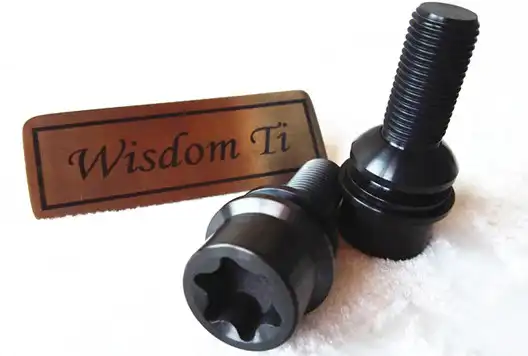
Aerospace engineers have long recognized forging as the superior method for producing critical fasteners. The process involves heating titanium to specific temperatures and applying controlled compression forces. Unlike machining, which cuts away material, forging shapes metal through pressure. This fundamental difference creates continuous grain structures that resist crack initiation under cyclic loading.
Wheel attachment systems experience tremendous forces during vehicle operation. Braking generates compressive loads, acceleration creates tensile stresses, and cornering imposes complex shear forces. Forged titanium lug bolts must resist all three simultaneously without yielding or failing. Understanding how forging achieves these properties helps procurement professionals select appropriate fasteners for demanding applications.
Metallurgical Transformation During the Forging Process
Titanium's crystalline structure undergoes significant changes when subjected to forging operations. The metal exists in different phase states depending on temperature. Below approximately 882 degrees Celsius, titanium maintains an alpha phase with hexagonal close-packed crystal structure. Above this transition point, it transforms into beta phase with body-centered cubic arrangement.
Temperature Control and Phase Management
Forging operations typically occur between 870 and 980 degrees Celsius for Ti-6Al-4V alloy. This temperature range corresponds to the alpha-plus-beta phase region where both crystal structures coexist. Working in this temperature zone allows good formability while maintaining fine grain structure and balanced mechanical properties. Exceeding these limits produces coarse grains that reduce strength, while insufficient heating makes titanium resistant to deformation.
Precise temperature monitoring requires specialized equipment. Infrared thermometers track surface temperatures during heating cycles. Embedded thermocouples verify die temperatures remain within specifications. These controls prevent thermal gradients that could create inconsistent microstructures across forged titanium lug bolt cross-sections. Professional manufacturers maintain documentation systems proving temperature compliance for critical aerospace and automotive applications.
Plastic Deformation and Grain Boundary Creation
Applying compressive force to heated titanium causes atomic planes to slip past one another. This plastic deformation breaks apart large irregular grains present in cast billets. The refined microstructure achieved through forging contributes to overall durability and reliability, resulting in improved strength, toughness, and fatigue resistance. More grain boundaries mean dislocations encounter more obstacles during stress application, effectively strengthening the material.
Eliminating Internal Defects Through Compressive Forces
Cast titanium contains inherent flaws including porosity, shrinkage cavities, and microscopic voids. These defects concentrate stress during loading and serve as initiation sites for crack propagation. Forging's compressive nature forces these internal spaces to close, creating denser material with improved structural integrity.
Porosity Reduction and Density Enhancement
Casting processes trap gases within molten titanium that solidify as microscopic bubbles. These pores reduce effective load-bearing cross-sectional area. Under tension, stress concentrates around pore perimeters, potentially initiating cracks. The forging process helps eliminate internal defects and porosity that may be present in cast titanium alloys, resulting in components with superior structural integrity.
Density measurements confirm this improvement quantitatively. Cast titanium alloy typically achieves 97-98 percent of theoretical density due to porosity. Forged components reach 99.5 percent or higher density through compressive consolidation. This seemingly small difference translates into substantial strength gains. Forged titanium lug bolts without internal defects distribute loads uniformly, preventing premature failures that could compromise wheel retention safety.
Inclusion Distribution and Surface Integrity
Surface quality also improves dramatically compared to cast components. Casting leaves rough surfaces requiring extensive machining. Forging produces near-net shapes with smooth surfaces directly from dies. Fewer machining operations mean less subsurface damage and reduced opportunity for introducing stress concentrators. The result is forged titanium lug bolts with better fatigue resistance and longer service life.
Fiber Flow Alignment and Directional Properties
Perhaps forging's most significant advantage involves creating continuous fiber flow throughout the component. Visualize metal grain structure like wood grain—cutting across fibers creates weak points while following the grain maximizes strength. The forging process enhances titanium's grain structure, improving mechanical properties such as strength and toughness, making them highly durable.
Load Path Optimization in Bolt Geometry
Forged titanium lug bolts experience primarily tensile forces along their axis when properly torqued. Forging dies shape titanium so grain boundaries align parallel to this primary load direction. When stress applies along the grain flow, strength reaches maximum potential. Contrast this with machined bolts where cutting operations sever grain structures randomly, creating discontinuities that weaken the component.
Thread regions require special consideration. Rolled threads produced during or after forging maintain continuous fiber flow around thread roots. This unbroken structure resists fatigue crack initiation far better than cut threads. Racing teams and aerospace applications universally specify rolled threads on critical fasteners because failure consequences are unacceptable. The strength advantage justifies any additional manufacturing complexity.
Microstructural Uniformity Across Cross-Sections
Machined components lack this uniformity. Material properties depend on the original billet's processing history. The center of large billets may have experienced different cooling rates than edges during initial casting. These variations create uncertainty in final part performance. Forging's controlled deformation process erases prior processing history, creating fresh microstructures with consistent characteristics throughout.
Advanced Design Features in Modern Titanium Lug Bolts
Contemporary engineering has evolved beyond simple hexagonal bolt heads. Modern forged titanium lug bolts incorporate sophisticated design elements that enhance installation reliability and long-term durability. These features represent decades of accumulated knowledge about fastener performance under demanding conditions.
T80 Torx Drive System Advantages
The six-point star pattern of Torx drives provides superior engagement compared to traditional hex heads. Torx screws were designed to resist cam-out, allowing titanium Torx screws to provide increased torque as well as better torque transfer between driver and fasteners. The T80 designation indicates the specific size suitable for M14 thread applications common in high-performance vehicles.
Torx geometry distributes installation torque across six contact points rather than hex's six corners. This distribution reduces tool wear and prevents rounding that occurs with hex drives subjected to high torque repeatedly. Titanium's tendency toward galling makes proper tool engagement critical. Torx drives minimize slippage that could damage fastener heads during installation.
Floating Washer Design for Load Distribution
Integral washers on lug bolts eliminate the need for separate components. However, rigid washers transmit unevenly if wheel mounting surfaces aren't perfectly flat. Floating washer designs incorporate a swivel interface, allowing the washer to conform to surface irregularities. This conformability ensures uniform pressure distribution around bolt holes.
Uneven loading creates stress concentrations in wheel materials that may crack over time. It also affects torque-tension relationships, potentially resulting in insufficient clamping force. Professional-grade forged titanium lug bolts specify floating washers for applications where wheel flatness cannot be guaranteed. This design feature provides insurance against installation variables that might otherwise compromise joint integrity.
Partner with Baoji Wisdom Titanium for Superior Fastening Solutions
Baoji Wisdom Titanium Industry and Trading Co., Ltd delivers ISO 9001-certified forged titanium lug bolts engineered to aerospace standards. Our manufacturing facility in Baoji Titanium Valley maintains complete production control from raw material processing through final inspection. We offer M14×1.5 and M14×1.25 thread specifications with T80 Torx drives, floating washer configurations, and multiple finish options, including natural titanium and PVD black coating.
Minimum order quantity of 100 pieces accommodates specialized applications while maintaining competitive pricing. Our experienced engineering team provides technical support for custom specifications, torque recommendations, and installation procedures. Transform your wheel assembly performance with premium forged titanium components. Contact us for detailed specifications and quotations: sales@wisdomtitanium.com
FAQs
Q1: How much stronger are forged titanium lug bolts compared to machined versions?
A: Forging increases tensile strength by 15-25 percent compared to machined titanium from bar stock. This improvement results from grain refinement, defect elimination, and optimized fiber flow that forging creates. The continuous grain structure resists crack propagation better than machined components where cutting operations sever grains randomly.
Q2: Can forged titanium lug bolts be reused after wheel removal?
A: Yes, properly manufactured forged titanium bolts withstand multiple installation cycles. Thread rolling during forging creates surfaces resistant to galling. However, always inspect threads for damage before reinstallation. Replace any bolts showing wear, deformation, or thread damage. Apply fresh anti-seize compound during each installation to protect thread surfaces.
Q3: Why do forged titanium lug bolts require different torque specifications than steel?
A: Titanium's elastic modulus differs from steel, affecting the torque-tension relationship. Titanium stretches less under identical loads, requiring adjusted torque values to achieve proper clamping force. Manufacturers typically recommend torque values 10-15 percent lower than steel specifications. Always follow specific recommendations for your titanium fasteners rather than using OEM steel torque values.
Q4: What advantages does T80 Torx drive provide over hexagonal heads?
A: Torx geometry distributes installation torque across six contact surfaces rather than hex's six corners. This distribution prevents tool slippage and reduces wear on both fastener and installation tools. The design resists cam-out, allowing higher torque application without damaging drive features. This reliability proves essential when installing multiple bolts to precise specifications.
Q5: How does floating washer design improve wheel installation reliability?
A: Floating washers articulate to conform to mounting surface irregularities. This movement ensures uniform pressure distribution even when wheel faces aren't perfectly flat. Rigid washers concentrate loads at high spots, potentially causing wheel damage or inconsistent clamping force. Floating designs provide insurance against installation variables that might otherwise compromise joint integrity.
References
- Yongshengtai Titanium. "The Comprehensive Guide to Titanium Forging Process: Temperature Ranges and Phase Transformation Effects." Technical analysis of forging temperature control and its impact on grain structure refinement in titanium alloys.
- Lasting Titanium. "Benefits and Challenges of Forging Titanium Alloys: Enhanced Mechanical Properties Through Grain Alignment." Comprehensive examination of how forging improves strength, toughness, and fatigue resistance in titanium components. December 2024.
- KDM Fabrication. "Insights on Titanium Forging: Grain Structure Enhancement and Mechanical Property Improvement." Technical guide covering forging techniques and their effects on material durability and performance characteristics. September 2024.
- Lasting Titanium. "How Forging Revolutionizes Titanium Alloys: Defect Elimination and Structural Integrity." Analysis of forging's role in removing internal porosity and enhancing component reliability. October 2024.
- Extreme Bolt and Fastener. "Titanium Torx Screws: Enhanced Torque Transfer and Driver Engagement Characteristics." Technical specifications and performance advantages of Torx drive systems in titanium fastener applications.