
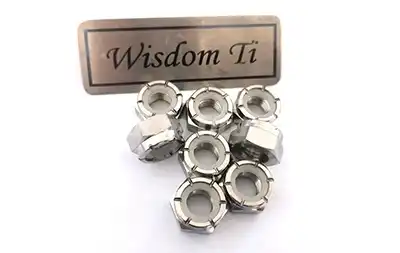
For safety and performance reasons, it is important to know the right fitting depth for nylon locking nuts and bolts when working with important fastening systems. To make sure that titanium nylon lock nuts work properly and keep their structure, the thread contact should be at least 1.5 times the width of the bolt. This engagement depth lets the nylon insert firmly grip the bolt threads while spreading loads across the joined piece. If there isn't enough engagement, the part may fail too soon when it's subjected to vibration or thermal cycles. This is especially true in high-performance automobile, aircraft, and racing uses where dependability cannot be compromised.
How Far Down Should Nylon Locking Nuts and Bolts Be Installed?
Defining Proper Thread Engagement
"How far down" refers to the thread engagement depth, which is the length of time that bolt threads and internal nut threads are in touch with each other. For normal uses, industry guidelines set by groups like the American Society of Mechanical Engineers say that the minimum engagement should be 1.5 times the average bolt width. In high-stress situations, the contact may need to be up to two times the width.
The best contact depth for titanium nylon lock nuts on an M10 bolt is between 15mm and 20mm. This makes sure that there are enough threads to connect with the nylon insert and enough shear strength across the threaded contact. The nylon insert thickness, which is usually between 3 and 5 mm based on the nut size, needs to be taken into account when measuring contact depth.
Critical Factors Influencing Installation Depth
Bolt Length and Thread Availability
Bolt length directly limits the amount of contact that can be reached. When engineers choose fasteners for an assembly, they have to make sure that the length of the bolt is at least three full thread pitches longer than the thickness of the materials being joined plus the height of the nut. This extra space lets the bolt fit properly without going through the nylon plug or bottoming out in a blind hole.
Load Requirements and Safety Margins
Applications that are loaded and unloaded over and over, like suspension parts in race cars, need the highest level of contact to avoid fatigue failure. To account for the high vibrational loads and fast temperature changes that happen during competition, racing teams usually set engagement levels at the upper end of the suggested ranges.
Material compatibility also affects the best depth. When engineers attach titanium parts to metal frames, for example, they have to think about how the two materials will expand at different temperatures. Adequate thread contact allows for changes in dimensions without affecting the strength of the joint.
Common Installation Errors and Their Consequences
The most common startup mistake is under-engagement. When thread attachment drops below 1.5 diameter, stress is put on fewer threads because there is less contact area. This concentration speeds up thread loss, especially in aluminum and other soft materials. The nylon part might not fit properly, which would mean it wouldn't lock.
Another very important risk is over-tightening. Too much force can bend or push the nylon insert out past the thread crests, which makes locking less effective. When it comes to titanium screws, over-torquing may be more than the material's yield strength. This can cause lasting deformation that makes the joint less stable in the future. Because titanium is not as springy as steel, the torque requirements for Grade 5 titanium nylon lock nuts are usually between 60 and 80% of the values for steel fasteners of the same type.
Cross-threading during installation hurts the threads on both the bolt and the nut. This makes stress lifters that let cracks spread when the system is loaded. This mistake happens a lot when people are in a hurry to put something or try to thread nuts onto bolts at the wrong angle. When nylon plugs are added for extra protection, even a small misalignment can cause threads to catch in the wrong place.
Procurement Guide for Titanium Nylon Lock Nuts
Supplier Selection and Certification Requirements
Buyers in the industrial sector who need to get titanium nylon lock nuts must check the quality management systems and licenses of the suppliers. ISO 9001 certification shows that quality control processes have been created, while AS9100 certification shows that quality skills are specific to aerospace. Suppliers that work with car OEMs should keep their IATF 16949 license up to date to make sure they meet the quality standards of the auto business.
Material approvals make it possible to track each output lot. Reliable providers give mill test results that show the chemical make-up and mechanical properties of titanium alloys that are used to make fasteners. These records show that the material meets the requirements set by ASTM B348 for Grade 5 titanium. They prove that the minimum amount of titanium in the material is 89.2%, with aluminum and vanadium added as alloying elements.
Customization sets value-added partners apart from basic providers. Being able to make non-standard thread sizes, changed nylon insert specs, or custom surface treatments lets buyers get the best fasteners for their needs instead of having to base their designs on standard parts that are available.
Pricing Structure and Order Considerations
For common sizes from M3 to M24, the least amount of titanium nylon lock nuts that can be ordered at once is usually 100 pieces. With lead times of one to two weeks, suppliers who keep popular sizes in stock can meet these minimum orders. Because of the unique requirements, production takes longer, usually between 4 and 6 weeks from when the order is placed to when it is shipped.
Bulk pricing systems encourage obligations that are bigger. When you order more than 1,000 pieces, you can often get savings of 15 to 25 percent off the minimum number price. Costs can go down even more with annual supply deals that include predicted amounts. This is because sellers can plan production and buy raw materials around guaranteed demand.
Terms of payment depend on the seller and the size of the order. Most of the time, prepayment or a letter of credit is needed from new buyers. Once a partnership is established, the terms change to net-30 or net-60, which makes it easier for buyers to handle their cash flow. Currency hedging may be used in international deals to keep costs stable over long buying cycles.
Evaluating Supplier Service Quality
How quickly a company answers technical questions shows how well they can help customers and how committed they are to doing so. Good sellers give you your own account manager who knows the needs of your business and can help you choose the right products with engineering advice. If you can get thorough answers to questions about specifications within 24 hours, that means you have enough expert staff and are focusing on your customers.
Overall cost of ownership is affected by how reliable shipments are and how well they are packaged. Damaged fasteners that get lost or damaged in transportation slow down production and raise the cost of checking. Reliable sellers use separate packaging with protective materials that keep threads from getting dirty and surfaces from getting damaged during shipping. To avoid delays in clearing customs, international packages should have the right paperwork.
After-sales service is what sets great providers apart from average ones. Long-term relationships are formed when both parties are ready to address quality concerns, quickly provide replacement parts, and work together to solve installation problems. Before committing to large orders, buyers should check out a supplier's track record by calling sources and looking at the supplier's name in the industry.
Conclusion
Installing nylon locking nuts and bolts at the right level is essential for making sure that the joints are safe and reliable in tough situations. The mix of titanium nylon lock nuts' light weight, strength, resistance to corrosion, and vibration-resistant closing systems makes them very useful for a wide range of applications. Engineers and techs can make sure joints are strong and avoid common installation mistakes by learning about the things that affect the best thread contact, such as bolt length, load requirements, and material compatibility. Titanium screws are more expensive, but they are worth it in weight-sensitive situations and corrosive conditions where they will last for a long time and pay for themselves. Organizations can use these advanced fasteners to improve performance and safety in automobile, aircraft, and industrial settings by following standard installation processes, keeping torque specs, and putting in place the right inspection routines.
Partner With Wisdom Titanium for Superior Titanium Nylon Lock Nuts
To get the best performance from fasteners, you need to work with manufacturers that have a lot of knowledge and know exactly what the engineering needs of important uses are. Baoji Wisdom Titanium Industry and Trading Co., Ltd. makes hot-forged hex titanium nylock nuts that meet the strict requirements of the aircraft, automobile, and motorsport industries. Our ISO 9001-certified factory is in Baoji Titanium Valley in Shaanxi Province, which is China's top titanium production area. We use full supply chain integration to offer stable quality and low factory prices.
We have titanium nylon lock nuts in sizes ranging from M3 to M24. They are made from Grade 5 titanium and have natural titanium finishes and nylon cores that fit perfectly. We can help with both prototype development and large-scale production. Our minimum order size is only 100 pieces, and we keep standard setups in stock and ready to ship. Because we can customize for OEMs, we can make thread sizes that aren't standard, insert specs that aren't standard, and finishes that aren't standard that are made to fit your exact application needs.
Wisdom Titanium is a reliable seller of titanium nylon lock nuts that can ship products all over the world. They offer quick quotes, expert advice, and helpful customer service after the sale. Please email our team at sales@wisdomtitanium.com to talk about your fastener needs and find out how our experience making titanium products can improve the performance and dependability of your important parts.
FAQ
Can titanium nylon lock nuts be reused after disassembly?
Titanium nylon lock nuts are designed to only be used once. When the nylon plug is first put in place, it deforms to fit the bolt thread shape. This creates the friction that locks the bolt in place. Taking off and putting back on the same nut makes the nylon even more compressed, which makes it less good at keeping the threads engaged. Even though the titanium body is still physically sound after it has been taken off, the broken locking mechanism can't provide the same level of vibration protection as a new fastener. When putting things back together, you should always use new lock nuts for safety-critical parts like brake parts, suspension systems, and structural connections. The extra cost of new screws is small compared to the damage that could happen if the joint fails because the locking mechanism isn't working right.
What temperature ranges can titanium nylon lock nuts withstand?
Titanium lock nuts with standard nylon cores keep locking effectively from -40°C to about 120°C. Specialized high-temperature nylon types raise this limit to 150°C, making them good for use near brakes or in engine areas that get moderately hot. After these points, nylon starts to lose its flexibility and ability to lock together when heated. When temperatures stay above 150°C for a long time, all-metal locking nuts with thread deformation or spring elements are needed instead of polymer inserts. The titanium nut body can withstand temperatures above 400°C without losing its strength. This means that the only part that is limited by temperature is the nylon insert.
How do I determine proper installation depth for my specific application?
Finding the bolt's nominal width is the first step in figuring out the right fitting depth. Multiply this width by 1.5 to find the shortest length of thread engagement that is suggested. For example, an M12 bolt needs to be engaged at least 18 mm. Make sure the distance from the first thread that is connected to the bearing surface of the nut is at least the estimated minimum. When measuring contact, look at the thickness of the nylon insert, which is usually between 3 and 5 mm based on the size of the nut. For extra security, engagement levels that are two times the diameter of the bolt should be aimed for in situations with high dynamic loads or important safety features.
References
- American Society of Mechanical Engineers. (2019). ASME B18.16.6: Prevailing Torque Type Steel Metric Hex Nuts and Hex Flange Nuts. New York: ASME Press.
- Barrett, R.T. (2020). Fastener Design Manual. NASA Reference Publication 1228. Washington, DC: National Aeronautics and Space Administration.
- Bickford, J.H. (2018). Introduction to the Design and Behavior of Bolted Joints: Non-Gasketed Joints (5th ed.). Boca Raton: CRC Press.
- Society of Automotive Engineers. (2021). SAE J429: Mechanical and Material Requirements for Externally Threaded Fasteners. Warrendale: SAE International.
- Titanium Metals Corporation. (2017). Design Guidelines for the Selection and Use of Titanium Alloys in Aerospace Applications. Denver: TIMET Technical Publications.
- Wittenberg, T. & Schmidt, H. (2019). Thread Engagement Length and Its Effect on Ultimate Tensile Failure. Journal of Mechanical Engineering Science, 233(12), 4387-4401.




