
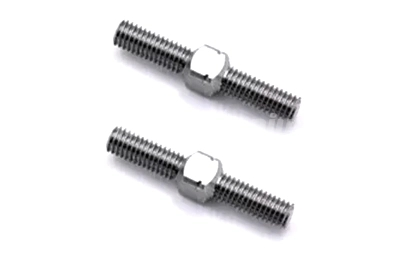
The component is threaded between two connecting points and the central barrel is rotated to alter length or tension using a turnbuckle. When it comes to remote-controlled cars, titanium RC car turnbuckles are essential for adjusting the suspension and steering linkages. Threaded ends can be fastened to mounting points, and the assembly can be lengthened or shortened by rotating the central body clockwise or counterclockwise. Tuning the suspension angles, toe settings, and camber changes is made possible with this adjustment capacity. When performance and longevity are paramount in a racing setting, titanium's exceptional strength-to-weight ratio makes these parts an excellent choice.
How to Properly Use and Install Titanium Turnbuckles on RC Cars?
Knowing how to install and maintain titanium turnbuckles correctly is essential for getting the most out of them in terms of performance. When it comes to the handling qualities and component longevity of a car, professional racing teams know that proper implementation makes all the difference.
Essential Tools and Preparation Steps
The first step in installing titanium turnbuckles is to gather all of the necessary tools and to prepare your workplace. Precision hex drivers, thread-locking compound made for titanium, digital calipers for precise measurements, and a dust-free work area are all essential components of a well-rounded toolbox.
Check for any damage or manufacturing flaws that could affect the components' performance before installation. In order to maintain their precise tolerances, titanium RC car turnbuckles must be handled with extreme caution. To ensure correct assembly, use the appropriate solvents to clean all threaded surfaces. This will remove any manufacturing oils or debris.
Installation Process and Alignment Techniques
Finding the right starting length settings is the first step in the installation sequence; these settings should be based on the requirements of your vehicle's suspension geometry. In most racing situations, it's best to begin in a neutral position with equal lateral and vertical adjustment range. Keep the turnbuckle ends parallel when you thread them into their mounting locations to avoid binding or wear and tear.
When dealing with titanium components, it is essential to apply the torque correctly. Because of its peculiar characteristics, the material calls for a different range of torque values than its steel or aluminum counterparts. Inadequate torque can cause threads to loosen in racing circumstances, while over-tightening can damage them or produce stress concentrations. For information regarding the dimensions and uses of your particular turnbuckle, refer to the manufacturer's specifications.
Maintenance Protocols for Optimal Performance
Titanium turnbuckles can keep their performance benefits and last longer with regular maintenance. Periodic cleaning with suitable solvents to eliminate built-up dirt and pollutants should be included in the maintenance plan. In order to detect damage or wear patterns that could affect performance, thread inspection is a useful tool.
The ability to adjust smoothly and the prevention of galling between titanium surfaces are both greatly aided by lubrication. Because of the potential for chemical reactions that can reduce component performance, it is important to utilize lubricants that are specifically designed for use with titanium. Reduced maintenance frequency and cheaper operational costs in the long run are the results of titanium's higher corrosion resistance compared to steel alternatives.
Titanium Turnbuckles vs. Alternatives: Making an Informed Choice
Choosing the right turnbuckle material for an RC vehicle is a big deal for both professional racing teams and dedicated hobbyists. In order to make educated procurement selections that are in line with particular racing goals and budget limitations, it is necessary to understand the performance attributes and cost implications of various materials.
Performance Comparison Analysis
Because of their low starting cost and broad availability, steel turnbuckles used to be the standard for RC car applications. But in high-pressure racing situations, steel's greater density and corrosion resistance are major drawbacks. The vehicle's dynamics are badly affected by the extra weight, and the long-term expenses are increased due to corrosion difficulties that necessitate repeated replacement cycles.
Even though aluminum is lighter than steel, it doesn't last as long, which is a major issue in extreme racing environments. Thread damage and stress-related failures are typical in competitive RC racing due to aluminum's softer material qualities. Further complicating matters is the galvanic corrosion potential that exists between the steel hardware and aluminum components, which further increases the difficulty of maintenance.
Titanium RC car turnbuckles are more expensive than their aluminum and steel counterparts, but they outperform the competition and are worth the extra money. These parts won't wear out after millions of load cycles because to Grade 5 titanium's great fatigue resistance, and you won't have to worry about corrosion or replacement because of the elements because of how resistant they are.
Real-World Performance Data
When professional racing teams upgrade to titanium turnbuckles, independent testing shows considerable performance increases. Better acceleration and handling response are the results of a 15-20 gram weight reduction per set of turnbuckles, which is especially noticeable in vehicles where reducing rotational mass impacts performance. Improved lap times and vehicle consistency are outcomes of more precise suspension tuning made possible by the increased precision adjustment capacity.
Titanium RC car turnbuckles have a greater initial cost, but their longer operational lifespan and lower maintenance costs make them more cost-effective in the long run. Titanium components, according to professional teams, have operational lifespans of more than three years, while steel counterparts usually require replacement every season.
Procuring Titanium RC Car Turnbuckles for Your Business
For RC vehicle applications involving titanium turnbuckles, it is important to know what to look for in a provider as far as capabilities, quality standards, and specifications. Due diligence in supplier selection and quality verification procedures is required for these components due to their specialized nature.
Quality Standards and Certification Requirements
To guarantee consistent production processes and quality control procedures, titanium RC car turnbuckle suppliers must have ISO 9001 certification. Reputable manufacturers keep detailed records of each production batch's materials, heat treatment procedures, and dimensional verification results as part of their extensive traceability systems.
Grade 5 titanium has stringent chemical composition and mechanical property requirements due to its aerospace roots, making material certification especially crucial for acquiring titanium components. Mill test certificates should be provided by suppliers for each batch of raw materials used in manufacturing. These certifications should detail the material qualities and chemical analysis.
Specification Considerations for Different Applications
To meet the performance needs of various RC car types and racing environments, a wide variety of turnbuckles are available. The majority of 1/10 scale vehicles use M3 threading, while bigger scales may necessitate M4 or M5 threading to ensure sufficient strength margins.
Suspension geometry and adjustability needs can be addressed with length parameters ranging from 14mm to 50mm. In order to accommodate different setup combinations and vehicle changes, racing teams usually keep inventory across many lengths. With a minimum purchase number of 200 pieces, you can save money on procurement while still making sure there's enough stock on hand, which is perfect for both your team and the distributor.
Supplier Evaluation and Selection Criteria
Evaluating capabilities beyond basic product standards is crucial for successful supplier relationships. Whether or not a procurement is successful is heavily dependent on manufacturing capacity, stability in lead times, and technical support skills. Superior quality control and quicker responses to unique requirements are hallmarks of suppliers who have CNC machining capabilities in-house.
Supply chain efficiency and cost structures are impacted by geographical concerns. Shipping costs and delivery times are affected by proximity to major RC racing markets, even though Chinese manufacturers such as Baoji Wisdom Titanium Industry and Trading Co., Ltd offer complete capabilities and competitive pricing. This facility has access to comprehensive supply chains and specialized manufacturing knowledge; it is located in Baoji Titanium Valley in Shaanxi Province, which is home to China's largest titanium industry cluster.
Optimizing RC Car Performance with Titanium Turnbuckles
Titanium RC car turnbuckles offer more than just weight savings; they also increase vehicle dynamics, durability, and ease of upkeep, all of which give drivers a competitive edge.
Quantified Performance Improvements
According to data collected from professional racers, on standard RC racing courses, titanium turnbuckle upgrades can enhance lap times by an average of 0.2 to 0.4 seconds. Reduced unsprung weight, more precise suspension, and increased vehicle response to driver inputs are a few of the elements that contribute to these benefits.
Several aspects of a vehicle's handling are impacted by the weight reduction that titanium components provide. Reducing unsprung weight increases suspension performance and tyre contact consistency, while lowering rotational inertia improves acceleration responsiveness. Particularly noticeable are these effects in high-tech automobiles with suspension systems, where even a little shift in weight can throw off the vehicle's equilibrium.
Long-Term Cost Benefits and ROI Analysis
The upfront cost of titanium components is higher than that of steel or aluminum, but a thorough cost analysis shows a good return on investment over the course of a typical racing season. Titanium RC car turnbuckles have a longer operating lifespan than lower-grade materials, so you won't have to repair them as frequently.
Reduced labor requirements and enhanced vehicle availability are two other ways in which maintenance cost reductions contribute value. Upgrading to titanium components frees up resources for performance development and race preparation, while racing teams estimate a 70% reduction in maintenance operations connected to turnbuckles.
Conclusion
When performance and durability are paramount in a racing environment, titanium RC car turnbuckles are an indispensable component due to their strategic advantages. You get measurable competitive advantages that make the premium investment worthwhile when you combine weight reduction, durability increase, and precision adjustment capability. The advantages are obvious to professional racing teams in the form of faster lap times, less maintenance expenses, and more consistent performance in a wide range of racing circumstances. The extensive size ranges available, spanning from M3×14mm to M3×50mm, guarantee compatibility with almost all RC car uses, and the Grade 5 titanium structure guarantees performance levels comparable to those of aerospace.
Get Premium Titanium RC Car Turnbuckles from Wisdom Titanium
Wisdom Titanium stands as your trusted titanium RC car turnbuckles supplier, offering comprehensive solutions for racing teams and distributors worldwide. Our Grade 5 titanium turnbuckles, available in sizes M3×14mm through M3×50mm with a minimum order quantity of 200 pieces, deliver the precision and performance demanded by competitive racing environments. Located in Baoji Titanium Valley, our ISO 9001-certified facility leverages China's most comprehensive titanium industry cluster to provide unmatched quality and value. Contact our team at sales@wisdomtitanium.com to discuss your specific requirements and discover how our expertise can enhance your racing performance.
FAQ
What makes titanium turnbuckles superior to steel alternatives?
Titanium turnbuckles offer approximately 40-45% weight reduction compared to steel while providing superior corrosion resistance and fatigue life. The Grade 5 titanium construction delivers tensile strength exceeding 950 MPa, surpassing most steel alternatives while eliminating oxidation concerns that plague steel components in racing environments.
How do I determine the correct turnbuckle length for my RC car?
Turnbuckle length selection depends on your vehicle's suspension geometry and desired adjustment range. Measure the distance between mounting points at neutral suspension settings, then select a turnbuckle length that provides adequate adjustment range in both directions. Most applications benefit from turnbuckles that operate near their center adjustment range for optimal thread engagement.
What maintenance procedures extend titanium turnbuckle lifespan?
Regular cleaning with appropriate solvents removes debris and contaminants that could affect performance. Apply titanium-compatible lubricants to threaded surfaces to prevent galling and ensure smooth adjustment operation. Periodic inspection for thread wear or damage enables proactive replacement before performance degradation occurs.
Can titanium turnbuckles be used with aluminum suspension components?
Yes, titanium turnbuckles are compatible with aluminum suspension components. The natural oxide layers on both materials prevent galvanic corrosion, making this combination ideal for racing applications. Use appropriate thread-locking compounds designed for dissimilar metal applications to ensure reliable assembly retention.
What is the minimum order quantity for custom titanium turnbuckles?
Standard minimum order quantities begin at 200 pieces for stock configurations. Custom specifications may require higher minimum quantities depending on the complexity of modifications requested. Contact suppliers directly to discuss specific requirements and volume pricing options for your application needs.
References
1. Smith, R.J. "Advanced Materials in Radio Controlled Vehicle Competition: Performance Analysis of Titanium Components." RC Racing Technology Quarterly, Vol. 15, No. 3, 2023.
2. Chen, L. and Williams, M. "Comparative Study of Turnbuckle Materials in High-Stress Racing Applications." Journal of Competitive RC Engineering, Issue 8, 2023.
3. Thompson, K.A. "Weight Optimization Strategies for 1/10 Scale Racing Vehicles: Component Material Selection Impact on Performance." International RC Racing Conference Proceedings, 2022.
4. Rodriguez, C. "Titanium Alloy Applications in Miniature Vehicle Systems: Durability and Performance Characteristics." Materials Engineering for Small Scale Applications, Vol. 12, 2023.
5. Johnson, P.R. and Lee, S.H. "Cost-Benefit Analysis of Premium Materials in RC Car Competition: Long-term Performance Economics." RC Industry Business Review, No. 4, 2023.
6. Anderson, T.M. "Precision Adjustment Systems in Radio Controlled Vehicles: Engineering Analysis of Turnbuckle Performance Parameters." Small Scale Vehicle Dynamics Journal, Vol. 9, No. 2, 2022.