
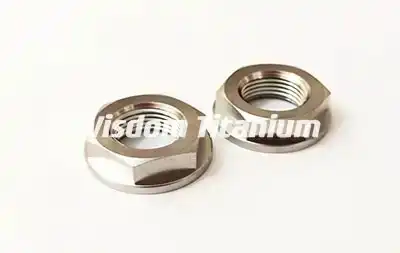
Jam nuts are low-profile locking screws that keep threaded systems from coming loose when there is shaking, thermal expansion, or dynamic loads. When a titanium jam nut is tightened against a main nut or threaded part, it creates frictional forces on the thread sides that push against each other and hold the link in place. Instead of using deformable inserts like most locking systems do, jam nuts provide security through pure mechanical delay. This makes them perfect for high-temperature settings where nylon-insert locknuts would fail. Because they are usually only half as tall as regular hex nuts, they are essential in tight spaces like race car suspension systems and motorbike brake calipers.
Understanding Jam Nuts and Their Working Principles
What Defines a Jam Nut?
In order to meet standards like DIN 439 or ISO 4035, jam nuts are hexagonal closures that are about 50% shorter in height than normal nuts. This narrower shape makes it possible to put nuts in places where there isn't enough vertical space for full-height nuts, like on rod ends in adjustable control arms or on threaded shafts in precision machinery. The word "jam" comes from the way they work: when they are torqued against another nut or threaded part, they create a wedging effect that locks both parts together by engaging opposite threads.
Titanium jam nuts made from Grade 5 titanium metal (Ti-6Al-4V) have a tensile strength of over 900 MPa and weigh 45% less than steel nuts of the same size. The material doesn't rust, so it doesn't have the galvanic reactions and thread galling that happen when stainless steel parts are exposed to saltwater or chemicals. Surface treatments like anodizing or PVD covering make things more resistant to wear and tear and make them easier to identify for quality control in production settings.
Mechanical Locking Principles
The locking process of a jam nut depends on making two frictional edges on threaded surfaces. When a main nut is tightened on a bolt, it makes the fastener have preload stress. There are compressive forces that trap the thread sides between the two nuts when you thread a titanium jam nut against the main nut and torque it in the opposite direction. Vibrations can't loosen this setup because any rotational movement has to beat friction at both the nut-to-bolt and nut-to-nut surfaces at the same time.
The preload effect keeps the tightening force constant even when outside forces cause the joint to move slightly. In racing, the turning motion of the car puts varying horizontal forces on the suspension fasteners. The jam nut keeps the main fastener from backing out while letting the ride height or camber angle be adjusted in a controlled way. Thread-locking compounds harden into ties that can't be broken. Jam nuts, on the other hand, let you take things apart without using heat or chemical solvents, so the thread stays intact during multiple maintenance rounds.
Why Titanium Enhances Jam Nut Performance?
Titanium's elastic value is about 110 GPa, while steel's is 200 GPa. This means that the material can bend slightly when it is loaded before going back to its original shape. This flexibility helps keep the threads engaged during thermal cycles, when steel fasteners might lose preload because changes in temperature can affect the standards for size. The low thermal expansion rate of the material makes it less likely that parts will break when they are heated by an engine or when they are braking.
Corrosion resistance is very important in naval and vehicle settings where road salt or seawater speeds up the breakdown of steel. When paired with aluminum or carbon fiber parts, titanium makes a solid oxide layer that heals itself when scratched. This keeps threads from galvanic corrosion. This feature makes the product last longer in places where steel jam nuts would need to be replaced after just one season.
Core Properties and Benefits of Titanium Jam Nuts
Material Performance Comparison
Titanium Grade 5 jam nuts are the strongest fasteners you can buy compared to their weight. While alloy steel has a higher absolute tensile strength, titanium has the same strength at a much lower mass, which becomes even more of a benefit when hundreds of fasteners are used in a car assembly. Aluminum jam nuts are about the same in terms of how much they weigh, but they don't have the fatigue strength that is needed for cyclic loads in suspension or engine uses.
Corrosion protection tests show that titanium is better in tough settings. Studies that put stainless steel jam nuts in salt spray show that the surface gets pitted after 500 hours. But titanium parts keep their thread integrity for more than 2,000 hours without any measurable degradation. Because it lasts longer, it needs less upkeep and costs less over its lifetime in business truck fleets or marine installations.
Because the material doesn't weaken at high temperatures, it can be used in places where steel bolts would weaken above 300°C, like in brake system parts. Titanium keeps its mechanical properties at temperatures close to 450°C. This means that brake caliper bolts will keep their holding force even after being heated and cooled many times during track days or races.
Procurement Value Proposition
To figure out the total cost of ownership, you have to compare the original prices of materials to the benefits they bring to the business. Titanium jam nuts usually cost three to five times more per unit than steel ones, but this price difference goes down when you consider how much lighter they are. Automakers say that replacing steel fasteners with titanium jam nuts in chassis and engine systems as part of regular lightweighting programs improves fuel economy by 0.5% to 1%.
The investment is worth it for racing teams because they can see speed gains in lap times. Replacing steel suspension bolts with titanium jam nuts lowers the unsprung mass. This makes the wheels more sensitive to changes in the road surface, which improves the regularity of the tire contact patch during cornering. A full suspension fastener change can cut unsprung weight by two to three kilograms per corner, which professional drivers can feel right away as a difference in how the car handles.
Aside from the cost of the materials, quality assurance factors affect buying choices. Titanium providers with a good reputation provide material certificates that show the alloy's composition and ingot batch records. This makes sure that the titanium meets aerospace material standards like AMS 4928. This tracking is very important for OEM applications because regulatory checks need written proof of where parts came from and batch testing is used to confirm their mechanical properties.
Installation and Application of Titanium Jam Nuts
Proper Installation Procedures
To properly install jam nuts, you need to know about torque requirements that are different from those for normal steel screws. Titanium has a smaller modulus of elasticity, which means that over-torquing can forever loosen threads, which makes the nut useless. When you take into account the thread pitch and bolt diameter, the recommended torque values are usually between 60 and 70% of the standards for a similar steel fastener. Using a measured torque wrench keeps you from making mistakes during fitting that could damage the joint.
When locking movable parts, the order in which they are installed is important. Make sure the main nut is fully against the mounting surface or gap as you thread it into place. Hold the main nut still with a second wrench and push the jam nut against it. Tighten the jam nut. This method keeps the change from being messed up while setting up the locking interference. Putting anti-seize powder on threads lowers the chance of galling without affecting the friction-based locking action too much.
The amount of thread contact affects how well the lock works. For jam nut fitting to work properly, the bolt needs to have at least six full threads engaged. If there isn't enough contact, the stress is concentrated on the first threads, which makes them more likely to break under vibration or impact loads. By choosing bolt lengths that allow the right amount of thread expansion, fitting problems can be avoided while keeping assembly profiles small.
Industry Application Examples
The most difficult use for titanium jam nuts is in the suspension systems of racing cars. With adjustable control arms, the ride height and alignment need to be changed a lot during competition seasons. This means that screws need to be able to handle being open and tightened many times without affecting the thread quality. Teams in endurance races say that titanium jam nuts keep their secure locking during 24-hour events, even though they are constantly vibrating and changing temperatures.
Mounting brake calipers on motorcycles is another important use case. When you hit the brakes hard, the caliper bolts hold the brake systems together. During this time, the brake rotors pass heat that can reach 600°C to the bolts. Because they are stable at high temperatures and don't rust, titanium jam nuts are perfect for this open spot where steel nuts would rust from road salt and water.
Custom bike shops that work with professional racers use titanium jam nuts to hold the stem bolts and rear axle in place. The lighter weight makes the bike perform better on rising stages, and the resistance to rust makes sure that the bike will work well in a wide range of weather conditions for a long time. They are used in suspension linkage pivots by high-end mountain bike makers because the low shape lets moving parts fit closely together.
Conclusion
In situations where a fastener needs to be light, resistant to rust, and able to withstand vibrations, titanium jam nuts have been shown to work well. Their mechanical closing mechanism doesn't use any wearable parts, so it works the same way every time it's put together. Titanium Grade 5 has unique qualities that make it stronger than steel or aluminum. It also lasts longer and is more resistant to corrosion, so the higher cost is worth it because it saves money over time and performs better.
When making decisions about what to buy, it helps to know what the product needs and what the seller can do. Racing teams want low minimum order numbers and custom surface finishes, but OEM makers need to be able to prove where the materials came from and collect statistical process control data. Titanium's worth goes beyond comparing its initial purchase price when you look at its total cost of ownership, which includes benefits like reduced weight, longer service intervals, and less upkeep work.
Partner with Wisdom Titanium for Premium Titanium Jam Nut Solutions
Wisdom Titanium makes aerospace-grade titanium jam nuts that are designed to work in tough situations in cars, motorcycles, and races. We are an ISO 9001-certified factory in Baoji Titanium Valley, which is the world's most important place for making titanium products. We control the whole supply chain, from getting the raw materials to inspecting the finished products. Our Grade 5 titanium jam nuts are made with precise CNC cutting, and you can choose from polishing, anodizing, or PVD finishing the surface to suit your needs. We offer full material certifications and a minimum order size of 200 pieces for titanium jam nut providers, modification shops, and race teams. Email our engineering team at sales@wisdomtitanium.com to talk about your needs and get full technical information to help you make your choice.
FAQ
Are titanium jam nuts stronger than steel equivalents?
Grade 5 titanium jam nuts are about the same in tensile strength as medium-carbon steel bolts, but they weigh 45% less. Titanium has a better strength-to-weight ratio, but high-grade alloy steel has higher actual strength numbers. Titanium is better than other metals because it doesn't rust and doesn't wear down when loaded and unloaded many times.
What torque specifications apply to titanium jam nut installation?
Tighten titanium screws to about 60 to 70% of the number given for steel parts that are the same. The exact requirement is based on the thread width, pitch, and surface finish. Using a measured torque wrench keeps you from over-tightening, which can damage titanium threads forever and make locking less effective.
Can I purchase titanium jam nuts in small quantities for custom builds?
There are a lot of specialized sellers that can handle small orders with as few as 200 pieces. This amount helps race teams and special fabrication shops that need certain thread sizes without having to commit to large-scale stocking levels. Depending on how much it costs to set up the factory, custom surface styles and non-standard sizes may need higher minimums.
References
1. Boyer, R., Welsch, G., & Collings, E.W. (1994). Materials Properties Handbook: Titanium Alloys. ASM International, Materials Park, Ohio.
2. Bickford, J.H. (2008). Introduction to the Design and Behavior of Bolted Joints: Non-Gasketed Joints, Fourth Edition. CRC Press, Boca Raton, Florida.
3. SAE International (2019). Aerospace Material Specification AMS 4928: Titanium Alloy Bars, Wire, Forgings, Rings, and Bird-shapes Shapes 6Al-4V, Annealed. SAE Technical Standards, Warrendale, Pennsylvania.
4. DIN Standards Committee (2016). DIN 439: Hexagon Thin Nuts - Product Grade A. Deutsches Institut für Normung, Berlin, Germany.
5. Donachie, M.J. (2000). Titanium: A Technical Guide, Second Edition. ASM International, Materials Park, Ohio.
6. Campbell, F.C. (2008). Elements of Metallurgy and Engineering Alloys. ASM International, Materials Park, Ohio.