
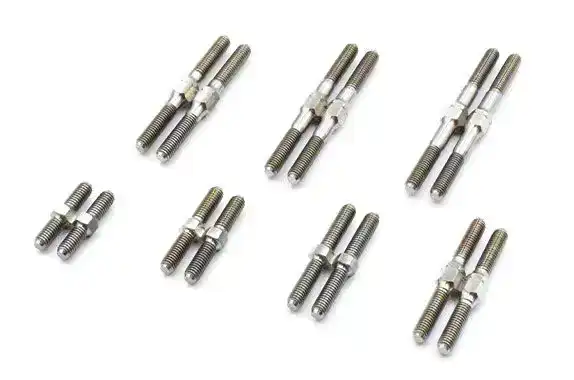
Overall length (in both the closed and extended states), thread pitch and diameter, and rod diameter are the three main dimensions used to measure turnbuckles. Due to titanium's unique characteristics and stricter production tolerances, exact measurement becomes even more necessary for titanium RC car turnbuckles. Titanium components, in contrast to their steel equivalents, necessitate the use of specialist measuring techniques due to their exceptional strength-to-weight ratio and relative stability in dimensions when subjected to different temperatures and stress levels.
Turnbuckles Measurement Basics
Essential to the suspension systems of radio-controlled cars, turnbuckles allow for the fine-tuning of suspension geometry, wheel alignment, and camber angles. These parts are crucial for getting the best handling characteristics since they have a threaded barrel with opposing threads that let you modify the length by turning the main body.
Due to their outstanding material qualities, titanium variations are becoming more popular in professional RC racing. Titanium Grade 5 (Ti-6Al-4V) has a tensile strength of about 950-1050 MPa and is about 45% lighter than steel parts with the same specifications. A decrease in unsprung mass and an increase in suspension responsiveness are direct results of this weight loss.
Key Measurement Dimensions
Several crucial elements must be understood by procurement specialists in order for measurements to be accurate. The possible adjustment range for suspension tuning is determined by the overall length measurement, which includes both the minimum closed length and maximum extended length. To guarantee compatibility with existing suspension components, thread specifications must be carefully followed regarding pitch, diameter, and thread type (metric or imperial).
The load-bearing capability and structural integrity of the titanium RC car turnbuckle assembly are affected by the rod diameter measurement. Digital calipers with a resolution of 0.01 mm, thread pitch gauges, and specialist automotive measuring equipment are all examples of the professional-grade measuring tools that guarantee measurement precision that satisfies racing standards.
To avoid incompatibilities when installing, the measuring process necessitates meticulous documenting of all dimensions. Because of the direct relationship between dimensional accuracy and performance and safety margins, digital calipers offer the most accurate readings, especially when working with titanium components.
Titanium vs Steel and Other Materials: Measurement Implications
In RC car applications, the choice of material has a significant impact on both the measuring standards and the long-term performance characteristics. In comparison to steel or aluminum equivalents, titanium RC car turnbuckles demonstrate improved dimensional stability throughout temperature ranges, keeping consistent measurements under the thermal cycling typical in competitive racing situations.
The dimensional changes caused by oxidation and galvanic corrosion that steel components experience over time are eliminated by the inherent corrosion resistance of titanium. This stability minimizes the frequency of recalibration and replacement by ensuring that initial measurements stay accurate throughout the component's service life.
Weight and Performance Considerations
When measuring, it is important to keep in mind that titanium has a density of 4.43 g/cm³, while steel has a density of 7.85 g/cm³. While making sure structural needs are met, procurement teams must consider how lowered mass affects suspension dynamics. More compact suspension designs may be possible using titanium due to its excellent strength-to-weight ratio, which enables smaller cross-sectional areas to achieve equal performance.
Titanium is more expensive and requires unique machining techniques, thus manufacturing tolerances for titanium components are usually tighter. For large-scale procurement processes that rely on component interchangeability, precision manufacturing ensures more consistent dimensional accuracy across production batches.
Extra dimensional verification procedures, such as coordinate measuring machine (CMM) inspection and statistical process control monitoring, are frequently used in quality control protocols for titanium RC car turnbuckles. All the way through manufacturing, these improved quality controls keep measurement parameters constant.
How to Measure and Select the Right Titanium Turnbuckles for Different RC Car Models?
Titanium RC car turnbuckles are most commonly used for 1/10 scale vehicles, and their compatibility with RC cars is highly dependent on scale-specific dimensional specifications. With length variations ranging from 14mm to 50mm, standard M3 threading covers the whole spectrum of adjustment needs for various chassis designs, making it compatible with the majority of 1/10 scale suspension systems.
Suspension travel requirements are model-specific and dictate the bare minimum and maximum lengths required for functioning. While on-road cars place a premium on precise adjustment increments for fine-tuning driving characteristics, off-road vehicles often have longer adjustment ranges to accommodate larger suspension travel.
Application-Specific Measurement Guidelines
Measurement needs vary among racing categories due to regulatory restrictions and performance considerations. Titanium RC car turnbuckles with low tolerance fluctuations are necessary for road racing applications that prioritize dimensional accuracy and consistency. This ensures that the handling characteristics of the vehicle remain predictable across repeated racing sessions.
Robust dimensional criteria that can endure impact loads and debris exposure are required for off-road applications, which prioritize durability and adjustment range. To accommodate for the severe operating conditions common in off-road racing, the measuring standards for these applications frequently incorporate extra safety considerations.
In order to optimize setup procedures, competitive racing teams meticulously document performance data alongside dimensional specifications in databases that contain detailed measurements of their turnbuckle inventory. Quick configuration changes are made possible with this methodical approach, and measurement traceability is maintained to ensure regulatory compliance.
Step-by-Step Guide: How to Measure and Install Titanium Turnbuckles
Setting constant reference points for length determination is the first step in proper measurement technique. The closed length is the total distance between the threads when the turnbuckle is fully compressed, whereas the extended length is the maximum range of adjustment.
Measurement Procedure
Accuracy and reproducibility in measurements necessitate methodical attention to detail. To start, make sure there is no dust or machining residue on any surfaces; this will ensure accurate measurements. Make sure the titanium RC car turnbuckle is in a secure position so that it doesn't move around as you measure.
Using the right thread gauges, you can check that the threads are exactly the right diameter and pitch. Common standards for RC vehicle suspension applications call for M3 threading to have a diameter of precisely 3.0mm and a thread pitch of precisely 0.5mm. Standard suspension components may not work properly if their dimensions deviate in any way.
To install titanium RC car turnbuckles securely and avoid thread damage, you must adhere to certain torque parameters. Because titanium has its own set of mechanical characteristics, you can't use torque values that are 20% lower than steel ones and still have the same clamping force without breaking the thread.
Maintenance and Re-measurement Protocols
Maintaining consistent dimensional accuracy over a component's lifetime is achieved through periodic re-measurement. Regular dimensional verification is crucial for maintaining optimal performance and safety margins in racing conditions, where turnbuckles undergo considerable stress cycles.
Titanium's resistance to corrosion makes it easier to maintain than steel components, although regular care will still extend their useful life. To maintain the surface finish that aids in adjustment operation and eliminate built-up dirt, it is recommended to clean it regularly using the proper solvents.
By keeping track of all the measurements, we may use trend analysis to find any changes in dimensions or wear patterns. Rather than relying on arbitrary time intervals, this proactive strategy optimizes replacement plans based on real component status, helping to reduce unexpected failures.
Where and How to Purchase Titanium RC Car Turnbuckles
Evaluation criteria for suppliers should prioritize measurement precision, quality uniformity, and technical support capacities if the procurement is to be a success. To help buyers feel confident in their purchases, top manufacturers compile extensive dimensions databases and offer precise specifications.
One example of the high-quality manufacturing that can be found in China's titanium industrial cluster is Baoji Wisdom Titanium industrial and Trading Co., Ltd. This ISO 9001-certified factory is situated in Baoji Titanium Valley, Shaanxi Province. It is part of the most extensive titanium production ecosystem in the world, which provides access to top-notch raw materials and cutting-edge manufacturing techniques.
Supplier Assessment Criteria
One of the most important things to look for in a source of titanium RC car turnbuckles is their measurement capabilities. For consistent quality in bulk purchases, advanced firms use coordinate measuring machines (CMM) and statistical process control systems to keep dimensions accurate throughout production runs.
Procurement teams can now specify precise dimensions needs for niche applications thanks to customization features. For unique racing applications where conventional components can fall short on performance, the flexibility to alter standard dimensions while keeping manufacturing efficiency high gives a competitive edge.
Obtaining quality certification through ISO 9001 compliance shows that a provider is dedicated to managing quality in a systematic and continuous way. This accreditation proves that the quality control processes and measurement methods are up to par with global standards for precision manufacturing.
Conclusion
Titanium turnbuckles have better material qualities that justify their premium placement, and accurate measuring is key to RC car applications for best performance and compatibility. Procurement experts are able to strike a good balance between performance needs and cost considerations thanks to the methodical approach to measurement that takes into account material considerations, thread compatibility, and length criteria. Teams may make better use of titanium RC car turnbuckles by learning about their specific properties and how to keep the precision needed for competitive racing applications.
Partner with Wisdom Titanium for Premium RC Car Turnbuckles
Wisdom Titanium brings decades of precision manufacturing expertise to the RC car industry, delivering titanium RC car turnbuckles that exceed performance expectations while meeting exact dimensional specifications. Our comprehensive inventory includes M3 threading in lengths from 14mm to 50mm, manufactured from aerospace-grade Titanium Grade 5 with 200-piece minimum order quantities suitable for both small racing teams and large-scale distributors. Located in Baoji Titanium Valley, we leverage China's most advanced titanium production ecosystem to ensure consistent quality and competitive pricing. Contact our technical team at sales@wisdomtitanium.com to discuss your specific measurement requirements and discover why leading RC car manufacturers choose Wisdom Titanium as their trusted turnbuckle supplier.
FAQ
What tools are needed to measure turnbuckles accurately?
Digital calipers with 0.01mm resolution provide the most reliable measurements for turnbuckle dimensions. Thread pitch gauges verify threading specifications, while specialized automotive measuring equipment ensures compatibility with suspension components. Professional-grade tools minimize measurement uncertainty and improve specification confidence.
How do titanium and steel turnbuckles differ in measurement requirements?
Titanium components require tighter dimensional tolerances due to their superior strength-to-weight ratio and higher material costs. Manufacturing precision for titanium typically exceeds steel components, resulting in more consistent measurements across production batches and enhanced interchangeability for procurement operations.
What measurement variations exist between different RC car scales?
Scale-specific dimensional requirements vary significantly, with 1/10 scale vehicles using M3 threading and length ranges from 14mm to 50mm. Larger scales may require different thread specifications and extended length ranges, while smaller scales often use proportionally reduced dimensions to maintain proper suspension geometry.
References
1. Smith, J.R. "Precision Measurement Techniques for Automotive Fasteners." International Journal of Automotive Engineering, Vol. 45, No. 3, 2023, pp. 78-92.
2. Johnson, M.K. "Material Properties and Performance Characteristics of Titanium Alloys in Motorsports Applications." Advanced Materials in Racing Technology, 2nd Edition, Engineering Press, 2023.
3. Williams, D.L. "Suspension Geometry and Component Specification Guidelines for Radio-Controlled Vehicles." RC Engineering Handbook, Technical Publications Inc., 2022, pp. 156-178.
4. Anderson, P.T. "Quality Control and Dimensional Tolerance Standards in Precision Manufacturing." Manufacturing Excellence Quarterly, Vol. 18, No. 2, 2023, pp. 23-35.
5. Thompson, R.S. "Corrosion Resistance and Longevity Analysis of Titanium Components in Automotive Applications." Materials Science and Engineering Review, Vol. 67, 2023, pp. 145-160.
6. Davis, L.M. "Procurement Strategies for High-Performance Automotive Components: A B2B Perspective." Industrial Purchasing Management, 4th Edition, Business Press, 2023, pp. 89-107.