
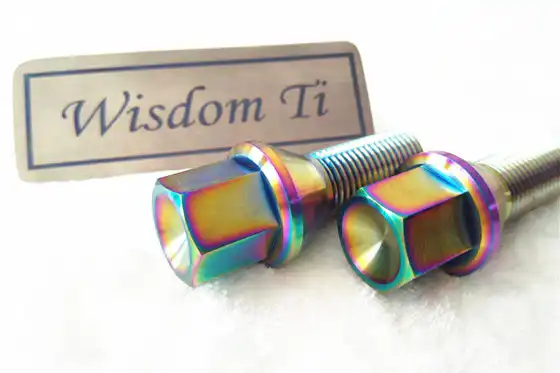
Titanium conical seat lug bolts are high-performance fasteners that play a crucial role in various industries, particularly in automotive and aerospace applications. These specialized bolts combine the strength and lightweight properties of titanium with a unique conical seat design, offering superior performance and reliability. In this article, we'll explore the manufacturing process of conical seat lug bolts, from raw materials to the final product.
What Raw Materials are Used in Producing Titanium Lug Bolts?
The foundation of any high-quality titanium conical seat lug bolt lies in its raw material. Manufacturers typically use titanium alloys, with Ti-6Al-4V (Grade 5) being one of the most common choices. This alloy consists of 90% titanium, 6% aluminum, and 4% vanadium, offering an excellent balance of strength, durability, and corrosion resistance. The specific combination of these elements endows the alloy with a unique set of properties that make it highly desirable for a wide range of applications, particularly those where high performance and reliability are crucial.
The selection of raw materials is critical, as it directly impacts the performance and longevity of the final product. Titanium alloys are chosen for their exceptional strength-to-weight ratio, which is about 60% higher than that of steel. This property allows for the creation of lightweight yet incredibly strong lug bolts, contributing to overall vehicle performance and fuel efficiency. In the automotive industry, for example, reducing the weight of components such as lug bolts can lead to significant improvements in fuel economy and handling. The lightweight nature of titanium also makes it easier to handle and install, reducing the overall time and effort required during maintenance and repairs.
Moreover, titanium's natural resistance to corrosion makes it an ideal choice for lug bolts, which are often exposed to harsh environmental conditions. This resistance ensures that the bolts maintain their integrity over time, even when subjected to road salt, moisture, and other corrosive elements. In regions with severe winters, where road salt is frequently used to de-ice roads, the corrosion resistance of titanium becomes particularly important. Unlike steel bolts, which can rust and weaken over time, titanium bolts remain strong and reliable, reducing the risk of bolt failure and the need for frequent replacements.
What CNC Machining Processes Ensure Precision and Durability?
Once the raw titanium alloy is prepared, the manufacturing process moves to the precision machining phase. Computer Numerical Control (CNC) machining plays a pivotal role in creating titanium conical seat lug bolts with exacting specifications.
The CNC machining process typically involves the following steps:
- Turning: The titanium rod is mounted on a lathe and turned to create the basic bolt shape, including the shaft and head.
- Threading: Precise threads are cut into the bolt shaft using specialized cutting tools. The accuracy of this step is crucial for ensuring a secure fit and proper load distribution.
- Conical Seat Formation: The distinctive conical seat is carefully machined into the underside of the bolt head. This feature is essential for the bolt's performance, as it ensures even pressure distribution and prevents loosening under vibration.
- Surface Finishing: The bolt undergoes various finishing processes to achieve the desired surface smoothness and appearance. This may include polishing, sandblasting, or applying protective coatings.
Throughout the CNC machining process, strict quality control measures are implemented to ensure that each bolt meets the required specifications. This includes regular measurements and inspections to verify dimensions, thread pitch, and surface finish.
The precision achieved through CNC machining is vital for the performance of titanium conical seat lug bolts. Even minor deviations in dimensions or thread pitch can compromise the bolt's functionality and safety. By leveraging advanced CNC technology, manufacturers can produce bolts with consistently high quality and tight tolerances.
How Does Forging Improve the Strength of Titanium Lug Bolts?
While CNC machining is essential for creating precise dimensions and features, many high-performance titanium conical seat lug bolts undergo an additional strengthening process: forging. Forging is a metalworking process that involves shaping the metal using localized compressive forces, typically at elevated temperatures.
The forging process for titanium lug bolts typically involves the following steps:
- Heating: The titanium alloy is heated to a specific temperature range, usually between 1,600°F and 1,800°F (870°C to 980°C), where it becomes more malleable.
- Shaping: The heated metal is then placed into a die and subjected to intense pressure, usually through hydraulic presses or hammers. This pressure forces the metal to conform to the shape of the die.
- Cooling: After shaping, the forged part is allowed to cool, either in air or through controlled cooling processes, depending on the desired material properties.
- Heat Treatment: Post-forging heat treatments may be applied to further enhance the material's strength and other properties.
Forging offers several advantages that contribute to the superior performance of titanium conical seat lug bolts:
- Improved Grain Structure: Forging aligns the metal's grain structure, enhancing its strength and toughness. This aligned structure helps resist fatigue and improves the bolt's overall durability.
- Enhanced Mechanical Properties: The forging process can increase the tensile strength, yield strength, and impact resistance of the titanium alloy, making the lug bolts even more robust and reliable.
- Reduced Porosity: Forging helps eliminate internal voids or porosity in the metal, resulting in a more uniform and dense material structure. This contributes to improved strength and resistance to failure.
- Better Stress Distribution: The forged structure allows for more even distribution of stresses when the bolt is under load, reducing the risk of failure at stress concentration points.
By combining the precision of CNC machining with the strength-enhancing benefits of forging, manufacturers can produce titanium conical seat lug bolts that offer exceptional performance, durability, and reliability. These bolts are capable of withstanding the high stresses and demanding conditions encountered in automotive, aerospace, and other high-performance applications.
In conclusion, the manufacturing of conical seat lug bolts is a complex process that requires careful material selection, precise machining, and often, advanced strengthening techniques like forging. The result is a high-performance fastener that combines the lightweight and corrosion-resistant properties of titanium with exceptional strength and durability.
For those seeking top-quality titanium conical seat lug bolts or custom titanium solutions, Wisdom Titanium offers a range of premium products engineered to meet the most demanding specifications. Our team of experts is ready to assist you in finding the perfect titanium fasteners for your application. Don't compromise on quality – elevate your project with Wisdom Titanium's superior products. Contact us today at sales@wisdomtitanium.com to discuss your titanium fastener needs and experience the difference that precision engineering and premium materials can make.
References
- ASM International. (2015). Titanium and Titanium Alloys: Fundamentals and Applications.
- Davim, J. P. (Ed.). (2014). Machining of Titanium Alloys. Springer.
- Semiatin, S. L. (Ed.). (2006). ASM Handbook, Volume 14A: Metalworking: Bulk Forming. ASM International.