
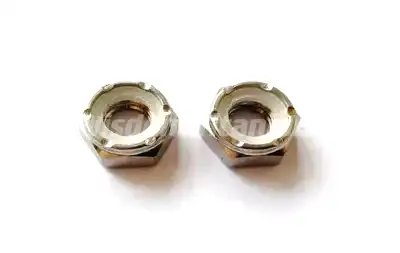
Nylon insert lock nuts are precision fasteners engineered through a multi-stage process that integrates metal forming with polymer technology. Titanium nylon lock nuts specifically begin with high-grade titanium alloy rods that undergo hot forging to create hexagonal blanks, followed by CNC threading to exact tolerances. A heat-resistant nylon ring is then either injection-molded directly into the nut's top or press-fitted into a pre-machined groove. This nylon collar creates frictional resistance against bolt threads, preventing loosening under vibration while maintaining reusability across multiple assembly cycles.
Detailed Manufacturing Steps of Titanium Nylon Lock Nuts
Material Sourcing and Titanium Blank Preparation
Getting approved Grade 5 titanium metal that meets ASTM B348 or AMS 4928 standards is the first step in the manufacturing process. Chemical composition is confirmed by mill test results. The right amount of aluminum (5.5–6.75%) and vanadium (3.5–4.5%) ensures the best strength qualities. We have long-term partnerships with smelters in Baoji Titanium Valley. There, supply chains are fully linked from making sponge titanium to casting ingots. This makes it possible to track materials, which is very important for military and medical device uses.
To work with titanium's unique ability to bend, hot forging is used instead of cold heading for blank preparation. Induction heating devices heat titanium rods to the right temperature for forging without letting alpha-case formation happen, which would make the top layers brittle. Multi-stage upset forging gradually forms hexagonal features, with die designs that account for the springiness of titanium. Forged blanks have equalized grain structures that give them isotropic mechanical qualities. This means that they don't have the directional weaknesses that come with screw-machined parts.
After forging, annealing is done in vacuum ovens at 1,300°F for two hours to get rid of any remaining stresses. This heat process evens out the microstructure and stops air from soaking in, which would weaken the top layers. Rapid cooling in neutral gas atmospheres keeps the balance between the alpha and beta phases, which is important for getting the minimum tensile strength of 130 ksi.
Precision CNC Machining and Threading Operations
For thread cutting, multi-axis CNC lathes with live tools are used for single-setup processing that gets rid of positional mistakes. Carbide plugs with polished rake faces keep titanium from galling, and cutting speeds of 150 to 200 surface feet per minute keep output and tool life in balance. Using water-soluble emulsions in flood cooling systems stops chip welding and protects work areas from heat damage.
Thread forms must strictly follow unified standards, and Class 2A external threads give nylon inserts the best amount of room to connect. Coordinate measuring tools take a sample of every 50th piece to make sure that the thread depth error stays within ±0.001 inches throughout production runs. Pay close attention to the small diameter measurements because threads that are too small make nylon less compressible and make sealing less effective.
Hex measurements are precisely milled to keep wrench flat-to-flat specs of ±0.005 inches. This keeps the tool from slipping when installing torque. The chamfer angles at the thread entry make it easier to line up the bolts, which is especially important for blind assembly tasks that are common in car frame applications. Surface finish standards aim for 63 micro-inch Ra on the thread sides. This encourages consistent nylon bonding and lowers friction coefficients during installation.
Nylon Insert Integration and Molding Techniques
There are two main ways to integrate nylon, which depend on the amount of output and the performance needs. For large-scale jobs, injection molding is the most common method. Computer-controlled machines heat polyamide 6/6 plastic to 500°F and then pour it into precise holes that have been cut into the top of the nut. Mold temperatures stay between 180°F and 200°F, which helps molecules line up in a way that makes the material less likely to creep under long-term clamp loads. To stop polymer spraying, which would make the density distribution less even, injection pressure profiles rise slowly.
Cooling rounds last for an extra 15 to 20 seconds while the pressure stays the same. This makes sure that the hole is completely filled and prevents sink marks. The torque mechanism is created by the nylon ring's interference fit with the threaded hole. The inner diameter of the ring is usually 0.008 to 0.012 inches smaller than the bolt's pitch diameter. This relationship between sizes tells us how much force to use for installation. For M6 sizes, it's set to produce 3 to 8 inch-pounds of breakaway resistance, and it increases proportionally with bigger diameters.
Press-fit insertion is good for low-volume output and lets you make quick changes to the nylon standard. Before they are put together mechanically, pre-formed nylon rings made by compression molding are checked for their dimensions. Seat rings are pressed into undercut holes by hydraulics using controlled force patterns that can be checked by watching the load in real time. This method makes it easy to make special nylon formulas for use in high-temperature situations. For example, glass-filled versions can be used to increase the temperature range to 350°F for turbocharger mounting uses.
Quality Control and Certification Processes
Every lot of products goes through several stages of checks that are in line with ISO 9001 standards and standards specific to the business. Optical comparators and CMM devices are used in dimensional inspection to check more than 15 important parameters, such as thread pitch, hex size, overall length, and nylon insert concentricity. Statistical process control keeps an eye on data trends and takes corrective steps when parameters get close to the limits of tolerance.
Prevailing torque testing confirms that the locking works according to the IFI-100 standards. Automated test stands put measured bolts through sample nuts while keeping track of torque curves to make sure that breaking values are within the acceptable range. Tests are done at room temperature and higher temperatures that are similar to service settings. This makes sure that the nylon insert works well across all working temperature ranges.
Participants in vibration endurance tests put together bolt-nut pairs through more than 100,000 oscillation cycles while keeping an eye on clamp load retention. Accelerometers make sure that the test fixture's shaking amplitudes meet the standards, which are usually 0.8 mm of movement at 30 Hz. After testing, successful samples keep 85% or more of their original preload, showing that they are resistant to the self-loosening processes that happen with most fasteners.
Each shipment comes with a material certification that lists the chemicals used, the mechanical qualities, and the heat treatment settings. Aerospace users can fully trace their orders back to the ingot serial numbers, which meets the standards of the AS9100 quality system. Corrosion protection is proven by salt spray tests according to ASTM B117. titanium nylon lock nuts showed no red rust after 1,000 hours of exposure, while stainless steel controls had surface corrosion.
Applications and Market Demand for Titanium Nylon Lock Nuts
Primary Industries and Critical Use Cases
When a part fails in the most demanding application environment—motorsports—it directly affects safety and performance. Formula race teams use titanium nylon lock nuts all over the suspension links, which are places where vibrations can happen at more than 200 Hz when the car is turning quickly. Because moving parts like brake rotors and wheel hubs are lighter, gyroscopic effects are lessened. This makes the car more quick when changing directions. Track data analysis shows that upgrading fasteners leads to measurable improvements in lap times. This means that the costs of procurement are justified by the economic benefits they provide.
Titanium lock nuts are used in flight control systems, landing gear parts, and engine mounts by aerospace makers. As part of the FAA's approval process, a lot of testing has to be done and written down. This includes checking the fatigue life over 100,000+ pressurization cycles and temperature ranges from -65°F at cruise level to 250°F near engine bays. Multiple technical needs can be met by a single component design that saves weight, resists corrosion, and keeps vibrations safe.
Titanium's biocompatibility is used in surgery tools and implantable devices for medical purposes. In spine fusion hardware, orthopedic implant systems use small lock nuts that are compatible with MRIs and don't rust when they come in contact with body fluids. The non-magnetic qualities keep the structure solid even after years of physiological loading and stop picture artifacts during diagnostic testing.
Manufacturers of high-performance bikes are looking for bike fans who are willing to spend money on small performance gains. Custom frame makers use titanium hardware in the drivetrain and brake systems to help professional riders save weight and keep the parts from rusting. The natural titanium finish looks good and fits with the expensive brand branding, which helps price increases that cover the costs of production.
B2B Procurement Considerations and Supplier Evaluation
When purchasing managers look at titanium lock nut providers, they need to make sure that the companies can make the nuts in ways other than just having ISO 9001 certification. For important uses, AS9100 aircraft approval means that quality systems have been set up for tracking, process control, and managing corrective actions. Ask for mill test results that list the titanium's chemical make-up and mechanical properties to make sure the material meets the standards instead of using commercially available options.
Assessing production potential keeps the supply chain from breaking down when demand goes up. Find out how much of the raw materials are in stock, how long it takes to get titanium billets, and how fast the factory can make things. Suppliers who keep more than 30 days' worth of titanium in stock protect against material shortages in this niche market, and multi-shift CNC operations show that they can handle large orders.
Manufacturers and dealers are different in how they offer technical help. Engineering teams that help with torque specifications, material replacement studies, and custom measurement possibility studies add value that goes beyond the price of commodities. Ask for case studies that show how the provider has solved problems in your business. This will show that they understand application-specific problems like preventing galling or environmental exposure conditions.
Minimum order numbers show how efficiently the product is made and where it fits in the market. Established manufacturers with 100-piece minimums offer flexible production schedules that can accommodate test builds and small batch orders. On the other hand, manufacturers with 10,000-piece minimums focus on mass production, which might not work well with specialty uses. Compare your inventory holding costs and the accuracy of your demand forecasts with the minimum order quantity (MOQ).
OEM Capabilities and After-Sales Support
Custom dimensioning lets you make designs that are better than what's in the store. Manufacturers who use CNC machines can change the specs of nylon inserts, thread lengths, or bolt sizes to meet the needs of each assembly. As an example of how working together as engineers can improve the performance of a final product, we've made low-profile lock nuts for race brake caliper gaps and versions with longer threads for clamping composite materials.
Prototype services shorten the time it takes to make a product. Quick delivery of sample numbers lets you test the design before investing in tools, which is especially helpful when looking into converting steel screws to titanium ones. By sending us your measurements and application information, you'll get working samples within two to three weeks. These will let you test their fit and performance while the product is being developed.
Technical paperwork helps with internal quality processes and following the rules. Aerospace AS9102 first article inspection standards and car PPAP files can both be met with complete data packages that include material certifications, dimensional records, and test results. Electronic certificate delivery through source sites makes it easier for production operations with multiple locations to keep track of their paperwork.
Logistics skills impact total landing prices and the dependability of the supply chain. If a supplier offers combined shipping, freight costs for mixed fastener orders go down, and wait times for replenishment orders go down because of regional warehousing. Having experience with international shipping and knowing how to use customs forms and Harmonized Tariff classifications can help you avoid delays at the border that can throw off your production plan.
Conclusion
When you know how difficult it is to make nylon insert lock nuts, you can see why titanium nylon lock nuts are better in important situations. When aerospace-grade titanium metals are combined with precision-molded nylon plates, screws are made that meet the needs for reduced weight, resistance to corrosion, and vibration security all at the same time. Hot forging creates grain structures that make wear life longer, and controlled nylon integration makes sure that the dominant torque is the same across thousands of production pieces.
The benefits of material science directly lead to performance gains that can be seen in race lap times, airplane carrying capacity, and the length of time that equipment lasts. The 40% lighter weight compared to steel, along with better protection to corrosion and temperature stability, make it worth buying for high-performance, racing, and aerospace uses. As automation in manufacturing improves and more eco-friendly materials come out, titanium nylon lock nuts will continue to grow into uses that were previously controlled by traditional fasteners. This is because engineers need lighter, stronger, and longer-lasting ways to join things.
Partner With Wisdom Titanium for Premium Lock Nut Solutions
Wisdom Titanium makes hot-forged hex titanium nylon lock nuts that are designed for high-performance, aircraft, and motorsports businesses that need to hold things together securely. Our factory in Baoji Titanium Valley is ISO 9001-certified and has both integrated supply chain benefits and precise CNC capabilities. It makes Grade 5 titanium lock nuts from M3 to M24 sizes with both metric and inch thread types. Each nut goes through strict quality checks, such as measurements being checked, common torque tests, and material approval. This makes sure that they always work well in tough conditions.
Our 100-piece minimum orders allow for the development of prototypes and small-batch production while keeping factory prices low. A large stock of raw titanium materials allows for quick turnaround on standard specs. OEM services are also available for custom measurements or nylon formulations. We've worked with race teams to cut down on unsprung weight, aerospace companies to meet strict certification standards, and custom motorbike builders who care about both speed and looks.
Get quick expert help from engineers who know how to solve the problems you're having with your program. Our team can help you with solutions backed by manufacturing knowledge, whether you need power specs for clamping composite materials or help choosing materials for corrosive settings. Get in touch with us at sales@wisdomtitanium.com to talk about your needs with a reputable titanium nylon lock nuts supplier that wants to elevate your projects by providing you with high-quality fastener solutions and dependable global shipping.
FAQs
Can Titanium Nylon Lock Nuts Be Reused Multiple Times?
Titanium nylon lock nuts with nylon cores can usually be installed 8–12 times before they stop closing properly, which is below the requirements. During each assembly, the nylon material changes shape in a stretchy way, which makes it easier for bolt threads to fit. As a preventative step, racing teams that take apart engines often change the lock nuts every 10 cycles. Less important uses may be able to go longer between replacements based on current torque measures. Reusability is much better than sticky thread lockers that need to be removed with a solvent. This gives you more operating freedom and lower costs for consumables.
How Do Titanium Lock Nut Costs Compare to Stainless Steel?
Titanium lock nuts usually cost 4 to 6 times more than stainless steel ones because they are harder to make and cost more to make. However, titanium is often better for performance uses when lifetime cost analysis takes into account things like weight saves, resistance to corrosion, and the ability to be used again and again. When motorcycle manufacturers use titanium gear to cut the weight of their vehicles by 2 pounds, the better acceleration gives them a competitive edge worth thousands of dollars. Marine equipment owners avoid having to replace expensive parts too soon because of corrosion in saltwater. When making a purchase choice, the total cost of ownership should be taken into account, not just the unit price.
What Certifications Are Required for Aerospace Applications?
Material certificates according to AMS 4928 are needed for aerospace titanium lock nuts to show that they are made of Grade 5 alloy and have certain mechanical qualities. AS9100 quality methods must be followed during the manufacturing process, and AS9102 standards must be followed for first article checks. Each fastener needs to be able to be tracked back to the titanium ingot heat lots and come with mill test results that confirm the chemistry and tensile qualities. Testing for salt spray according to ASTM B117 and vibration testing according to the requirements of the airplane maker round out the certification package. OEMs require suppliers to keep their approved partner status, which includes regular checks to make sure they are still following the process.
References
- American Society of Mechanical Engineers. "ASME B1.1-2019: Unified Inch Screw Threads." ASME Standards Committee, 2019.
- Industrial Fasteners Institute. "IFI-100: Metric Prevailing Torque Type Hexagon Locknuts." Industrial Fasteners Institute Technical Standards, 2018.
- Boyer, Rodney, Gerhard Welsch, and E.W. Collings. "Materials Properties Handbook: Titanium Alloys." ASM International, 1994.
- SAE International. "AMS 4928: Titanium Alloy Bars, Wire, Forgings, Rings, and Drawn Shapes 6Al-4V Annealed." Aerospace Material Specifications, 2020.
- Bickford, John H. "Introduction to the Design and Behavior of Bolted Joints: Non-Gasketed Joints." CRC Press, 2008.
- ASTM International. "ASTM B348-13: Standard Specification for Titanium and Titanium Alloy Bars and Billets." ASTM Material Standards, 2013.




