
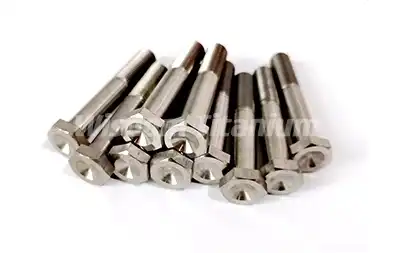
You measure a hex bolt by measuring four things: nominal diameter, length under head, thread pitch, and width across flats of head. A caliper measures diameter and length, and a thread gage measures pitch. Length is always measured from bearing face to tip. Then write down the material, grade, and standard, e.g., DIN 933 or DIN 931. This complete record eliminates ordering errors, secures thread engagement, and provides consistent torque. Below I’ll walk you through each measurement and how we use it when providing titanium fasteners.
What Dimensions Define a Hex Bolt?
A bolt label has a small area that can hold a lot of measurements. This is what each one means.
Core Dimensions: Diameter, Length, and Pitch
All you have to do is look at three numbers to finish the job. This is the outside diameter of the thread. For an M10 bolt, this is 10 mm. No matter how tall the head is, the length is from the base to the tip. Pitch is the distance from one thread to the next. The coarse pitch of M10 is 1.5 mm, and M12 is 1.75 mm. In the US, bolts are measured in threads per inch (TPI). Example: 1/2-13 UNC. Even if the sticker only says “M10 x 50” for diameter and length, you can still purchase the correct part. You also need to know the pitch, grade, and standard
Head Dimensions and Width Across Flats
It tells you what type of tool will work and how the clamp load is distributed across the head. The width across the flats is the size of the wrench or socket that you would use to measure it. The clearance depends on the height of the head, and the load is distributed by the bearing face. Standards don’t always match those values. Thus, it says that the M10 flats shall be 17 mm wide in DIN 933 and DIN 931 and 16 mm wide in ISO 4017 and ISO 4014. That millimeter caused the stocking distributors to label bins according to the standard. "Be sure you know what the standard is before you pick a wrench size.
How to Read a Hex Bolt Size Chart
One size chart in a table lists diameter, pitch, width across flats, head height, and typical lengths. The threads on the inch charts are 1/4 inch to 1 inch. The threads on the metric charts are M5 to M24. A chart helps me spot parts. The main standard, however, does set the tolerances and lengths that may be used. However, manufacturer specifications may vary. DIN 933 – Hex bolts with full threads DIN 931 – Hex bolts with partial threads They have been superseded by ISO 4017 and ISO 4014, but many people still order by DIN number. Compare the chart column to the standard on your drawing, not only the nominal size.
How to Measure a Hex Bolt Step by Step?
A consistent routine gives the same result every time. Start with the right tools, then follow the same order for each bolt.
Tools You Need
You don’t need many tools. A caliper measures the diameter, length, and head size of a hole. Many digital ones can read as small as 0.01 mm. If your thread pitch gage has leaves for both metric pitch and inch TPI, then you know what kind of thread it is. A micrometer is useful for small tolerances, and a go/no-go thread gage tells you if the thread passes inspection. Clean the thread first. Coatings or dirt that build up on it can throw off the reading. Both Grade 2 and Grade 5 titanium hex bolts can be measured with the same tools.
Measuring Length, Thread Length, and Grip
When you set the bolt against the caliper, the fixed jaw should be at the bottom of the head. Then measure the length from the tip to the bearing face. Then measure the length of the threaded part from the tip back to where the full thread ends. The straight shank is the part of the drill bit without any threads on it. This is also called the grip. The straight shank is found by subtracting the length of the threads from the total length. A DIN 933 bolt has very little grip because it is threaded all the way. The shank of a DIN 931 bolt can fit into the shear plane of a joint. With the bolt in your hand, write down all three numbers.
Common Measuring Mistakes
When you mix up the dimensions, you make the most mistakes. The length is too long for the head if you measure from the crown. If you match the diameter but don't check the pitch, cross-threading can happen. At first glance, a 1/2-inch bolt, which is 12.7 mm, looks a lot like an M12 bolt. The wrench's size refers to its head, not its thread. Steel bolts with marks like 8.8 or Grade 8 show how strong they are, not how big they are. It's best to use a clean sample as much as possible to get a correct reading. I check any parts I don't know with a pitch gauge before I quote something.
Identifying Thread, Material, and Grade
Dimensions alone do not describe a bolt. Thread system, material, and grade complete the picture.
Metric vs. Imperial Threads
You can't switch between metric and imperial bolts, even if they look the same. You write the diameter and the pitch when you write an M8 × 1.25 thread. If you look at a 3/8-16 UNC thread, it has a diameter and a TPI. A gauge tells you right away if the system is right or wrong: if no leaf fits perfectly, it's probably the wrong system. Also, look at the thread tolerance class. When it comes to metric commercial bolts, 6g is a common external class. A mismatched bolt might start to thread and then bind, which damages the part and wastes time. You should never switch systems, even if the diameters look close.
Titanium Grade 2 and Grade 5
Grades show performance, not size. ASTM B348 says that Grade 2 titanium is commercially pure, offers strong corrosion resistance, and has a minimum tensile strength of 345 MPa. Grade 5, which is Ti-6Al-4V, can reach at least 895 MPa. Steel is about 7.85 g/cm³ dense, while titanium is about 4.5 g/cm³. In other words, a titanium hex bolt is about 40% lighter than a steel bolt. Grade 5 keeps its structural integrity up to temperatures of roughly 400°C (750°F). We supply both grades in DIN 933 and DIN 931. If the job is critical, ask for a material certificate and batch traceability.
Fit, Thread Engagement, and Torque
The right length depends on how thick the clamp is, how thick the washer is, how tall the nut is, and how far the thread sticks out. One to two threads should usually stick out past the nut. For tapped holes, engagement of about one diameter is often cited for steel parts, while softer mating materials need more. Because torque depends on diameter, grade, pitch, lubrication, and coating, a generic chart can mislead. Titanium threads can gall under friction. Our advice is to use an anti-seize compound, such as molybdenum disulfide, and a calibrated torque tool.
Choosing the Right Hex Bolt for Your Application
Size doesn't choose a bolt on its own. Check the load, the temperature, the vibration, the chance of rust, and tool access.
Matching the Bolt to the Service Environment
Structural work can include heavy hex bolts and controlled pretension. Machinery must withstand vibrations with repeated loading. Titanium is used in marine, chemical processing, aerospace, and motorsport, where weight and corrosion matter. It also works well with carbon fiber, as it does not suffer from the galvanic attack that aluminum does when in contact with carbon. For outdoor wood connections, lag or carriage bolts may be needed instead. Record the environment before selecting material, grade, and finish.
Hex Bolts Compared with Other Fasteners
Each type of fastener is designed to do a particular job. Hex bolts are used in machinery, automotive, and general industrial assemblies and allow easy wrench access. The socket head cap screw has high clamp force and fits tight places. A carriage bolt will not spin in wood or sheet material. A lag screw chews on wood. Hex flange bolt—Spreads load over a larger area of bearing and can replace a separate washer. Select based on joint geometry and engineering requirements, not habit.
Full Thread vs. Partial Thread
This one is the direct equivalent to the DIN number. DIN 933 bolts are fully threaded, so they are good for adjustable clamping and shallow joints. The DIN 931 bolts have a plain shank to keep the threads out of the shear plane and give a defined grip length. You should decide based on the length of the grip and the location of the shear plane. Mixing the two styles is a common stocking error, so I put the DIN number on each size.
Ordering Hex Bolts in Bulk
Good measurements make purchasing easier. These steps turn them into a clean order.
Supplier Checklist and Documentation
First you will need a full spec, system, diameter, length, pitch, thread style, head type, material, grade, finish, standard, packaging, and quantity. Then check the supplier’s quality system, manufacturing capability, export experience, and documents like material certificates and inspection reports. Wisdom Titanium is an ISO 9001-certified manufacturer established in 2016. We are located in Baoji Titanium Valley, the largest and most complete titanium industry cluster in China, Shaanxi Province. The local chain includes titanium sponge and ingots, bars, plates, tubes, forgings, and high-performance alloys. Our bolts are made from titanium rod and are inspected before dispatch.
What We Offer on Titanium Hex Bolts
We offer competitive prices for Grade 2 and Grade 5 titanium hex bolts as per DIN 933 and DIN 931 standards directly from our factory. Minimum Order Quantity: 200 pcs. We can make a custom design from your drawings or samples. We maintain stocks of raw materials and standard parts, which helps to keep prices stable. Our R&D team does custom work in-house, and all of our processes are ISO 9001. If you have many sizes, please send your complete list in one message so we can review and come back with a quote.
Ordering Examples and a Final Checklist
Suppose you measure 12 mm in diameter, 1.75 mm in pitch, and 60 mm under the head. That's an M12 x 60 coarse thread bolt. Head standard, grade, material, and finish are TBD. A 1/2-inch, 13 TPI, 2-inch-long bolt would be a 1/2-13 × 2 (UNC). Please check diameter, length, pitch, thread length, width across flats, material, grade, finish, standard, quantity, packaging, and delivery location before sending your inquiry. Add a drawing or sample if you have one. The full request cuts down on e-mail and replaces errors.
Conclusion
A hex bolt is measured by its nominal diameter, length under the head, thread pitch or TPI, and width across flats, with thread length and grip recorded separately. A caliper, a pitch gauge, and a clean sample give dependable readings, while the governing standard sets tolerances. DIN 933 and DIN 931 differ in thread length, and the M10 head size of 17 mm under DIN versus 16 mm under ISO shows why the standard matters. Grade and material describe performance, not size: titanium Grade 2 offers corrosion resistance, and Grade 5 offers higher strength. Fit, thread engagement, and torque depend on lubrication and the mating parts. A full written specification reduces errors in bulk purchases.
FAQ
Where do I measure hex bolt length?
Measure from the underside of the head to the tip. Head height is not part of the length. Countersunk designs differ, because the whole head sits flush and counts toward overall length.
Can I tell metric from imperial by diameter alone?
No. A 1/2 inch bolt measures 12.7 mm, close to M12, but the thread pitch differs. Check the pitch with a gauge before you order.
What is the difference between DIN 933 and DIN 931?
DIN 933 covers fully threaded hex bolts. DIN 931 covers partially threaded ones with a plain shank, which gives a defined grip length.
What are Grade 2 and Grade 5 titanium?
Grade 2 is commercially pure titanium with good corrosion resistance. Grade 5 is Ti-6Al-4V, with a minimum tensile strength of 895 MPa under ASTM B348.
Request a Titanium Hex Bolt Quote from Wisdom Titanium
Wisdom Titanium is a direct-from-factory titanium hex bolt supplier with ISO 9001-certified processes. We supply Grade 2 and Grade 5 bolts to DIN 933 and DIN 931, accept custom designs, and start orders at 200 pcs. Our stock of raw materials and standard parts supports stable, competitive pricing. Email your drawing or size list to sales@wisdomtitanium.com, or visit wisdomtitanium.com for details.
References
- ASME B18.2.1, Square, Hex, Heavy Hex, and Askew Head Bolts and Hex, Heavy Hex, Hex Flange, Lobed Head, and Lag Screws (Inch Series), 2012
- ISO 4017, Fasteners — Hexagon head screws — Product grades A and B, 2022
- ISO 898-1, Mechanical properties of fasteners made of carbon steel and alloy steel — Part 1: Bolts, screws and studs, 2013
- ASTM B348/B348M, Standard Specification for Titanium and Titanium Alloy Bars and Billets, 2019
- Machinery's Handbook, 31st Edition, Industrial Press, 2020
- Titanium: A Technical Guide, 2nd Edition, ASM International, 2000