
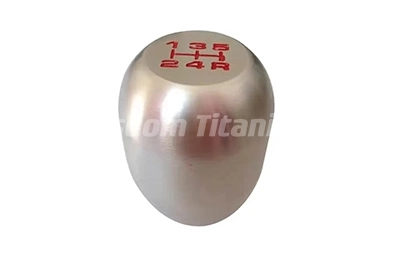
A titanium gear knob stands out as a precision-engineered automotive component crafted from aerospace-grade titanium alloy, typically Grade 5 (Ti-6Al-4V). What makes it exceptional is titanium's unique combination of ultra-lightweight construction, superior strength-to-weight ratio, and outstanding corrosion resistance. Precision CNC machining allows for customized designs with intricate gear tooth patterns or personalized engravings, while the material's natural tactile properties deliver consistent feedback during gear changes. Unlike plastic or conventional metal alternatives, titanium gear knobs maintain structural integrity under extreme temperature fluctuations and resist wear over extended use, making them the preferred choice for automotive manufacturers, modification shops, and performance enthusiasts seeking both functional excellence and aesthetic sophistication.
Understanding Titanium Gear Knobs: Composition and Core Benefits
What makes up a titanium gear knob has a direct effect on how well it works and how much it costs to buy. Knowing about these basic traits helps people who are buying cars make smart decisions about where to get their parts.
Material Composition: Grade 5 Titanium
Grade 5 titanium, which is also called Ti-6Al-4V, is made up of pure titanium, about 6% aluminum, and 4% vanadium. This particular mix has a tensile strength of more than 900 MPa and a mass of only 4.43 g/cm³, which is about 60% less than steel. The aluminum part makes it more resistant to rust, and the vanadium part makes it stronger and more stable at high temperatures. Aerospace companies have used this metal for decades in important jobs where failure is not a choice. When I look at gear knobs for use in cars, this track record gives me faith in their long-term dependability.
The precise CNC cutting process turns raw titanium bar stock into finished gear knobs with micron-level accuracy. Mills that are controlled by computers slowly remove material, making complex shapes that could not be made by casting or forging alone. This method of subtractive production also gets rid of any holes or other imperfections inside the structure that might weaken it.
Performance Advantages in Automotive Applications
It is possible to measure the performance benefits of titanium gear knobs, which directly lead to better drive dynamics and lower servicing costs. The qualities of the material make it useful in a number of operating areas.
Getting rid of extra weight is the most obvious effect. A normal titanium gear knob is 40–60% lighter than a stainless steel part of the same size and shape. This lowers the mass, which lowers rotational friction during gear changes. This lets the moves happen faster and more accurately. When racing teams move from parts made of other materials to ones made of titanium, they regularly report measurable improvements in shift timing. It's especially clear when there are fast changes in the order of events, because milliseconds add up to big advantages in the race.
Corrosion protection makes things last a lot longer. When titanium is introduced to oxygen, it forms a stable oxide layer. This layer acts as a barrier against chemical attack and can fix itself. This passive film doesn't change when the pH level changes from very acidic to very basic. I looked at titanium gear knobs that had been exposed to road salt, water, and high temperatures for years, and the surfaces were hardly worn down. In the same conditions, stainless steel parts show pitting and discoloration that weakens both their look and their structural stability.
Temperature steadiness makes sure that performance stays the same in all kinds of weather. Titanium holds its mechanical qualities from -200°C to +600°C without losing much of its power. In the summer, temperatures inside closed cars often reach over 70°C. In the north, temps drop below -30°C in the winter. In these temperature ranges, normal materials expand and shrink a lot, which could make threaded joints loose. Titanium has a low thermal expansion rate (8.6 × 10⁻⁶ /°C), which means that its dimensions don't change much and the installation stays safe no matter what the weather is like outside.
Ergonomic Design and Driver Experience
Beyond the qualities of the raw material, the form and finish of titanium gear knobs have a huge effect on how the driver interacts with them and how comfortable they are. Machined titanium has a natural texture that makes it easy to hold on to. It doesn't need any extra coats or processes that might wear off over time. The material's thermal conductivity (about 7 W/m·K) gives it a unique feel: it's noticeably cooler than aluminum in hot weather, but not too cold to drive on in the winter like bare steel.
Manufacturers can make knobs with the best shape for different hand sizes and grip tastes by using customized designs. CNC machining lets you make surfaces with complicated designs like knurling, gear tooth profiles, or natural curves that make them safer to hold. These features are useful in addition to looking good. They lower the amount of grip force needed during turns and keep drivers from getting tired after long drives.
The shift feel quality is affected by how the weight is distributed on a properly made titanium gear knob. Engineers can place the center of gravity perfectly by carefully removing material with precise machining. This creates a balanced feel that makes gear activation clear through haptic feedback. This level of tactile feedback is needed for performance driving; drivers need to be able to tell exactly when the synchronizers connect and the gears mesh without having to look.
Titanium Gear Knob vs Other Materials: A Detailed Comparison
To make choices about what to buy, you need to be able to compare different products objectively. Knowing the pros and cons of each titanium gear knob helps buyers match them to the needs of their applications and their budgets.
Weight and Strength Characteristics
Choosing the right material has a big effect on both the weight of the parts and their ability to support weight. The best way to compare things in automobile settings, where both strength and weight are important at the same time, is to use the strength-to-weight ratio.
The density of aluminum gear knobs is about 2.7 g/cm³, which makes them very light, but their tensile strength is much lower (200–400 MPa for popular car metals). Because of this, aluminum parts need to have bigger cross-sections to be as strong as other materials, which often cancels out the density benefit. After some light use, I've seen metal gear knobs get surface wear and thread damage. This happens most often when they are used in high-torque situations or when they were installed too tightly.
Even though stainless steel is very strong (500–800 MPa based on grade), it is also very heavy (8.0 g/cm³ density). During shifts, the extra mass creates visible motion, which makes it less accurate and requires more force to change directions quickly. This delay is bad for performance applications that want to be able to respond to shifts. Also, because stainless steel conducts heat more efficiently, these buttons get too hot or too cold when they are subject to temperature changes.
The weight decrease of carbon fiber composite gear knobs is amazing; they are sometimes as light as or lighter than titanium. But carbon fiber has directional strength qualities, which means it is very strong along the fiber orientation but weak when viewed perpendicular to the fiber layup. The threaded part that is needed for fixing makes a point where two different types of material could fail. Extreme temperatures can make the carbon core and metal pieces expand at different rates, which can cause them to loosen or crack over time.
Titanium has the best mix of strength and weight. It is about half as heavy as most grades of stainless steel and has the same qualities in all directions. This mix lets designers cut down on the amount of material needed while keeping the structure strong and the thread contact strong.
Corrosion Resistance and Environmental Durability
Longevity has a direct effect on the total cost of ownership and the amount of upkeep that needs to be done. How long a material lasts and how well it looks depend on how resistant it is to natural damage.
The inactive oxide layer of titanium is better at protecting than other materials. Stainless steel needs chromium content (18%) to make a protected layer. However, chloride ions from road salt can get through this barrier and start rusting in one spot. Once it starts, pitting rust in stainless steel moves quickly, weakening the structure and making sides that are too sharp to hold comfortably.
Aluminum forms a protective oxide layer, but it can still be damaged by galvanic rust when it comes into contact with metals that are not the same. This happens a lot when aluminum gear knobs are attached to steel shift handles in cars. Electrochemical processes speed up the loss of material at the junction, which could lead to seizure or loosening. To stop galvanic pairs, proper installation needs isolation washers and anti-seize compounds, which make things more complicated and increase the need for upkeep.
Carbon fiber materials don't rust when exposed to chemicals, but they do break down in UV light and absorb water. Long-term contact to sunshine breaks down the polymer matrix, which makes the surface chalk and weakens the material. Delamination between fiber layers can happen when moisture gets in through tiny cracks. These failure modes move forward without being seen until the structure suddenly breaks.
Titanium stays stable in all conditions found in cars, even without coats or regular upkeep. The material works the same whether it's exposed to salty air from the coast, pollution from factories, or hard winter road repairs. This natural durability lowers lifetime costs and stops the wear and tear that lowers the quality of the inside of a car over time.
Cost Considerations and Value Analysis
The cost of titanium's raw materials is higher than those of other materials. For example, Grade 5 titanium bar stock is usually 5–8 times more expensive than stainless steel of the same size and 15–20 times more expensive than aluminum. But a full value study must look at more than just the price of the materials. It must also look at how efficiently they are made, how long they last, and how well they work.
The amount of time spent on CNC cutting has a big effect on production costs. Titanium can only be cut at about 40% of the speed of aluminum, so it needs special tools and cutting methods. The cost per unit goes up because the making process takes longer. But titanium's higher strength lets wall sections be thinner and material volumes be smaller, which partly makes up for the longer time it takes to machine. Precision makers, like Wisdom Titanium, have come up with ways to make their processes more efficient so that they can keep production costs low while still meeting tight standards.
Costs change a lot when you think about how long something will last. A titanium gear knob will usually last three to five times longer than an aluminum one and two to three times longer than a stainless steel one. When spread out over the life of the object, the cost boost goes down a lot. Performance situations where a broken part could lead to expensive downtime or safety risks are a good reason to spend money on materials that are reliable.
Positioning of a brand also affects how people see its value. Customers who buy high-end or racing cars expect materials that show quality and care. Titanium parts have a unique look and feel that helps people remember the name and are happy with their purchases. When automakers go after niche markets, they find that titanium parts set their products apart in a way that supports charging more.
Conclusion
Titanium gear knobs are the result of excellent material science and precise manufacturing coming together to make a product with real performance benefits that support its high price. Grade 5 titanium has special qualities that make it valuable in the car supply chain. These include an extremely high strength-to-weight ratio, natural resistance to rust, and a longer service life. To make the best sourcing choices, you need to look at things like material certificates, how they are made, and how reliable the supplier is. Following proper setup and upkeep will make these parts last a long time while keeping your car performing at its best for years. As more people start using them and making methods get better, titanium parts will become the standard for quality in high-end cars.
Upgrade Your Automotive Components with Wisdom Titanium
Wisdom Titanium delivers precision-engineered titanium gear knobs that meet the demanding requirements of automotive manufacturers, modification shops, and performance enthusiasts. As an ISO 9001-certified titanium gear knob manufacturer located in Baoji Titanium Valley—the world's most comprehensive titanium production center—we maintain complete control over quality and supply chain stability. Our aerospace-grade Grade 5 titanium components feature precision CNC machining with tolerances to ±0.05mm and extensive customization options including logo engraving, surface treatments, and geometric optimization. With dedicated engineering support, competitive bulk pricing, and reliable international shipping, we provide complete solutions for your titanium component requirements. Contact our technical team at sales@wisdomtitanium.com to discuss your specifications and receive detailed quotations tailored to your volume and customization needs.
FAQ
Can titanium gear knobs fit all manual transmission vehicles?
Titanium gear knobs accommodate most manual transmissions using standard M10x1.25 or M12x1.25 thread specifications. However, some vehicles use proprietary threads or reverse-threaded connections that require verification before ordering. Measuring your existing shift lever threads or consulting vehicle service documentation ensures proper compatibility. Custom threading options are available for non-standard applications, though minimum order quantities may apply. Thread adapters provide alternatives for unusual specifications without custom manufacturing.
How does the lifespan of titanium gear knobs compare to stainless steel or aluminum?
Titanium gear knobs typically outlast aluminum alternatives by 3-5 times and stainless steel by 2-3 times under equivalent operating conditions. Titanium's corrosion resistance and fatigue strength prevent the degradation modes that eventually compromise other materials—aluminum develops thread wear and surface corrosion within 3-5 years, while stainless steel shows pitting and thread damage after 7-10 years. Properly installed titanium components often remain fully functional for decades, frequently outlasting vehicle ownership periods. This extended service life reduces replacement costs and maintenance intervals significantly.
What customization options are available for titanium gear knobs?
Extensive customization includes dimensional modifications (diameter, height, contour), surface finishes (bead blasted, polished, anodized), and branding integration through laser engraving. Logo engraving reproduces complex graphics with permanent marks visible throughout product life. Anodizing creates controlled color variations from natural titanium gray through gold, blue, and purple tones. Geometric customization optimizes ergonomics for specific hand sizes or grip preferences. Thread specifications can be modified to match non-standard transmissions. Minimum order quantities for highly customized designs typically start around 50-100 units depending on tooling requirements.
References
1. Boyer, R., Welsch, G., & Collings, E.W. (1994). Materials Properties Handbook: Titanium Alloys. ASM International, Materials Park, Ohio.
2. Donachie, M.J. (2000). Titanium: A Technical Guide, 2nd Edition. ASM International, Materials Park, Ohio.
3. Lutjering, G. & Williams, J.C. (2007). Titanium, 2nd Edition. Springer-Verlag, Berlin Heidelberg.
4. Veiga, C., Davim, J.P., & Loureiro, A.J.R. (2012). Properties and Applications of Titanium Alloys: A Brief Review. Reviews on Advanced Materials Science, 32(2), 133-148.
5. Peters, M., Kumpfert, J., Ward, C.H., & Leyens, C. (2003). Titanium Alloys for Aerospace Applications. Advanced Engineering Materials, 5(6), 419-427.
6. Rack, H.J. & Qazi, J.I. (2006). Titanium Alloys for Biomedical Applications. Materials Science and Engineering C, 26(8), 1269-1277.




