
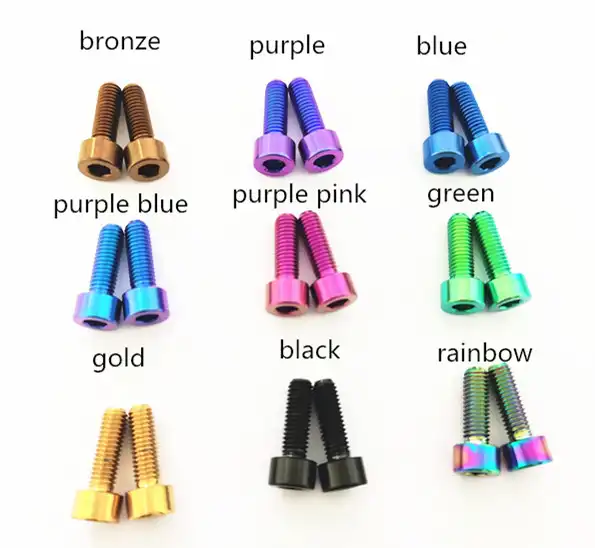
The titanium allen head bolt is a great example of how contemporary material science can satisfy the needs of industry. These specialty fasteners have aerospace-grade performance and can be used in a wide range of industries. Knowing how to use Grade 5 titanium fasteners can make a big difference in the success of any project, whether you're putting together marine equipment or manufacturing high-performance machinery.
Understanding Grade 5 Titanium Allen Head Bolts
Material Composition and Properties
The unique qualities of Grade 5 titanium come from its well-calibrated mix of chemicals. The aluminum part works as an alpha stabilizer, making the material stronger and less dense. Vanadium is a beta stabilizer that makes things more ductile and easier to shape. These components combine to make an alloy that is stronger than 900 MPa, or about 130,000 psi. This substance is only 60% as heavy as steel alloys, but it is just as strong.
The natural oxide layer on titanium allen head bolts sets them apart from other types of fasteners. When titanium comes into contact with oxygen, it automatically creates a protective covering of titanium dioxide (TiO₂). If this passive layer is damaged, it swiftly heals itself, which protects against corrosion all the time. The material can withstand seawater, chlorides, and most industrial chemicals; it can be used in places where stainless steel would eventually fail.
Design Features of DIN912 Standard
The DIN912 standard says that socket head cap screws with internal hexagonal drives should be used for most titanium allen head bolts. Compared to regular external hex heads, this design has a lot of benefits. The cylindrical head profile fits snugly or recessed into assemblies, making smooth surfaces that don't catch on anything. The deep hexagonal socket transfers more torque than external drives, which lets you tighten it properly without stripping it.
The shape of the socket is quite useful in tight situations. Technicians can get to the bolts from straight above without having to make room for wrenches to swing. This makes it easier to install and lets you put fasteners in places that regular hex heads can't reach. Most of the time, thread specifications follow ISO metric standards. In industrial settings, the most frequent diameters are M3 through M24.
Manufacturing Process and Quality Control
To make titanium allen head bolts, you need particular manufacturing skills. The procedure starts with high-purity titanium rod stock that is CNC machined to make the head contour and socket recess. When threading titanium, you need to use the right tools and cutting speeds because it tends to work-harden. For looks, you can polish the surface, and for color identification, you can anodize it.
Good manufacturers have strict testing procedures in place during the whole production process. Tensile testing makes sure that the produced bolts are strong enough to fulfill minimum standards. Dimensional inspections make sure that the threads are correct and that the sockets are the right depth. Material certification documents link each batch of manufacturing to the source ingot, making it possible to hold people accountable and check materials when industry standards or client specifications call for it.
Applications Across Critical Industries
Aerospace and Aviation Engineering
The aircraft sector was the first to use titanium fasteners decades ago. Aircraft makers utilize titanium allen head bolts a lot in control systems, engine parts, and structural assembly. Every gram saved in building an airplane means that it will use less fuel over its lifetime. Grade 5 titanium is as strong as structural steel but weighs about half as much as fasteners.
Materials used in flight-critical applications must be able to handle vibration, severe temperatures, and possible exposure to corrosive fluids. Titanium fasteners stay strong during thousands of flight cycles and don't rust when they come into contact with hydraulic fluids, aviation fuels, or moisture in the air. Their non-magnetic qualities keep them from interfering with sensitive navigation and communication devices, which adds additional practical benefit.
Marine and Offshore Applications
Seawater is one of the most difficult places for corrosion to happen. The salt content, the amount of oxygen, and the marine life all work together to damage regular fasteners. In these settings, titanium allen head bolts work quite well. They have been shown to last more than 20 years in polluted seawater without appreciable wear and tear. The material doesn't corrode or pit even one mile below the ocean surface or when marine growth grows directly on the fastener surface.
Boat builders and operators of offshore platforms use titanium fasteners for equipment that is exposed to splash zones, changing tides, and continual dampness. The bolts stay strong even when seawater moves at speeds of up to 120 feet per second, which is much faster than stainless steel can handle. This performance gets rid of the need for maintenance cycles that come with replacing rusted fasteners, which lowers the cost of owning the item over time, even though the original cost is higher.
Automotive and Motorsports Performance
More and more, high-performance vehicles are being built with titanium fasteners because they help reduce weight, which gives them an edge over other vehicles. In racing, titanium allen head bolts are used in suspension parts, brake assemblies, and engine internals. Taking off a pound from rotational or reciprocating loads makes acceleration, handling, and fuel economy better. Engineers can make structures lighter without giving any safety margins thanks to the strength-to-weight ratio.
In motorsports, parts are put through a lot of vibration, temperature changes, and mechanical stress. Titanium fasteners stay tight even after many heat cycles and don't come loose from vibration. The material's high fatigue strength means that bolts can handle being loaded over and over again without cracking. These qualities mean that the equipment is more reliable and needs less maintenance during competitive seasons.
Selecting the Right Titanium Allen Head Bolts
Size and Specification Considerations
To choose the right fastener, you first need to know what your application needs in terms of mechanics. Find out how much shear and tensile load the joint can handle, and then choose the right bolt diameter and grade. At the same weight, Grade 5 titanium is about twice as strong as commercially pure Grade 2 titanium and four times as strong as 316 stainless steel.
The length of the thread on a fastener affects how well it fits into tapped holes or with mating nuts. Full-thread bolts provide you the most flexibility, but they could make important joints less strong against shear. Partial-thread designs provide most of the strength in the shank while still allowing for enough thread engagement to make sure the assembly is strong. Length criteria should take into account the length of the grip, the thickness of the washer, and the thread engagement needs, but they shouldn't stick out too much, which could cause problems or injuries.
Surface Finish Options
There are different surface treatments for titanium allen head bolts that change how they look and work. Polished finishes look nice and make surfaces smoother, which helps them withstand contamination and corrosion. Anodized coatings make colorful oxide layers that let you tell them apart and make the surface a little harder. Depending on how thick the coating is, the colors can be bronze, blue, purple, or gold.
Some applications need special surface treatments. Nitriding procedures make surface layers that are very hard and don't wear down easily in places with a lot of friction. For medicinal uses, chemical treatments can make biocompatibility better. Talk to your supplier about surface finish needs early on in the design phase. Some treatments may change the tolerances for dimensions or need a minimum order quantity.
Certification and Traceability Requirements
Industries that have strict quality standards often need proof of material certification. Aerospace, medical, and defense applications usually need test reports that prove the chemical makeup, mechanical qualities, and traceability of the production lot. ISO 9001 accreditation shows that manufacturers have quality management systems in place that cover every part of the production process.
When you need titanium allen head bolts for important uses, ask for mill test papers that prove the grade and qualities of the material. Certification should have heat numbers that connect fasteners to certain production batches. This ability to track things back lets you look into quality problems if they come up and shows that you follow industry standards during audits. Reputable vendors keep thorough records to meet these needs without needing to be asked.
Partner with Baoji Wisdom Titanium for Quality Fasteners
Baoji Wisdom Titanium Industry and Trading Co., Ltd. located in China's famous Baoji Titanium Valley. It combines the best manufacturing in the area with the best service standards in the world. Our company has been ISO 9001 certified since 2016 and works in a wide range of fields, such as aerospace, energy, marine engineering, medical device manufacturing, and automotive.
Our main product line is based on titanium allen head bolts made to DIN912 standards. We make fasteners out of Grade 2, Grade 5, and Grade 7 titanium. The threads range from M3 to M24 and the lengths range from 5mm to 100mm. There are many ways to finish the surface, including as polishing, anodizing, or making it look the way you want it to for a certain use.
For making fasteners, Baiji Titanium Valley has advantages that no other place can match. There are hundreds of titanium businesses in the area, making it China's most concentrated industrial hub. This whole industrial chain goes from making titanium sponge to making precision-engineered parts. This ecosystem helps our facility by giving us access to high-quality raw materials and specialized knowledge that isn't available in most places around the world.
For inquiries about our titanium allen head bolts or to discuss custom requirements, contact our sales team directly. Email sales@wisdomtitanium.com with your specifications, and we'll provide detailed quotations including technical recommendations for your application.
FAQs
Q1: Why is Grade 5 titanium better than stainless steel for fasteners?
A: Grade 5 titanium is about four times stronger than 316 stainless steel while weighing roughly half as much. It also offers excellent corrosion resistance, especially in marine and harsh environments, making it ideal for weight-critical applications.
Q2: Can titanium Allen head bolts be reused?
A: In many industrial applications, titanium bolts can be reused if threads show no damage or galling. For critical uses such as aerospace or medical applications, reuse is generally not recommended.
Q3: How can galling be prevented when installing titanium bolts?
A: Use a titanium-compatible anti-seize lubricant, install bolts slowly, and avoid excessive tightening. Using dissimilar materials for mating parts also helps reduce galling.
Q4: What torque values should be used for Grade 5 titanium bolts?
A: Titanium bolts are typically torqued to about 60–70% of the torque used for equivalent steel bolts. Always follow manufacturer torque charts and use proper lubrication.
Q5: Are titanium Allen head bolts suitable for high-temperature applications?
A: Grade 5 titanium performs well up to about 400°C (752°F). Prolonged exposure above 540°C (1000°F) may reduce strength, so alternative materials may be required for higher temperatures.
References
- KD Fasteners, Inc. "CP Titanium Hex Head Bolt Supplier - Grade 5 Titanium Hex Bolt." Accessed December 2025.
- Extreme Bolt & Fastener. "Titanium Grade 5 Fasteners & Flanges." Accessed December 2025.
- ACER Racing. "Titanium Screws | Aerospace Grade 6AL4V Titanium Bolts & Titanium Nuts." Accessed December 2025.
- Boltbase. "Socket Cap Screws Your Complete Guide To DIN 912." November 2024.
- Flybear Fastener. "Titanium Alloy Fasteners: High-Strength Lightweight Solution." July 2025.




