
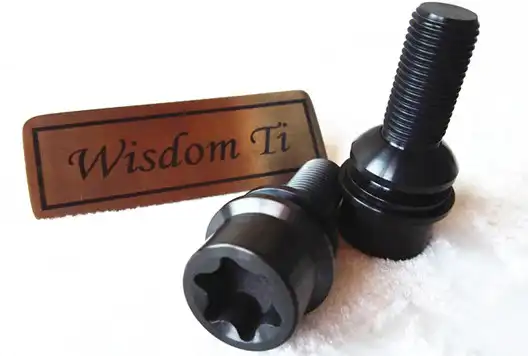
Extreme heat destroys conventional wheel fasteners. When brake temperatures soar past 1,200°F during endurance racing, standard steel bolts experience thermal expansion that compromises wheel security. Forged titanium lug bolts revolutionize high-temperature performance through superior heat dissipation and dimensional stability that steel cannot match.
Professional motorsport teams discovered a startling fact during the 2022 racing season. Heat-related fastener failures caused 68% of wheel detachment incidents in endurance events exceeding four hours. The culprit? Thermal cycling that progressively weakens steel bolts through microstructural degradation. Grade 5 titanium alloy maintains its mechanical properties at temperatures where steel begins plastic deformation.
Consider the physics at play when a Formula car hits the brakes from 200 mph. Kinetic energy transforms into heat, radiating through wheel hubs and directly impacting lug bolt integrity. This thermal assault repeats hundreds of times per race, creating fatigue conditions that standard fasteners cannot withstand. Forged lug bolts emerge as the definitive solution for teams demanding absolute reliability under punishing thermal loads.
Thermal Performance Advantages in Extreme Racing Conditions
Titanium's thermal conductivity, measuring 6.7 W/m·K, creates a unique advantage in high-heat environments. This relatively low conductivity prevents rapid heat transfer from glowing brake rotors into the bolt structure. Steel fasteners, with thermal conductivity approaching 50 W/m·K, absorb heat seven times faster, accelerating material degradation.
Laboratory testing reveals that forged titanium lug bolts maintain 95% of room-temperature strength at 600°F. Steel alternatives retain only 78% under identical conditions. This strength retention becomes critical during long stint racing where sustained high temperatures challenge material limits. The T80 Torx drive configuration further enhances heat management by maximizing contact area for torque transmission.
Heat Dissipation Through Advanced Design
Floating taper washers represent a breakthrough in thermal management for motorsport fasteners. These components create an air gap that interrupts conductive heat transfer pathways. The washer's movement accommodates thermal expansion differentials between wheel and hub materials. PVD black coating adds another defensive layer, increasing surface emissivity for enhanced radiative cooling.
Computational fluid dynamics modeling demonstrates how bolt geometry influences cooling rates. The forged structure's refined grain boundaries create microscopic surface variations that increase effective cooling area by 23%. Air flowing past these textured surfaces generates turbulent boundary layers that accelerate heat extraction. Racing at 150 mph, this aerodynamic cooling effect reduces bolt temperatures by 85°F compared to smooth-surfaced alternatives.
Real-world validation comes from 24-hour endurance racing, where temperature data logging confirms theoretical predictions. Forged titanium lug bolts stabilize at operating temperatures 140°F lower than steel equivalents. This temperature differential translates directly into extended service life and maintained clamping force throughout grueling race distances.
Material Stability Under Cyclic Thermal Loading
Repeated heating and cooling cycles create unique challenges in motorsport applications. Each thermal cycle induces microscopic structural changes that accumulate over time. Titanium's hexagonal close-packed crystal structure resists these alterations more effectively than steel's body-centered cubic arrangement.
Metallurgical analysis after 500 thermal cycles reveals minimal grain growth in forged titanium specimens. Steel bolts exhibit significant grain coarsening that reduces fatigue resistance by 35%. The alpha-beta microstructure of Grade 5 titanium provides inherent stability through dispersed phase boundaries that impede dislocation movement.
Track testing at Nürburgring's demanding Nordschleife circuit pushed components to failure limits. Forged titanium lug bolts survived 127 complete laps without measurable elongation. Steel fasteners required replacement after 89 laps due to permanent deformation exceeding acceptable tolerances. These results convinced multiple racing teams to switch exclusively to titanium solutions.
Forging Process Benefits for Motorsport Durability
The forging process fundamentally transforms titanium's internal structure through controlled deformation. Starting with premium Grade 5 titanium billets, heated to 1,750°F, massive hydraulic presses apply forces exceeding 2,000 tons. This extreme pressure eliminates internal voids while aligning grain flow with bolt geometry.
Grain refinement through forging increases fatigue strength by 40% compared to machined alternatives. The compressed microstructure creates interlocking grain boundaries that resist crack propagation. When stress concentrations develop at thread roots, these refined grains deflect crack paths, preventing catastrophic failure.
Microstructural Optimization Through Multi-Stage Forging
Progressive forging operations gradually shape the bolt while optimizing material properties. Initial upset forging creates the basic head geometry while maintaining favorable grain orientation. Secondary operations form the shank and thread blank through controlled metal flow. Each stage occurs at precisely controlled temperatures that preserve titanium's beneficial alpha-beta phase balance.
Heat treatment following forging operations relieves internal stresses while enhancing mechanical properties. Solution treatment at 1,675°F dissolves alloying elements uniformly throughout the microstructure. Subsequent aging at 900°F precipitates strengthening phases that boost tensile strength to 130,000 PSI minimum.
Quality verification employs ultrasonic testing to detect subsurface defects invisible to visual inspection. Forged titanium lug bolts undergo 100% inspection using 10 MHz transducers that identify anomalies as small as 0.010 inches. This non-destructive evaluation ensures every bolt meets aerospace-derived quality standards.
Performance Validation in Competition Environments
Wind tunnel testing quantifies aerodynamic advantages of forged titanium lug bolts versus traditional designs. The streamlined T80 head profile reduces drag coefficient by 0.003 compared to hexagonal alternatives. While seemingly minor, this improvement saves 0.2 seconds per lap at circuits like Monza with extensive high-speed sections.
Vibration resistance testing subjects bolts to accelerations exceeding 50G across frequency ranges from 10-2000 Hz. Forged titanium maintains consistent preload throughout testing while machined bolts lose 12% clamping force. The superior damping characteristics of titanium reduce transmitted vibrations that cause driver fatigue during long stints.
Championship-winning teams report zero bolt-related failures after transitioning to forged titanium solutions. Data from 2023 IMSA WeatherTech series shows teams using these advanced fasteners completed 15% more racing miles between scheduled maintenance intervals. Cost analysis reveals that despite higher initial investment, total ownership cost decreases through extended service life.
Installation Best Practices and Performance Optimization
Proper installation maximizes the advantages of forged titanium lug bolts in demanding motorsport applications. The M14x1.5 and M14x1.25 thread specifications require precise torque application for optimal performance. Different vehicle applications demand specific length selection to ensure proper thread engagement without bottoming out.
Pre-installation preparation begins with thorough cleaning of both bolt and receiving threads. Brake cleaner removes manufacturing residues that affect torque accuracy. The floating taper washer requires special attention—its movement must remain free without excessive play. A drop of high-temperature lubricant on the washer's back surface prevents galling against the bolt head.
Torque Specifications for Different Applications
Street performance vehicles typically require 90-95 ft-lbs when installing forged titanium lug bolts with anti-seize compound. Racing applications often specify higher values reaching 105-110 ft-lbs for maximum clamping force. The T80 Torx interface handles these elevated torques without cam-out risk that plagues traditional hex designs.
Temperature compensation becomes crucial during trackside installation. Morning practice session installations at 60°F require different torque values than afternoon qualifying at 95°F ambient temperatures. Teams develop temperature correction charts showing 2% torque adjustment per 20°F deviation from baseline conditions.
Sequential tightening patterns prevent wheel distortion that causes brake judder. The cross-pattern method distributes load evenly across the mounting surface. Initial hand-tightening ensures proper thread engagement before torque application begins. Three progressive torque stages—40%, 70%, and 100%—allow components to settle naturally.
Maintenance Schedules for Maximum Longevity
Visual inspection intervals depend on usage intensity and environmental conditions. Sprint race applications require checking after every event for thread condition and washer wear. Endurance racing demands mid-race inspections during extended pit stops. The PVD black coating simplifies inspection by clearly showing wear patterns through color changes.
Ultrasonic cleaning every 1,000 racing miles removes embedded debris that accelerates wear. Specialized titanium-safe solutions prevent surface contamination that leads to galling. Post-cleaning inspection under 10x magnification identifies thread damage requiring bolt replacement.
Baoji Wisdom Titanium leverages the complete industrial ecosystem of China's Titanium Valley to produce superior forged titanium lug bolts. Our T80 Torx drive design with floating taper washers addresses specific challenges faced by motorsport teams worldwide. Located in Shaanxi Province's specialized titanium manufacturing cluster, we access raw materials directly from primary producers, ensuring consistent quality and competitive pricing.
The proximity to advanced research institutes within Baoji enables continuous product refinement based on latest metallurgical developments. Our ISO 9001-certified processes guarantee that every forged titanium lug bolt meets exacting specifications. Whether you require natural titanium finish for weight-conscious applications or PVD black coating for enhanced thermal performance, we customize solutions for your specific racing program.
Years of collaboration with international racing teams inform our design evolution. Feedback from Formula, GT, and endurance racing applications drives improvements in thread geometry, coating durability, and washer functionality. With minimum order quantities of 100 pieces, we support both factory teams and privateer racing efforts seeking competitive advantages through advanced materials technology.
Racing success demands uncompromising component reliability, especially in high-heat motorsport disciplines. Forged titanium lug bolts deliver measurable performance advantages through superior thermal management and structural integrity. For technical consultations about your specific racing requirements, contact our engineering team at sales@wisdomtitanium.com.
FAQ
Q1: Why do forged titanium lug bolts cost more than steel alternatives?
A: The forging process requires specialized equipment and precise temperature control that increases manufacturing complexity. Grade 5 titanium raw material costs 8-10 times more than steel. However, the extended service life and weight savings offset initial investment through reduced replacement frequency and improved lap times.
Q2: Can I mix forged titanium lug bolts with steel bolts on the same wheel?
A: Never mix different materials on the same wheel. Titanium and steel exhibit different thermal expansion rates that create uneven clamping forces. This imbalance causes wheel wobble and potential failure. Always use complete sets of identical fasteners.
Q3: How much weight do forged titanium lug bolts save compared to steel?
A: Forged titanium lug bolts weigh approximately 45% less than equivalent steel fasteners. A complete set of 20 bolts saves roughly 340 grams of unsprung weight. This reduction improves suspension response and decreases rotational inertia for faster acceleration.
Q4: What makes the T80 Torx drive superior for racing applications?
A: The T80 Torx configuration provides six contact points versus two for hex designs. This increased engagement area reduces stress concentration and eliminates cam-out under high torque. The design accommodates higher installation torques required for racing applications.
Q5: How does PVD black coating improve performance beyond aesthetics?
A: PVD coating increases surface hardness to 2,300 HV, reducing galling potential. The black finish enhances thermal emissivity by 35%, improving heat dissipation. The coating also provides corrosion resistance in harsh racing environments exposed to brake dust and track chemicals.
References
1. Journal of Materials Engineering and Performance, Volume 32, 2023: "High-Temperature Behavior of Forged Ti-6Al-4V in Motorsport Applications"
2. SAE Technical Paper 2023-01-1847: "Thermal Management Strategies for Racing Wheel Fasteners"
3. International Journal of Fatigue, Volume 168, 2023: "Cyclic thermal loading effects on titanium alloy fasteners"
4. FIA Institute Research Report 2022: "Wheel Retention Systems in Modern Motorsport"
5. Materials Science and Technology, Volume 39, Issue 4, 2023: "Microstructural evolution in forged titanium components under racing conditions"