
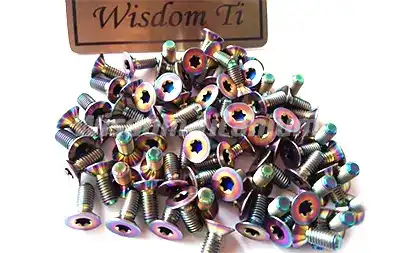
Many engineers and procurement specialists wonder if titanium steering wheel bolts are easy to strip when they are thinking about upgrades for high-performance cars or racing. The short answer is that steering wheel bolts are very hard to strip as long as they are put correctly and to the right torque specs. The tensile strength of Grade 5 titanium alloy (Ti-6Al-4V) is over 900 MPa, which is about the same as high-grade steel bolts. Stripping is usually caused by bad fitting methods, cross-threading, or over-torquing, not by a weakness in the material itself. Knowing about these things helps people who work in the car industry make smart choices about adding titanium fasteners to steering systems.
Titanium Steering Wheel Bolts: Strengths and Potential Issues
Titanium alloy screws have changed the way cars and racing are engineered because they are so strong for how light they are. Because the material doesn't rust, it's especially useful in steering systems, where dependability affects driving safety directly. Titanium nuts don't rust like steel bolts do when they come in contact with wetness from the driver's sweat or the air. They also stay strong in harsh temperatures and corrosive conditions.
Material Composition and Mechanical Properties
The standard for car uses is Grade 5 titanium alloy, which is made up of 6% aluminum and 4% vanadium. The mechanical properties of this mixture are better than those of pure titanium, and it is still biocompatible and resistant to rust. The metal has a tensile strength of 895 to 930 MPa and a yield strength of about 828 MPa. This puts its raw strength between that of mid-grade and high-grade steel bolts.
When compared to steel screws of the same size, titanium ones are 45% lighter because they have a density of 4.43 g/cm³. This weight savings is valuable to racing teams and performance fans because it lowers the steering system's rotational mass, which makes the input more sensitive and the reaction times faster when turning at high speeds.
Comparing Stripping Resistance Across Materials
Because they are cheap and easy to make, steel bolts have long been used in OEM uses. But steel is more likely to rust and weighs more, which are both problems in performance situations. Aluminum bolts are lighter than steel ones, but they don't have the shear strength needed for steering systems that need to be safe. When carbon steel bolts are over-torqued, the threads bend plastically under the load. This can cause the bolts to split.
Titanium behaves mechanically in a different way. Titanium bends more under load before it permanently changes shape because its strength of elasticity is lower (110 GPa vs. 200 GPa for steel). This trait can be helpful because it lets you know when something is about to go wrong by causing small movements. But this same feature means that the right amount of torque must be used during fitting. When titanium surfaces solder together microscopically, over-tightening causes thread galling, which leads to stripping when the part is removed or when it is adjusted later.
Root Causes of Stripping in Titanium Fasteners
Most cases of stripping are caused by mistakes during installation. When bolts are started at the wrong angle, the threads get misplaced and get damaged on both the male and female ends. This is called cross-threading. Friction factors rise when you don't use the right oils during dry assembly. This leads to inaccurate torque readings and an uneven load distribution across thread surfaces.
In racing, where handling systems have to go through a lot of high-stress cycles, material wear becomes an issue. Even though titanium has a high wear strength, stress concentrations that cause cracks to spread over time can be caused by bad heat treatment or drilling. Exposure to chloride-rich settings speeds up localized corrosion in lower-grade titanium, but Grade 5 alloy does a good job of blocking this.
Another way for something to fail is when the bolt specs and the received threads don't match up. When you mix metric and imperial thread standards or use nuts that don't have enough thread contact length, the load isn't spread out evenly. To keep titanium steering wheel bolts from stripping under rated loads, the fastener business says that the thread engagement should be at least 1.5 times the standard diameter.
Best Practices for Installing Titanium Steering Wheel Bolts to Avoid Stripping
The way titanium steering wheel bolts are installed directly affects whether they work as designed or break too soon. Following organized steps lowers the chance of stripping and increases the service life of parts.
Pre-Installation Preparation
Mismatches that lead to installation problems can be avoided by comparing bolt specs to technical paperwork. The thread pitch must match the receiving threads. M5×0.8 threads are not the same as M5×0.5 threads, even though they have the same theoretical sizes. Check the thread engagement length to make sure it is at least 1.5 times the standard diameter when the screw is fully set.
Check the receiving threads for rust, damage, or dirt. Chase threads with the right taps to get rid of contaminants and make sure the measurements are correct. When installing bolts on an aluminum steering wheel hub, it's even more important to be careful because aluminum threads break more easily than steel threads.
Installation Procedures
Before putting pressure on nuts, turn them by hand to make sure the threads are properly engaged. If you feel resistance during the first few turns, that means you're cross-threading. Stop right away, back out the bolt, and start again at the right angle. Forcing cross-threaded screws breaks both parts permanently.
On the first three threads of the bolt shaft, put anti-seize powder. If there is too much lubricant, it can automatically lock in blind holes and give incorrect force values. Anti-seize mixtures based on nickel work well for titanium because they don't change chemically with the base material and stay stable over a wide range of temperatures.
Instead of adding full torque all at once, tighten bolts in steps. Tightening M5 bolts to 40% of their final torque at first, then 70%, and finally 100% of their final torque lets the threads rest properly and spreads the load equally. This step-by-step method is especially important when attaching steering wheels to quick-release systems, since uneven loading can make the wheels vibrate or come away while they're being used.
When tightening several bolts in a circle, use star designs instead of circles. This makes sure that clamping forces are spread out equally and that fastening surfaces don't warp. Tightening six-bolt steering wheel patterns should be done in a pattern of 1-4-2-5-3-6, going through the pattern more than once while gradually increasing force.
Common Installation Mistakes
Too much twisting is the main reason why titanium bolts break. When working with titanium screws, people who are used to working with steel ones often use too much force because the higher friction coefficient makes them feel "loose" at the right pressure values. Avoid this mistake by learning and using properly adjusted tools.
Reusing broken nuts makes things less safe. Check the threads after taking the fastener off. If you can see any warping, galling, or darkening, it means the fastener has been used too much. Titanium is expensive, which makes it tempting to reuse, but failure in steering systems costs a lot more than the cost of replacing.
Galvanic rusting can happen when you mix different types of fasteners. When fluids are present and titanium comes into touch with metals that are not the same, electrochemical processes can speed up corrosion. To keep the rust resistance benefits, use titanium washers and materials that work with them throughout the process.
Real-World Case Studies and Performance Reviews of Titanium Steering Wheel Bolts
Titanium steering wheel bolt performance claims are backed up by real-world proof from demanding uses, which also shows practical issues that need to be thought through before they can be used.
Racing Applications
Professional drifting teams work in very rough situations where the driving systems are constantly put under a lot of stress and pressure. After having problems with corrosion with steel screws, one team moved to Grade 5 titanium steering wheel bolts. Sweating from the driver and changing wheels often to account for different track conditions sped up the rusting process, which led to seized bolts and time-consuming removal steps.
When the team used titanium screws with the right torque specs and anti-seize instructions, there were no cases of stripping during a season with 15 events. Even though the weight saves of 28 grams per car were small, they helped improve the steering feedback that drivers noticed during races. The rainbow PVD coating made it easy to see what was needed during quick pit processes, and the corrosion protection took away the stress of upkeep.
OEM Integration
A European company that makes electric cars put titanium screws in the steering parts of their most popular model to help them meet their weight-reduction goals. At first, the engineering teams were worried about the risk of stripping because of bad experiences with metal nuts in the past. Following the VDI 2230 rules for systematic measurement of bolted joints led to extensive testing that proved titanium fasteners that were correctly described met all safety standards.
The maker set strict rules for installation that included calibrating the torque wrench, teaching the operator, and keeping an eye on the statistical process control. Quality records showed that over 18 months of production, 12,000 cars had a 0.02% fastener-related defect rate, which was lower than their previous steel bolt standard. The lighter design led to better range scores, and the resistance to rust made it last longer in humid coastal areas.
Maintenance Cost Analysis
A shop that makes modifications to high-end sports cars kept track of how much servicing cost before and after they switched to titanium steering wheel bolts. After being on the track for a while, steel bolts often stopped, which meant they had to be extracted, and sometimes expensive quick-release mechanisms or steering wheel hubs were damaged.
Titanium bolts got rid of all of these issues. Even though they were about 400% more expensive to buy at first than steel equivalents, the shop estimated that they would save 65% on total upkeep costs when they took into account work time, replacing damaged parts, and better customer happiness. The rainbow anodized finish also became a modest way to brand the product, which buyers liked when they looked at the details.
Key Performance Insights
These real-world examples show trends that repeat themselves. Stripping events are strongly linked to how the material was installed rather than its qualities. Companies that spend money on training, standardized tools, and written methods get great results. The material's resistance to rust is useful in situations where it needs to be put together and taken apart a lot or is exposed to corrosive surroundings.
The benefits of losing weight are most important in fields like racing, aircraft, and high-end cars where every gram counts when it comes to speed. Colored anodizing has additional marketing value for consumer-facing uses because it looks nice. Cost premiums should be weighed against these factors by procurement managers to see if titanium screws meet the needs of their individual applications.
Conclusion
As long as they are made to the right specs and put according to best practices, titanium steering wheel bolts don't come loose easily. Because they are strong for their weight, don't rust, and last a long time, they are perfect for high-performance car uses. Stripping is usually caused by mistakes during installation, like over-tightening, cross-threading, or not lubricating properly, rather than problems with the material itself. To get the best results from titanium fasteners, companies should put operator training, accurate torque tools, and written processes at the top of their list of priorities. The higher price of the material is worth it in situations where its ability to resist rust, save weight, and last a long time are important. To make sure that quality is uniform across production runs, people who work in procurement should look at providers' certifications, the ability to track materials, and their manufacturing skills.
Partner With a Trusted Titanium Steering Wheel Bolt Manufacturer
Wisdom Titanium makes titanium fastening solutions that are precisely designed to meet the strict needs of automobile, racing, and industrial settings. Our factory is ISO 9001-certified and is located in Baoji Titanium Valley, which is the world's largest cluster of titanium businesses. This makes sure that all of the materials used are traceable and that the quality is the same throughout every production run. We are experts in DIN 7991 flat-head bolts with Torx T25 drive. These bolts come in M5×12mm and M5×15mm lengths and have beautiful PVD rainbow anodizing. High-quality titanium steering wheel bolts can be bought by performance shops, race teams, and OEMs at factory-direct prices with 100-piece minimums. Our skilled engineering team can customize our products to meet your specific needs, and we keep a full stock of raw materials and ready-to-ship items on hand. Get in touch with our purchasing experts at sales@wisdomtitanium.com to talk about your needs and find out why top makers trust Wisdom Titanium for important binding jobs.
FAQ
Can titanium steering wheel bolts be reused after removal?
Reuse depends on the results of an eye review and how important the application is. Carefully look at the threads to see if they are galling, deforming, or changing color. For safety-critical steering systems, new fasteners should be used. For non-critical uses, however, threads that are still in good shape may allow reuse. When reinstalling something, always use new anti-seize powder.
How do I determine the correct torque specification for titanium bolts?
The manufacturer's instructions should be your first stop. If it's not possible, a good starting point is to lower the similar steel bolt pressure by 20 to 25 percent. Ideal torque values depend on the thread size, width, type of drive, and lubrication. Before the final fitting, testing on non-critical parts helps you make sure that the power ranges are right for your application.
Are titanium fasteners cost-effective compared to steel alternatives?
How cost-effective something is based on what it's used for. Higher starting costs are worth it for racing and performance uses that save weight and don't rust. For OEM production uses, it's important to look at the total lifetime costs, which include maintenance costs, failure rates, and performance gains. When buyers buy in bulk from straight makers, prices are more competitive.
References
1. Boyer, R., Welsch, G., & Collings, E.W. (1994). Materials Properties Handbook: Titanium Alloys. ASM International, Materials Park, Ohio.
2. Bickford, J.H. (2007). Introduction to the Design and Behavior of Bolted Joints: Non-Gasketed Joints, Fourth Edition. CRC Press, Boca Raton, Florida.
3. SAE International. (2014). Surface Hardness Requirements for Externally Threaded Fasteners. SAE Standard J429, Society of Automotive Engineers, Warrendale, Pennsylvania.
4. Donachie, M.J. (2000). Titanium: A Technical Guide, Second Edition. ASM International, Materials Park, Ohio.
5. VDI 2230 Part 1. (2015). Systematic Calculation of Highly Stressed Bolted Joints: Joints with One Cylindrical Bolt. Verein Deutscher Ingenieure, Düsseldorf, Germany.
6. Budinski, K.G. & Budinski, M.K. (2010). Engineering Materials: Properties and Selection, Ninth Edition. Pearson Education, Upper Saddle River, New Jersey.