
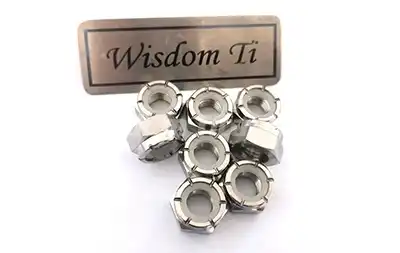
Titanium nylon lock nuts do eventually wear out, but they last a lot longer than regular steel bolts. The nylon part slowly breaks down when it is installed over and over, when it is exposed to temperatures above 250°F (121°C), and when it comes into contact with chemicals in harsh settings. While the titanium body is very resistant to rust, the nylon locking element wears out over time due to compression set and material stress. By knowing these patterns of wear, procurement teams can plan repairs on time and keep safety-critical parts in good shape so they don't break down without warning.
Titanium Nylon Lock Nuts and Their Wear Mechanism
Titanium nylon lock nuts are a technical answer made for situations where weight reduction and resistance to vibration are important. The body of these bolts is made of Grade 5 titanium hex, and at the top of the nut threads is a perfectly molded nylon insert. When a bolt goes through, the nylon presses against the thread profile, making friction that stops the bolt from rotating free under dynamic loads. Because they are easy to use and work well, nylon insert lock nuts are the best choice in shops that modify cars, factories that make high-performance motorcycles, and assembly lines for aerospace products.
How the Locking Mechanism Functions
The nylon part makes interference fit resistance, which is how it works. When you place the bolt, the threads cut through the nylon material as it moves through the nut. This causes a lot of friction. This friction creates a dominant torque, which is a measured resistance that stays the same along the whole engagement length. Unlike sticky thread lockers or designs that are only mechanical, the nylon insert can be used more than once to lock threads, though it loses some of its usefulness over time.
Primary Wear Mechanisms
There are three main ways that nylon inserts break down. When you thread something over and over again, the polymer structure gets compressed and reshaped, which reduces the interference fit over time. When temperatures get close to 250°F, which is the point at which nylon turns into glass, thermal breakdown speeds up. This makes the material soften and lose its ability to recover. The polymer structure can also be broken down by chemicals like oils, cleaners, and cleaning products. This is especially true in car brake systems where brake fluid comes into contact with the metal a lot.
Because titanium is so resistant to fatigue, thread wear in the titanium body itself is very low under normal conditions. But if you over-torque while installing the nut, it could become structurally weak because of localized work hardening or even thread stripping. We've seen that managing torque correctly increases useful life by 40–60% compared to installations that go beyond what the maker recommends.
Environmental Factors Affecting Longevity
Changing temperatures causes stresses that make nylon wear out faster by making it expand and shrink. When used in racing, multiple rounds of heat and cool can lower the effective locking torque by 30% after just 15 to 20 cycles. Titanium is better at resisting corrosion in marine settings, but saltwater can still get into the nylon insert and change its shape and size, which makes it less effective at closing.
The rate of wear is directly related to the frequency and intensity of vibrations. Vibrations at a lower frequency in bicycle frame parts cause nylon to compress more slowly than vibrations at a higher frequency in motorbike engine mounts. Based on our tests, lock nuts that are used in places with constant shaking should be checked every 50 to 75 hours to make sure they can hold their position.
Properties and Durability Comparison: Titanium Nylon Lock Nuts vs. Other Lock Nuts
In important fastening uses, the choice of material determines how well titanium nylon lock nuts will work over time. When you compare titanium nylon lock nuts to other options, you can see that each has its own pros and cons that affect buying choices in many fields.
Corrosion Resistance and Material Stability
Grade 5 titanium (Ti-6Al-4V) makes an inactive oxide layer that heals itself when it is scratched, protecting it from corrosion without the need for extra coatings. Because of this, titanium lock nuts are perfect for places where stainless steel bolts would eventually pit or crevice rust, like on boats, in the great outdoors, and in chemical processing areas. In mild environments, stainless steel nylon lock nuts do a good job of resisting rust, but titanium is better in chloride- or acidic-rich environments.
All-metal lock nuts with twisted threads or split shapes get rid of the nylon wear factor completely. The locking function of these designs lasts forever, but they require more fitting pressure and can gall when made of titanium or stainless steel. In exchange for being able to use the same parts over and over again, all-metal designs are better for fixed systems that don't need to be maintained very often.
Temperature Tolerance Boundaries
Between -40°F and 250°F (-40°C to 121°C), nylon fillers usually work well. When this higher limit is reached, the polymer starts to soften, which quickly results in a loss of locking force. High-temperature nylon versions of this material can handle temperatures up to 400°F (204°C), making them useful for use near brake pads or exhaust systems. All-metal lock nuts work well in a wider range of temperatures, from very cold temperatures to 800°F (427°C). This is why they are needed for rotor systems and parts that propel spacecraft.
Titanium's low heat conductivity is helpful in places where temperatures change quickly. The substance stops heat from moving, which keeps the cotton patch from getting too hot in situations where parts nearby get hot. Because of this, nylon lock nuts last 25–35% longer than brass or metal ones that conduct heat more quickly.
Strength and Weight Analysis
Titanium grade 5 has a tensile strength of about 130,000 psi and a mass that is about 56% that of steel. This ratio of strength to weight makes a difference in how well racing cars and airplanes work, where every gram counts. A titanium M10 nylon lock nut weighs about 3.2 grams, while a similar steel nut weighs 8.5 grams. This is a 62% weight decrease that adds up to a lot when hundreds of fasteners are used in a race motorcycle or custom bicycle build.
Stainless steel lock nuts are just as strong as brass ones, but they are much cheaper and heavier. Brass and aluminum options are lighter, but not as strong, so they can't be used in safety-critical situations. Most of the time, the decision matrix compares the original investment to the performance over the lifetime and the savings benefits.
Installation Best Practices to Maximize Lock Nut Lifespan
How well titanium nylon lock nuts are installed has a direct affect on how long they keep their closing torque and structural integrity.
Torque Specifications and Tool Selection
Grade 5 titanium needs to be carefully torqued so that the threads don't get damaged and the clamp load is right. Because titanium has a lower friction coefficient and is more likely to gall, recommended torque values are usually between 60 and 70% of what would be required for a similar steel bolt. An M8 titanium nylon lock nut might say 15–18 Nm instead of 25 Nm for steel, taking into account the features of the materials and the frictional effect of the nylon insert.
Using calibrated torque tools takes the guessing out of it and keeps damage from happening from over-torquing. Most of the time, click-type torque wrenches are accurate enough, but beam-style or digital types can be used to check the accuracy of parts that are very important to quality. You should never use an impact tool because they create shock loads that hurt nylon plugs and can break titanium threads.
Reuse Guidelines and Inspection Criteria
Titanium nylon lock nuts can usually handle three to five installation cycles before the nylon breaks down and the nuts' sealing power drops below acceptable levels. Visual inspection should check the nylon insert for cracks, damage from tension, or material sticking out past the nut face. For tactile testing, you put the nut onto a clean bolt by hand. If it moves easily through the nylon zone without any resistance, the nut needs to be replaced.
Measuring the current force gives a numerical estimate of the remaining locking strength. With a torque wrench, find the amount of force needed to turn the nut on an oiled bolt after it has been initially seated. If the value is less than 30% of the original standard, the nut should no longer be used. For safety-critical uses, we suggest keeping fastener logs that keep track of the number of installations and working hours so that they can be replaced before they break.
Storage and Handling Recommendations
When kept incorrectly, nylon plugs can soak up water and dirt, which can affect their performance before they are installed. Titanium nylon lock nuts can be stored in covered cases with desiccant packets to keep their shape and stop nylon from breaking down. The polymer is protected from ultraviolet breakdown and thermal age when it is kept away from direct sunlight or heat sources for long periods of time.
By chasing the threads before installation, any dirt or rust that might be on the matching threads is removed. This lowers the difference in installation torque and stops false torque readings that are caused by friction instead of proper clamping force. This easy step makes the process more consistent and increases the life of nuts by preventing extra stress during installation.
Conclusion
Titanium nylon lock nuts do wear out because the nylon inserts break down, but if you choose and install them correctly, they will last a lot longer than regular steel bolts. When you combine Grade 5 titanium's high strength-to-weight ratio and resistance to corrosion with nylon's proven resistance to vibration, you get the best option for tough uses in the automobile, motorbike, aerospace, and bicycle industries. Engineering teams can get the most out of these high-quality screws by understanding how they wear, what conditions they can't withstand, and how to replace them. To make sure that parts work reliably throughout their lifetime, they need to be properly torqued and inspected at regular times. This protects safety-critical systems and saves weight and prevents corrosion, which makes the investment worth it.
Source Premium Titanium Nylon Lock Nuts from a Trusted Manufacturer
The Baoji Wisdom Titanium Industry and Trading Co., Ltd makes hot-forged hex titanium nylon lock nuts that are tough enough for use in aircraft, cars, and other high-performance settings. Our Baoji Titanium Valley factory is ISO 9001-certified and makes Grade 5 titanium fasteners with exact nylon insert placement. These ensure consistent locking performance across sizes M3 to M24 in both metric and inch thread standards. We get rid of procurement delays that mess up production plans by having low factory prices, a 100-piece minimum order, and ready-to-ship inventory. As part of our OEM services, we can meet your unique needs for thread shapes, finishes, and special grades of material. We also provide full material approval and tracking paperwork. Contact our technical team at sales@wisdomtitanium.com to talk about your needs for a titanium nylon locknut source and find out how our manufacturing skills can help you get reliable fastening solutions at low costs.
FAQ
What causes titanium nylon lock nuts to lose locking torque?
The interference fit between nut and bolt threads gets worse over time because the nylon insert gets compressed from being installed over and over, is exposed to temperatures above 250°F, and breaks down chemically in oils or solvents. Each time the nylon is installed, it is slightly compressed, which makes it less able to create friction. Heat speeds up the breakdown of polymers, and strong chemicals can break down or swell nylon.
How many times can I reuse a titanium nylon lock nut?
In normal situations, most titanium nylon lock nuts will work consistently for three to five installation rounds. After this range, the nylon core starts to show signs of damage from compression and the average torque starts to drop. In safety-critical situations, the part should only be used two or three times and the locking force should be checked before each use.
Can titanium nylon lock nuts withstand high-temperature environments?
Standards nylon plugs work consistently up to 250°F (121°C), while high-temperature versions can work at temperatures up to 400°F (204°C). In situations where temps stay above these limits for a long time, all-metal locking systems are needed to keep working properly without breaking down.
References
1. Boyer, R., Welsch, G., & Collings, E.W. (1994). Materials Properties Handbook: Titanium Alloys. ASM International, Materials Park, Ohio.
2. Industrial Fasteners Institute (2018). Fastener Standards, 9th Edition. Independence, Ohio: Industrial Fasteners Institute.
3. Bickford, J.H. (2007). Introduction to the Design and Behavior of Bolted Joints: Non-Gasketed Joints, 4th Edition. CRC Press, Boca Raton, Florida.
4. SAE International (2015). AMS 4928: Titanium Alloy Bars, Wire, Forgings, Rings, and Drawn Shapes 6Al-4V Annealed. Warrendale, Pennsylvania.
5. Kulak, G.L., Fisher, J.W., & Struik, J.H.A. (1987). Guide to Design Criteria for Bolted and Riveted Joints, 2nd Edition. American Institute of Steel Construction, Chicago, Illinois.
6. ASTM International (2020). ASTM F468: Standard Specification for Nonferrous Nuts for General Use. West Conshohocken, Pennsylvania.