
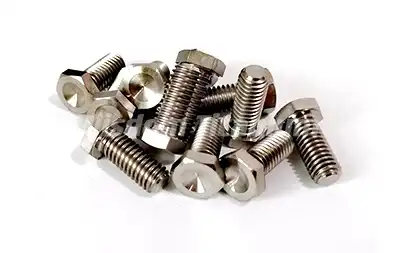
Usually, no. On a standard hex bolt, the stated length does not include the head. You measure from the flat bearing surface under the head to the tip of the thread. An M8 × 40 mm titanium hex bolt therefore has an 8 mm thread diameter and 40 mm of length below the head. Countersunk bolts are the main exception, because their heads sit flush inside the part and count toward total length. Flange, button-head, and custom designs can follow different drawing rules. I always advise buyers to confirm the supplier's dimensional standard before they approve samples or a bulk order.
How to Measure a Titanium Hex Bolt Correctly?
Measure From Under the Head to the Tip
First, find the flat surface under the head that will hold the weight. That part touches either the washer or the part that fits together. Put the hex bolt up against a properly set caliper and read how far the threads go. Don't use the nut, screw, or head. Then, check the reading against the drawing to see how close it is.
If the bolt has a thread, I write it down. The length of the thread affects how the joint handles shear load. After a quick look at the nominal diameter, thread pitch, width across flats, and head height, the inspection is done. The same process can be used by distributors on new lots before they put them on shelves.
When the Head Does Count Toward Length
Most of the time, countersunk (flathead) bolts are fine. Since the head is flat on the surface, the length goes from the top of the head to the end. This is how ISO 10642 socket countersunk screws should be used.
You can measure flange hex bolts, like an M10 × 120 titanium flange bolt, from under the flange. The under-head method is also used for button-head and socket-head screws. Because custom parts are based on the drawing, I ask for a sketch with measurements whenever the head style is different. Most length arguments are taken out before they even start in that one step.
Why Misreading Length Costs Money
Imagine a customer who orders a 40 mm bolt and thinks that the head comes with it. When it gets there, the bolt is 40 mm below the head. It could stick out too far, hit something close, or end up in a dark hole.
The damage gets worse for a supply wholesaler. A bolt that is the wrong length is sitting on the shelf and holding up money. Since titanium is more expensive than steel, every mistake also costs more. Make sure that every quote and purchase order has clear length rules. This will protect your inventory and your customer's schedule.
Titanium Hex Bolt Dimensions and Size Standards
Metric and Imperial Size Designations
Hex bolts made of titanium are the same size as those made of steel. The width and length of a metric bolt are written on it, like M8 × 40 mm. For example, 3/8-16 × 2 in. bolts show the width, the number of threads per inch, and the length. In both systems, the length of a standard hex bolt is found under the head.
For people in the US, this is important because a lot of stores carry both systems together. Even if a metric bolt and an inch bolt look alike, they will not have the same thread. The pitch or TPI should always be added to the order. Note that M8 comes with coarse pitch (1.25 mm), and any fine-pitch form needs to be named.
DIN 933 and DIN 931 Explained
Most metric hex bolt sales can be made with just two DIN numbers. In DIN 933 it talks about a fully threaded bolt. DIN 931 talks about one that is only partly threaded and has a plain shank under the head. Even though ISO 4017 and ISO 4014 are the same thing, a lot of people still order by the DIN number.
You can get DIN 931 bolts up to 125 mm long. The thread length is twice the diameter + 6 mm. This means that an M8 bolt has a 22 mm hole. The standard can make two M8 × 60 bolts behave in very different ways, so put the standard number on every line of the purchase order. Wisdom Titanium makes titanium hex bolt that is both DIN 933 and DIN 931.
Matching DIN and ISO Head Sizes
Many people who buy stockings get this one thing wrong. For some widths, the older DIN standards call for wrench sizes that are bigger than ISO. DIN says that the width across flats for M8 is 14 mm, while ISO 4014 and 4017 say it is 13 mm. M10 is also different.
Even if the bolt looks right on paper, it might not fit in the socket that the customer wants it to. Tell your supplier what standard the head has to follow, and on the first sample, check the head size. Use go/no-go gauges to check the thread too. It's much cheaper to inspect a small sample than to send back a whole lot.
Titanium Hex Bolt Materials, Threads, and Installation
Grade 2 and Grade 5 Compared
Grade 2 titanium is clean enough for business use. Grade 5 is Ti-6Al-4V, which is an alloy made up of 6% aluminum and 4% vanadium. For Grade 2, ASTM B348 says the minimum tensile strength must be at least 345 MPa. For Grade 5, it must be at least 895 MPa.
Grade 2 is good for jobs that involve chemicals, the sea, and other things that rust. Grade 5 is best for work that needs to be strong, like racing, aerospace, and building structures. Customers can choose without having to switch providers if the distributor has both types in stock. Putting different grades in the same bin is the biggest risk, so I suggest putting clear labels on each grade and size. Wisdom Titanium sells both Gr2 and Gr5 titanium hex bolt, and we check each one carefully before sending it out.
Corrosion Resistance and Weight Against Steel
Titanium makes a thin, solid oxide film that many chemicals and seawater can't damage. That's why people who buy chemical plants, subsea plants, and ships choose it.
Titanium is also not as heavy. Titanium is about 4.5 g/cm³ dense, while steel is about 7.8 g/cm³ dense. This means that a titanium bolt weighs about 40% less than a steel bolt. Stainless steel also doesn't rust, but it's not as light as that metal. Titanium costs more and gets rusty faster. In some parts, high-strength steel can still hold more weight. When you compare Grade 5 to Class 10.9 steel, don't use Class 12.9 bolts instead. Instead, get an engineer to look at it first.
Preventing Galling and Setting Torque
Titanium threads can get stuck when they rub against each other. This is called galling. Less risk is there when threads are clean, driving speed is slow, and an anti-seize compound is used. For tough jobs, coatings are another choice.
Do not copy torque numbers from charts for steel. The modulus of elasticity of titanium is lower, and the friction changes depending on the oil used. This means that the same torque will have a different preload. Set the target preload, thread pitch, and torque based on grade. Then test it on a real joint. Fine threads let you make smaller adjustments in thin parts, while coarse threads make it easier to put things together and can handle dirt. Titanium on titanium contact galls the most, so be careful when picking out nuts and washers.
How to Select the Correct Hex Bolt Length?
A Simple Length Formula
It's easy math to figure out the length. Here's how to figure out the length of a hex bolt: joint grip + washer thickness + nut contact + thread extension = bolt length.
Take an M8 joint that has two 10 mm and 12 mm thick plates. It has a 22 mm grip. Put in a 1.6 mm washer and an M8 nut that is about 6.5 mm thick. Then make the nut stick out about 2 mm. It adds up to 32.1 mm. To get to the next standard length, which is 35 mm, round up. Look at the picture to see if there are any coatings, seals, or shims that can help you hold on. Don't use a bolt that is too short to fully engage or one that is too long and hits other parts nearby.
Common Ordering Mistakes
Problems are mostly caused by missing parts in the order, not by the bolt. It's common for buyers to count the head as part of the length, mix metric and English threads, or leave out the pitch. Others use torque values for steel on titanium. When people order, they often forget to include grade, standard, and thread length when they only list diameter and length.
There are also mating materials that are important because the choice of nut and washer affects corrosion and galling. Type of thread, finish, quantity, diameter, pitch, length under the head, and grade should all be written on a full line item. A two-minute visit to that line can save your customer days of email and keep the wrong package off of their store.
Final Decision Guide
Make sure the bolt does what it's supposed to do. A lot of the time, Grade 2 is enough for rust in seawater or chemicals. Grade 5 is stronger for racing or making lightweight machines, and it's a good idea to check for shaking and strain. Marine joints need a galvanic check of the metals that are joining together.
For OEM projects, you should use an engineering drawing that shows the exact sizes, tolerances, markings, and packaging. Before full production, ask for prototypes or first-article samples if the part is made to order. That step lowers the risk and doesn't cost much compared to a lot that is turned down. Custom designs are welcome at Wisdom Titanium, and they can make parts from a sample or drawing you send them.
Titanium Hex Bolt Procurement Checklist for B2B Buyers
What to Put in Your RFQ
A full RFQ gets you a quote faster and more accurately. Write down the standard (DIN 933 or DIN 931), the grade of titanium, the thickness, the pitch, the length under the head, the thread type, the finish, the number, and how it will be packed. If the operating environment is hard, add it.
You can send the full size list in one table, with the grade and quantity for each size. We can send you a quote table with the size, grade, and price of the item. This way, your team can look over everything in one place instead of reading a lot of emails. Our minimum order quantity is 200 items. We will help you work through your size mix if you tell us about it. A titanium hex bolt order is only as good as the details you provide.
Documents and Sample Approval
Buyers in the US and Europe expect to see paperwork. Ask for certificates of conformity, reports on dimensional inspections, thread-gauge results, and certificates of material. Wisdom Titanium follows ISO 9001, and our bolts are checked before they are sent out.
First, order a small sample and check its length, head size, thread fit, and sharpness. Sample, trial order, and regular refills are all steps that are often taken together. When you plan to buy over a few months, having stock of raw materials and standard parts behind the quote helps keep prices stable. Let us know what documents your quality team needs, and we'll let you know what we can offer.
Why Buyers Work With Wisdom Titanium
Wisdom Titanium was established in 2016 and is an ISO 9001-certified company that makes and sells standard and custom CNC parts. We are in Baoji Titanium Valley in Shaanxi Province, which is the biggest hub for the titanium industry in China. It makes everything from bars, plates, tubes, and forgings to sponge and ingots.
We offer reasonable prices on Grade 2 and Grade 5 hex bolts to DIN 933 and DIN 931, as well as a min. order quantity of 200 pieces and unique designs. Our in-house research and development team does work for uses in aircraft, marine, medicine, chemicals, cars, and bikes.
Conclusion
To find out how long a standard titanium hex bolt is, measure from the bearing surface under the head to the thread tip. For countersunk bolts, the head is what matters most. Most ordering mistakes can be avoided by using the right standard, the right measurements, and a full specification. Fully threaded bolts are covered by DIN 933 and partially threaded bolts are covered by DIN 931. Head sizes can be different between DIN and ISO. Grade 2 is better at resisting corrosion, while Grade 5 is stronger. The joint is protected by galling control and torque values that are right for the job. To choose the length, a simple grip-based method is used, and an exact RFQ with certificates and sample approval is kept up to date.
FAQ
Does the length of a titanium hex bolt include the head?
Not at all. The length of a normal hex bolt goes from the base of the head to the end. Countersunk bolts are different because the length of the bolt includes the head.
What is the difference between DIN 933 and DIN 931?
DIN 933 talks about hex bolts with full threads. DIN 931 talks about hex bolts with a plain shank that are only partially threaded. The thread length for DIN 931 bolts up to 125 mm is twice the diameter plus 6 mm. On every order line, write the standard.
Can I use steel torque values on titanium bolts?
Titanium doesn't have a high modulus of elasticity, and the amount of friction changes depending on the oil used. Set the torque based on the grade, pitch, lubrication, and target preload, and then check it on the real joint.
Request Hex Bolt Pricing from Wisdom Titanium
Looking for a company that sells hex bolts in Gr2 and Gr5 titanium? It is possible to order DIN 933 and DIN 931 bolts directly from the factory, but there is a minimum order quantity of 200 pieces. Our team will send you a quote with your size list, grade, and number when you email sales@wisdomtitanium.com. Check out our full line of products at wisdomtitanium.com as well.
References
- ISO 4014: Hexagon Head Bolts – Product Grades A and B, 2011
- ISO 4017: Fasteners – Hexagon Head Screws – Product Grades A and B, 2014
- ASTM B348: Standard Specification for Titanium and Titanium Alloy Bars and Billets, 2019
- Machinery's Handbook, 31st Edition, Industrial Press, 2020
- Titanium: A Technical Guide, 2nd Edition, ASM International, 2000
- Introduction to the Design and Behavior of Bolted Joints, 4th Edition, CRC Press, 2007