
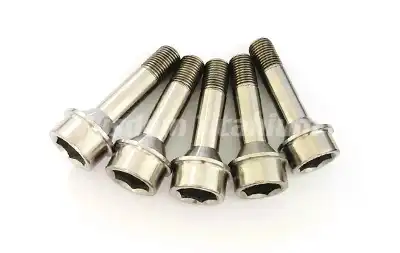
Yes, Ferrari titanium wheel bolts do reduce unsprung rotational mass — and the effect is more meaningful than most people expect. Because titanium alloy (Ti-6Al-4V) has a density roughly 43% lower than steel, a full set of Ferrari titanium wheel bolts saves approximately 1.1–1.4 kg compared to factory steel lug bolts. In vehicle dynamics, every kilogram of rotating unsprung mass removed is physically equivalent to eliminating about 4 kg of static sprung weight. That translates directly into sharper steering response, faster suspension recovery, and measurably better traction — all at a component level most owners never think to address.
Understanding Unsprung Rotational Mass and Its Impact on Ferrari Performance
What Is Unsprung Rotational Mass?
The wheel, tire, brake rotor, caliper, and wheel bolts are all examples of unsprung mass. Unsprung mass is everything that moves with the wheel instead of floating above the suspension. Rotational unsprung mass is the part that spins, and physics punishes it twice: the suspension has to react faster to changes in the road, and rotational inertia stops changes in wheel speed. At track speeds, those fractions of a second add up on a Ferrari that is going very fast.
Why It Matters Specifically on Ferrari Models
Engineers at Ferrari work very hard to make wheels and brakes lighter. Switching from steel to Ferrari titanium wheel bolts makes perfect sense from a scientific point of view. The carbon-ceramic brakes on the 488, F8 Tributo, SF90 Stradale, and Roma all make a lot of heat. Every gram saved at the hub improves lap times and ride quality in a measurable way.
The Role Wheel Bolts Play
About 70–80 g is how much one M14 steel wheel bolt weighs. When you add up the 20 bolts on all four corners, the weight starts to matter. It's not a rounding error; titanium bolts that meet the same requirements weigh 45% less. This is a real physics gain for every corner of the car.
Titanium vs. Steel Wheel Bolts for Ferrari: Weight, Strength, and Safety
Material Properties Side by Side
Steel SCM435 lug bolts have a tensile strength of about 1,000 MPa, but they are very dense—about 7.85 g/cm³. Titanium (Ti-6Al-4V Grade 5) has a tensile strength of 900–1,050 MPa (130,000–152,000 psi), but it is very light—only 4.43 g/cm³. Because titanium has a much better strength-to-weight ratio, it is used in both aircraft and racing.
Safety and Torque Compatibility
A common worry is whether titanium bolts can handle Ferrari's torque requirements, which for modern models are usually 100–120 Nm. The answer is simple: Ferrari titanium wheel bolts with hot-forged heads and rolled threads can meet or exceed those pressure requirements without breaking. The hot-forging process lines up the metal's grains, and rolled threads last longer than cut threads when it comes to wear.
Lifespan and Maintenance Comparison
Steel bolts rust, especially after many tire changes on cars that are exposed to dust from track brakes or salt on the road. Titanium naturally resists oxidation by having an oxide layer that repairs itself. This means that titanium lug bolts will look good and stay in good shape for a much longer time. Titanium is a good long-term investment for workshop owners because it requires less maintenance over the life of a vehicle.
Benefits of Using Ferrari Titanium Wheel Bolts Beyond Weight Reduction
Corrosion Resistance and Longevity
Titanium does not rust. When OEM steel bolts on expensive cars like the Ferrari 458, 599, or Purosangue rust, they become less safe and look bad. Ferrari titanium wheel bolts get rid of that problem completely. The hub area will always look as good as the rest of the car because it has a smooth finish and the metal is naturally resistant to chemicals.
Consistent Torque Behavior
After being tightened many times, steel bolts can stretch or gall against aluminum hubs. Titanium's mechanical behavior stays the same over multiple installation cycles, which makes each installation more accurate. A small amount of copper-free anti-seize powder is usually used to stop thread galling, which is titanium's one known friction risk. This is something that every expert workshop does.
Titanium lug bolts are also great for high-end workshop builds because of the following benefits:
- Color customization through PVD coating: PVD black, gold, rainbow, burned blue, and red are just a few of the options. This lets workshops match caliper color schemes or give the whole wheel assembly a consistent look.
- Laser-etched personalization: Initials of the owner, team logos, or limited-edition serial numbers can be engraved directly onto the bolt heads, changing a useful fastener into a feature that tells a story.
- High markup potential: A set of handmade titanium bolts doesn't cost as much as an exhaust or suspension job, but it adds value that isn't proportional to its cost. This gives shops a high-margin extra that looks good on social media.
Procurement Guide: How to Source Ferrari Titanium Wheel Bolts
Choosing a Qualified Manufacturer
Find a Ferrari titanium wheel bolts manufacturer that is ISO 9001-certified, uses confirmed Ti-6Al-4V bar stock, records chemical makeup through spectrometry, and tests batch samples for proof-load. To protect the Ferrari hub threads, the thread precision must meet a 6g tolerance class and be checked with Go/No-Go ring gauges.
Specifications to Confirm Before Ordering
M14 x 1.5mm thread pitch is the standard fitment for most Ferrari models. You can choose from different lengths. The 52 mm bolt works with Ferrari models 246, 308, 328, 348, 355, 360, 400, 412, 430, 456, 458, 488, 550, 575, 599, 612, Testarossa, Mondial, California, Challenge, Scuderia, and Stradale. Longer lengths—55, 62, 67, 69, and 72 mm—allow spacers to be used while still ensuring safe thread engagement. All nuts are put in place with a 17 mm Allen socket.
Customization and Minimum Order Considerations
Titanium lug bolt suppliers that are good at what they do will take small orders (at least 50 pieces) and offer laser-etch logo services as well as PVD color finishes. Make sure that your provider agrees not to share unique designs with other people and won't use your client's logos on other products. A professional supplier should be able to get samples to you between 7 and 15 days after you approve the design.
Installation Best Practices and Torque Specifications
Pre-Installation Checklist
Before putting on new bolts, use a thread chaser to check the hub threads. Make sure the wheel's seat is clean. To stop galling without messing up torque readings, put a thin layer of nickel-based anti-seize compound on the bolt threads (not the seat).
Correct Torque Procedure
Turn each bolt by hand until it's finger-tight, then use a calibrated torque wrench to turn them in a star shape. Most new Ferrari cars come with 100–120 Nm of torque; check the service manual to get the exact number. Ferrari titanium wheel bolts should never be hit with a pneumatic impact gun because the shock loads damage both the threads and the smooth finish.
Routine Maintenance After Installation
After the first 50 to 100 miles of driving after changing wheels, tighten all the bolts again. Check the heads of the bolts for damage on a regular basis. Titanium does not rust, so it does not need any extra surface cleaning when it is being used. One reason expert shops like titanium for builds where long-term dependability is important is that it doesn't need much care.
Conclusion
Ferrari titanium wheel bolts are a physically sound upgrade for any Ferrari application. The 45% weight loss compared to steel directly lowers rotational unsprung mass, which improves steering response and suspension dynamics all around the car. Combined with a tensile strength of 900–1,050 MPa, natural resistance to corrosion, and the option to customize the finish and engraving, these bolts occupy a rare position: they are a small part that improves performance and provides strong workshop margins. The material science and the business case both point in the same direction for procurement teams and workshop owners sourcing at volume.
FAQ
1. Do titanium lug bolts require different torque settings?
No. Use a calibrated torque wrench to set the torque to the original standard, which is usually 100–120 Nm. There is no need to make any changes unless a wet-torque number is given.
2. Is galling a real risk with titanium threads?
Yes, if the bolts are installed dry against a steel hub. Before installing, use a small amount of an anti-seize substance that is either copper-free or nickel-based. Good PVD coatings lower this risk significantly because they also work as a dry lubricant.
3. How much weight does a full set actually save?
A full set of 20 Ferrari titanium wheel bolts weighs about 1.1 to 1.4 kg less than the same number of factory steel bolts. This weight has about four times the handling impact of a static weight of the same size because it is rotating and unsprung.
4. Can I match bolt color to my brake calipers?
Yes, you can get PVD finishes in black, gold, rainbow, burned blue, and red. You can also talk to your supplier about getting custom colors. You can also have logos and serial numbers laser-etched on them.
5. What is the minimum order quantity for custom bolts?
Reliable sellers will take orders for as few as 50 pieces, and samples can be sent out 7–15 days after the design is approved.
Get Custom Ferrari Titanium Wheel Bolts from Wisdom Titanium
Wisdom Titanium supplies ISO 9001-certified Ferrari titanium wheel bolts — M14 x 1.5mm in six length options, full PVD color range, and laser-etched personalization — direct from our facility in Baoji Titanium Valley, Shaanxi Province. As an established manufacturer with aerospace-grade quality control, we accept small-batch orders with short lead times. Send your project specs to sales@wisdomtitanium.com to request a sample and quote today.
References
1. Milliken, W. F., & Milliken, D. L. Race Car Vehicle Dynamics. SAE International, 1995.
2. Dixon, J. C. Tires, Suspension and Handling. SAE International, 1996.
3. Donachie, M. J. Titanium: A Technical Guide. ASM International, 2000.
4. Heisler, H. Advanced Vehicle Technology. Butterworth-Heinemann, 2002.
5. Budynas, R. G., & Nisbett, J. K. Shigley's Mechanical Engineering Design, 10th ed. McGraw-Hill, 2015.
6. SAE International. "Fastener Design Manual." SAE Technical Paper Series, 2008.