
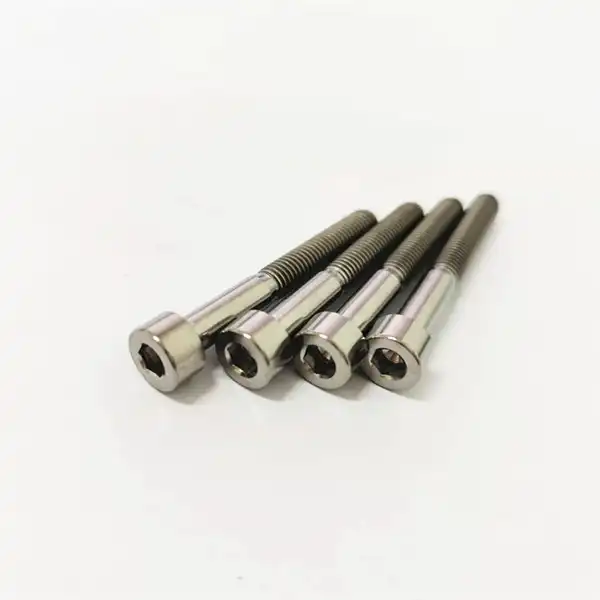
When looking for bolts for high-performance uses, it's important to know how strong DIN 912 bolts are. DIN 912 titanium bolts are precision-engineered socket cap bolts that are made to strict German industry standards (equivalent to ISO 4762). They have very high tensile strength, resistance to wear, and resistance to rust. These bolts are made from Titanium Grade 2 or Grade 5 (Ti-6Al-4V), which has tensile strengths of up to 895 MPa while still being only 56% as heavy as steel. DIN 912 titanium bolts are used more and more in mission-critical installations where failure is not acceptable because they are reliable in brake assemblies for spacecraft, suspension linkages for motorsports, and naval deck gear.
Understanding DIN 912 Titanium Bolts and Their Strength
What Defines the DIN 912 Standard for Titanium Fasteners
The DIN 912 standard calls for hexagon socket head cap bolts with a cylinder-shaped head and an internal hexagonal drive. It comes from German industrial engineering standards that stress accuracy in measurements and consistent load-bearing. For sizes from M1.6 to M24, this standard spells out specific limits for the head diameter, height, socket depth, and thread contact length. When used in titanium alloy building, the standard makes sure that threads work with foreign metric systems and takes into account the unique way titanium behaves mechanically when it is stressed.
In contrast to general-purpose fasteners, the shape of the DIN 912 allows high force to be transmitted through the internal hex drive without the need for an external wrench. This protects threaded connections in tight systems. The cylinder-shaped head design spreads clamping forces out evenly, which lowers stress levels that could cause wear cracks in lightweight titanium structures. Manufacturers who follow DIN 912 guidelines ensure consistent batches for automatic assembly lines and the ability to swap out new parts, which is very important when handling contracts that last more than one year.
Mechanical Properties: Tensile and Yield Strength Explained
To understand how DIN 912 titanium bolts work mechanically, you need to be able to tell the difference between two types of material that have different strength properties. Commercially Pure Titanium Grade 2 has a minimum tensile strength of 345 MPa and a yield strength of 275 MPa. It can be used in situations where maximum resistance to rust and electrical conductivity are more important than load-bearing capacity. This grade is used in places like chemical processes and medical implant systems where it is constantly in contact with corrosive media.
Ti-6Al-4V (Grade 5) is the most common titanium alloy used for structural fasteners. It has a tensile strength of 895 MPa and a yield strength of 828 MPa, which is about the same as Class 10.9 alloy steel nuts. The aluminum and vanadium alloying elements allow precipitation hardening, which makes the metal much stronger while still being very flexible. This type is used for dynamic loads in racing suspension bolts, which need to be able to withstand more than 10^7 cycles of stress from road accidents. The strength-to-weight benefit can be measured: a Grade 5 M10 bolt weighs about 12 grams, while a steel bolt weighs 22 grams, but it has the same gripping force.
Titanium's Unique Characteristics: Strength-to-Weight Ratio and Corrosion Resistance
Titanium alloys are different from stainless steel options because they have a built-in passivation process. Titanium surfaces quickly form a titanium dioxide (TiO2) layer that is 1 to 10 nanometers thick when they come into contact with air. If you scratch this clear oxide film, it grows back within milliseconds. This protects against chloride pitting, crevice corrosion, and stress corrosion cracking, all of which can happen to 316 stainless steel in naval settings. Test results from military building projects show that titanium fasteners keep their original sizes after being submerged in saltwater for 20 years, while stainless steel equivalents lose material and threads.
The edge in density directly leads to better performance in rotating systems. When you replace steel wheel hub bolts with titanium ones, the unsprung mass goes down. This lets the suspension systems react faster to changes in the road and makes the tire contact patch more consistent. Teams in racing record gains in lap times that can be measured thanks to weight saves in brake caliper bolts, suspension linkages, and chassis fasteners. The density of 4.43 g/cm³ allows for aggressive lightweighting tactics without affecting the structural safety margins needed by racing governing bodies.
Benefits of Choosing Titanium DIN 912 Bolts for Procurement
Exceptional Corrosion Resistance for Harsh Environments
When standard materials are used, fasteners constantly break down in chemical processing plants that use chlorine, cleaning agents, and acid solutions. It is impossible for strong sulfuric acid (except fuming amounts), nitric acid at any concentration, and organic acids commonly used in pharmaceutical production to damage titanium's passive oxide layer. The substance stays steady when it comes in touch with wet chlorine gas, which quickly eats away at stainless steel through pitting corrosion. Plants say that titanium flange bolts only need to be serviced every 10 to 15 years, while coated steel bolts need to be replaced every year. This directly cuts down on repair downtime and improves operating safety.
Most notably, titanium's value is shown in marine uses. Instrumentation on offshore platforms, underwater remotely operated vehicle (ROV) assemblies, and gear on boat decks are constantly hit by saltwater spray that contains chlorides, sulfates, and dissolved oxygen. 316 stainless steel works well in the short term, but after 3 to 5 years of contact, crevice rust starts to form in the thread roots and where the bolt meets the washer. Titanium bolts don't fail in this way at all; they keep their original holding force and torque-tension relationships for many decades. More and more, naval architects are choosing titanium for important uses where corrosion-related failure could lead to safety problems or costly fixes in an emergency.
Lightweight Strength Advantage for Design Efficiency
When automakers try to make electric cars, they are constantly under pressure to make their cars lighter so that the batteries don't add too much weight and hurt the range and speed. Using titanium fasteners instead of steel ones in brake systems, suspension parts, and battery pack enclosures can save between 1.5 and 3.0 kg per car without having to change the design or safety. This weight decrease doesn't seem like much until you multiply it by the number of units made each year, which is over 100,000. At that point, the material savings and higher energy efficiency scores become clear competitive benefits.
Titanium's high strength-to-weight ratio is used by companies that make high-performance motorcycles to improve power-to-weight ratios and control qualities. Titanium back axle nuts, sprocket bolts, and brake caliper fasteners lessen the gyroscopic effects of spinning wheel assemblies, which lets the car turn faster when cornering hard. Because there is less inertia, the suspension parts can react more quickly to changes in the ground. This makes the tire contact patch more stable and boosts the rider's trust while going fast. When riders spend a lot of money on aftermarket upgrades, these speed perks make paying more worth it.
Long-Term Value Through Durability and Reduced Maintenance
Lifecycle cost study shows that DIN 912 titanium bolt is more cost-effective than other materials, even though it costs more to buy at first. Take a chemical plant that uses 500 DIN 912 bolts for heat exchanger flanges. Every three years, the rust means that the $2 stainless steel bolts need to be replaced, which adds up to $1,000 per cycle plus $3,000 for labor costs during planned shutdowns. Titanium bolts cost $15 each, so the initial investment is $7,500. However, they last 20 years, so they don't need to be replaced five times, which saves $12,500 in upkeep costs.
When you add up the saved production costs from unplanned shutdowns due to fastener failures, the math makes more sense. When oil companies switch to titanium fasteners on important process equipment, the reliability of the equipment improves. This is because there are fewer unplanned repair events that stop production lines worth thousands of dollars per hour. The longer replacement times also cut down on the need for extra parts inventory and the storage costs that come with it. This makes supply chain management easier for factories with more than one production line.
How to Choose the Right DIN 912 Titanium Bolt for Your Project?
Understanding Project Requirements and Environmental Conditions
To choose the right DIN 912 titanium bolts, you must first do a full application study that looks at mechanical loads, weather exposures, and assembly limitations. Start by figuring out what the static and dynamic loads are. For example, is the bolted joint under pure tension from the internal loads of the pressure tank, shear forces from the bracket cantilevering, or a mix of tension and shear forces from vibration and heat expansion? Figure out how much clamping force is needed by using joint stiffness factors and safety gaps that are right for the amount of risk associated with failure. Write down the high and low temperatures, chemical risks, and humidity levels that affect the choice of material.
Installation ease affects the choice of head style. When there isn't much room for a wrench, low-profile designs or custom drives that transfer power efficiently are best. The amount of production determines whether standard catalog sizes are enough or whether special lengths and thread setups are worth the cost of investing in tools for dedicated production runs. In the aircraft or medical industries, regulations may require certain grades of materials, testing methods, or traceability paperwork. This limits the suppliers to those who have the right licenses.
Core Performance Metrics: Tensile Strength, Fatigue Resistance, Corrosion Immunity
Specifications for tensile strength must include safety factors that are acceptable for the effects of the application. Most structural aerospace joints use 3:1 safety margins, which means that the bolt's final tensile strength must be 300% higher than the highest expected loads. In racing, 2:1 gaps are sometimes acceptable as long as the conditions are controlled and the parts are inspected often. To find the stress in a bolt, use the formula stress = force / tensile stress area. The tensile stress area takes into account the smaller diameter at the thread bases, which is usually 75–80% of the standard diameter for metric threads.
When an assembly is loaded and unloaded over and over again, like in suspension parts, machinery that moves back and forth, or airplane control surfaces, fatigue resistance becomes very important. Titanium can handle about 50 to 60 percent of its total tensile strength in stress without breaking. This is higher than aluminum alloys but not quite as high as high-strength steels. The quality of the surface finish has a big impact on fatigue life. For example, machined threads with tool lines create stress clusters that shorten cycle life, while rolled threads work-harden the surface and create positive compressive residue stresses that increase fatigue resistance.
Comparing Material Options: Titanium vs. Stainless Steel vs. Alloy Steel
Decision matrices help you compare different things in a structured way. Rate each choice based on certain factors, including how well it resists rust, its strength-to-weight ratio, cost, availability, ability to be machined, and its heat stability. DIN 912 titanium bolt is great at resisting rust and being light, but it's not as good at being cheap to start with or easy to machine. When it comes to most factors, stainless steel 316 falls in the middle. It works well for most things, but it can't be used for very strong things. Alloy steel is the strongest material you can buy for the money, but it needs to be coated with protective materials and replaced often in places where it will rust.
Sometimes, application-specific factors are more important than general research. Magnetic resonance imaging (MRI) tools must have non-magnetic fasteners, so steel is not a choice, even if it is cheaper. Titanium's temperature stability is needed in aerospace uses that work near jet engine exhaust, even though nickel superalloys have higher hot strength. Medical implant systems must officially be made of biocompatible materials that have been tested for toxicity. This means that only medical-grade titanium and certain types of stainless steel with a proven clinical history are available.
Partner with Wisdom Titanium for Superior DIN 912 Titanium Bolts
Wisdom Titanium sells precisely designed DIN 912 titanium bolts manufactured in Baoji Titanium Valley, which is China's main titanium production hub and where more than 60% of the world's titanium working capacity is located. Our ISO 9001-certified plant in Shaanxi Province keeps a full stock of Grade 2 and Grade 5 titanium rod stock. This lets us quickly make standard configurations (M1.6-M24 threads, 6mm-250mm lengths) and personalized configurations that meet your exact needs. Because our supply chain is fully linked, we can offer price stability that distributors who rely on spot market purchases can't. This protects your buying budgets from material cost fluctuations.
Our skilled engineers work together to come up with solutions that are perfect for each application. They can help you choose the best thread lengths for your joint shape and suggest surface treatments (natural finish, Type II/III anodizing, PVD coating) that will work best in your environment. We work with air companies that need full paperwork on the traceability of their materials, racing teams that need the best strength-to-weight ratio, and marine equipment builders that need reliable materials that won't rust. You can meet your production and inventory management goals with our flexible minimum order amounts, volume pricing for large orders, and on-time shipping results of over 96%.
You can talk to our expert sales team about your fastener needs at sales@wisdomtitanium.com. They are knowledgeable professionals who know the important difference between good parts and great solutions. As a reliable provider of DIN 912 titanium bolts, we give you thorough quotes within 24 hours, along with information about the materials, proof of certification, and delivery dates that work with your project's goals.
Conclusion
When you look at the strength of DIN 912 bolts through the lens of titanium alloy engineering, you can see why procurement professionals are choosing these fasteners more and more for tough jobs. The mix of Grade 5 Ti-6Al-4V's excellent tensile qualities, its proven resistance to corrosion in harsh chemical and marine environments, and its weight-saving benefits makes for appealing lifetime value, even though it costs more to buy. When you choose the right material by matching the grade specs to the load requirements and installing it in a way that takes titanium's friction properties into account, the joint will work perfectly for a long time.
FAQs
What Makes DIN 912 Titanium Bolts Stronger Than Other Fasteners?
The tensile strength of Grade 5 titanium (Ti-6Al-4V) is about the same as that of Class 10.9 steel, but it is more resistant to wear and can't lose its strength through rust. The crystalline structure of the material stops cracks from spreading better than steel does under cycle loads, which increases the service life of parts that are likely to vibrate. Unlike coated steel rivets, whose protective layers wear away over time leaving the base metal open to damage from the environment, titanium's passive oxide layer keeps growing back, keeping its original strength properties over many decades of use, no matter what conditions it is exposed to.
How Can I Verify Certification and DIN 912 Compliance?
Ask for Material Test Reports that show the chemical make-up using optical emission spectroscopy and the material qualities of samples from each production lot that were tested by tensile. In dimensional inspection records, the head diameter, height, socket depth, and thread pitch should be checked against DIN 912 standards using precise measuring tools that can be linked to national standards. Independent verification is given by third-party approval from accredited labs, which goes beyond self-certification by the seller. For aircraft uses, AS9100 certification means that the quality management system meets the unique needs of the business for controlling the process and keeping track of materials.
Are Titanium Bolts Suitable for High-Temperature Applications?
Up to about 400°C, Grade 5 titanium keeps its mechanical qualities. After that, the strength decreases quickly, and rust becomes a problem, even with the protective oxide layer. Nickel-based superalloys or special high-temperature titanium alloys like Ti-6242S made for high-temperature service should be considered for applications that operate regularly above 300°C. Temperature drops to 500°C for short periods of time (for example, during thermal shock testing or welding close together) usually don't damage the integrity of a bolt as long as the exposure time is kept short and the mechanical loading during thermal cycling stays within the lower allowable stress limits for the operating temperature.
References
- ASTM International. Standard Specification for Titanium and Titanium Alloy Bars and Billets (ASTM B348). West Conshohocken, PA: ASTM International, 2020.
- Deutsches Institut für Normung. Hexagon Socket Head Cap Screws (DIN 912). Berlin: DIN Standards Committee Fasteners, 2018.
- Donachie, Matthew J. Titanium: A Technical Guide (2nd Edition). Materials Park, OH: ASM International, 2000.
- Lütjering, Gerd and Williams, James C. Titanium: Engineering Materials and Processes. Berlin: Springer-Verlag, 2007.
- SAE International. Aerospace Fastener Procurement Specification for Titanium Alloy Bolts (AS7228). Warrendale, PA: SAE International, 2019.
- Schutz, R.W. and Thomas, D.E. "Corrosion of Titanium and Titanium Alloys." ASM Handbook Volume 13B: Corrosion—Materials. Materials Park, OH: ASM International, 2005, pp. 252-299.