The m7 titanium bolt represents a crucial fastening component in industries where weight reduction and corrosion resistance cannot be compromised. From aerospace assemblies to medical devices, this specific bolt size fills a niche that demands both precision and performance. Yet many engineers and procurement specialists struggle to find comprehensive technical information about M7 specifications beyond basic dimensional data.
Thread Size & Diameter (M7)
The "M7" designation in metric fasteners refers to a nominal diameter of 7 millimeters measured at the major diameter of the external thread. This measurement represents the largest diameter of the threaded portion, taken from the crest of one thread across the bolt's center to the crest on the opposite side. In practical terms, if you measure across the peaks of the threads with precision calipers, you should read approximately 7mm, though manufacturing tolerances apply.
For m7 titanium bolt production, manufacturers work within ISO metric thread specifications that define not just the major diameter but also the minor diameter and pitch diameter. The minor diameter measures approximately 5.917mm for standard M7 bolts, representing the smallest diameter at the thread root. Between these two extremes sits the pitch diameter at roughly 6.378mm, which determines how male and female threads engage and transfer load during assembly.
Manufacturing tolerance stands at ±0.05mm for quality m7 titanium bolt production. This tight tolerance ensures proper thread engagement without excessive play or binding during installation. When titanium alloys undergo thread rolling or cutting operations, the material's work-hardening characteristics require careful process control to maintain these dimensional requirements while preserving the metal's beneficial properties.
Thread depth on an M7 fastener extends approximately 0.541mm from the major to minor diameter. This relatively shallow profile compared to larger bolts means thread engagement relies heavily on material strength and surface finish quality. Titanium's excellent strength-to-weight ratio compensates for the reduced thread depth, providing secure fastening despite the compact dimensions.
Pitch Options for M7 Titanium Bolts
Thread pitch defines the distance between adjacent thread crests, measured parallel to the bolt axis. For M7 fasteners, the standard coarse pitch measures 1.0mm according to ISO metric specifications. This means each complete revolution of the bolt during installation advances it exactly one millimeter along the threaded hole. The 1.0mm pitch represents the default specification when no additional pitch designation appears in part numbering or technical drawings.
The relationship between pitch and thread engagement length determines joint strength in critical applications. Engineers calculate the minimum thread engagement as 1.5 times the nominal diameter for steel-into-steel assemblies. However, titanium's lower modulus of elasticity compared to steel sometimes requires adjusted engagement calculations. A properly designed M7 joint using 1.0mm pitch threads needs approximately 10.5mm of engagement to develop the bolt's full tensile strength without thread stripping.
Pitch selection also influences preload accuracy during torque-controlled installation. The coarse 1.0mm pitch converts rotational torque into axial clamping force according to well-documented relationships between thread geometry, friction coefficients, and bolt stretch. Fine pitch threads theoretically allow finer adjustment of preload tension since each degree of rotation produces less linear displacement, but this advantage often disappears in practice due to friction variations and installation tool limitations.
Manufacturing consistency becomes more challenging as pitch decreases. Thread rolling operations that form m7 titanium bolt threads through plastic deformation work most reliably with coarse pitches where die pressures remain within optimal ranges. Thread cutting processes can produce finer pitches but generate more waste material and potentially compromise surface finish quality. Baoji Wisdom Titanium maintains 1.0mm pitch as the standard offering for M7 products, ensuring optimal manufacturing consistency while meeting the vast majority of application requirements.
Head Types for M7 Titanium Bolts
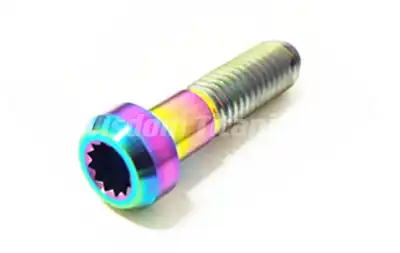
Head configuration determines how load transfers from the fastener into the clamped components and influences installation tool requirements. Socket head cap screws represent one of the most common head types for m7 titanium bolt applications. These feature a cylindrical head with a hexagonal socket drive, typically sized at 5mm across flats for M7 diameter bolts. The compact head profile suits assemblies where space limitations prevent using larger wrench clearances required by traditional hex heads.
The socket head design concentrates clamping force within a smaller bearing area compared to flanged alternatives. For M7 size, the standard socket head cap screw head diameter measures approximately 11mm with a height around 7mm. This geometry creates bearing stress beneath the head that may require washers when fastening soft materials like aluminum or composites. Engineers must verify that the bearing area provides adequate support without causing local crushing or dimpling of the clamped components.
Button head screws offer an alternative profile that reduces the head height compared to standard socket caps. With a lower, more rounded dome shape, button heads create a smoother external surface that poses less snagging hazard in applications involving moving parts or user contact. The reduced height comes with a trade-off in drive socket depth, potentially limiting the torque that can be safely applied without tool slippage or socket damage.
Countersunk heads allow m7 titanium bolt installations to sit flush with or below the component surface. The conical underside of a countersunk head requires a matching angled hole preparation, typically machined at 90 or 100 degrees included angle. This head type finds extensive use in aerodynamic surfaces where protruding fasteners would disrupt airflow or in aesthetic applications where visual smoothness matters. However, the angled bearing surface reduces effective clamping area compared to flat-bearing heads of equivalent diameter.
Hex head bolts provide the maximum bearing area for a given diameter, distributing clamping loads across a larger surface. An M7 hex head typically measures 11mm across flats, requiring an 11mm wrench for installation. The hex exterior allows tool engagement from the side, useful in applications where socket access from above proves impractical. Traditional hex heads also permit higher installation torques since the wrench engagement resists cam-out forces better than internal drive sockets.
Baoji Titanium Valley: Manufacturing Excellence
Located in Shaanxi Province, Baoji Titanium Valley forms China's largest and most comprehensive titanium industry cluster. The region concentrates hundreds of titanium and titanium-alloy enterprises into an integrated ecosystem that spans from primary metallurgy through precision component manufacturing. This geographic concentration creates advantages in supply chain efficiency, technical expertise sharing, and production scale that benefit companies like Baoji Wisdom Titanium, producing specialized components, including m7 titanium bolt products.
The industrial base maintains complete production chains covering titanium sponge reduction, ingot melting, bar and plate rolling, tube extrusion, forging operations, and high-performance alloy development. Few global locations match this vertical integration, which allows manufacturers to source raw materials, intermediate forms, and specialized processing services within the same regional cluster. The concentration of expertise and infrastructure supports both high-volume production and custom engineering for demanding applications.
Aerospace represents a key customer sector for Baoji's titanium industry, supplying components for China's commercial aircraft programs, military aviation, and space exploration initiatives. Marine engineering, petrochemical processing, medical implant manufacturing, and energy sector applications also draw upon the region's capabilities. This diverse customer base drives continuous improvement in manufacturing processes and quality systems since different industries impose varying requirements that collectively push capabilities forward.
Research institutes and national laboratories within the Baoji cluster provide technical support for process development, alloy optimization, and application engineering. These institutions collaborate with manufacturing enterprises to translate research advances into production-ready processes. The resulting innovation capacity allows Baoji manufacturers to develop new titanium grades, improve production efficiency, and solve customer-specific technical challenges that differentiate them from competitors lacking this research infrastructure.
International recognition has grown as Baoji enterprises expand exports to Europe, North America, Southeast Asia, and the Middle East. Global customers increasingly recognize the region as a reliable source for high-quality titanium products that meet international standards and specifications. Participation in international titanium conferences and trade exhibitions further enhances Baoji's visibility while exposing local manufacturers to global best practices and customer requirements.
Contact Baoji Wisdom Titanium for Your M7 Bolt Requirements
Baoji Wisdom Titanium Industry and Trading Co., Ltd. brings specialized expertise to m7 titanium bolt manufacturing through ISO 9001-certified processes and comprehensive quality systems. Since our founding in 2016, we have supplied aerospace, medical, energy, and industrial customers with titanium fasteners that meet demanding specifications for dimensional accuracy, material properties, and surface finish quality.
For inquiries, quotations, or technical discussions about M7 titanium bolts and other titanium fastener products, please contact us at sales@wisdomtitanium.com. Our knowledgeable staff responds promptly with the information you need to make informed decisions about fastener selection and procurement.
FAQs
Q1: What torque should I apply when installing M7 titanium bolts?
A: Installation torque depends on the titanium grade, lubrication condition, and required preload. As a general guideline, dry M7 Grade 5 titanium bolts typically require 4.5-5.5 Newton-meters to achieve 75% of proof strength preload.
Q2: Can M7 titanium bolts replace steel fasteners directly without design changes?
A: Direct replacement requires careful evaluation since titanium's properties differ from steel in several important ways.
Q3: How does the corrosion resistance of titanium compare to stainless steel in saltwater?
A: Titanium significantly outperforms even high-grade stainless steels in saltwater environments.
References
- International Organization for Standardization. (2015). ISO 9001:2015 Quality Management Systems — Requirements. Geneva, Switzerland: ISO.
- Boyer, R., Welsch, G., & Collings, E.W. (1994). Materials Properties Handbook: Titanium Alloys. Materials Park, OH: ASM International.
- Machinery's Handbook (31st Edition). (2020). Industrial Press Inc. Thread Standards and Fastener Specifications.
- Donachie, M.J. (2000). Titanium: A Technical Guide (2nd Edition). Materials Park, OH: ASM International.
- European Fastener Specifications (2018). ISO 4762 Hexagon Socket Head Cap Screws — Product Grade A. International Organization for Standardization.