
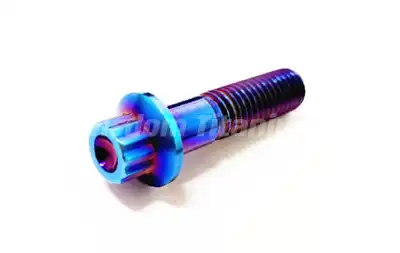
In high-performance engineering, the material used for the fastener determines how long the assembly will last. A bolt is more than just a piece of metal; it is a crucial part that can handle a lot of stress, vibration, and corrosion from the environment. When engineers ask for a m7 titanium bolt, they want a certain blend of lightness and strength. Even though this size seems normal, you need to know a lot about metallurgy to make sure it works under strain. We will look at the material qualities, strength ratings, and practical design factors that make titanium bolts the best choice for tough applications.
Which titanium grades matter for bolts?
The quality of the raw material is what makes a fastener work. Titanium is not one thing; it is a group of alloys, each with its own set of properties. Choosing the grade is the first stage in the design process for a m7 titanium bolt. Ti-6Al-4V, commonly known as Grade 5, is the most typical choice for applications that put a lot of stress on the material. This metal has 6% aluminum and 4% vanadium in it. It has the best strength-to-weight ratio of any titanium alloy. Engineers pick this grade when the bolt needs to hold up against high tensile loads without making the assembly much heavier.
Another option is commercially pure (CP) titanium grades, like Grade 2, which are typically used because they are very resistant to corrosion and can be easily shaped. Grade 2 is not as strong as Grade 5, but it is quite ductile. This lets the bolt's threads bend a little without breaking when you install it. We get our raw materials from Baoji Titanium Valley at Baoji Wisdom Titanium. One of the most complete industrial chains in the world is in this area. We can get high-quality sponge, ingots, and bars right away. This strategic location makes sure that the material used for your bolts fulfills the highest chemical and physical criteria right from the start.
Impurities in titanium can cause it to fail before it should. Adding things like iron and oxygen can make things stronger but make them far less flexible. A bolt that is fragile is a dangerous bolt. We have strict quality standards in place for our production process in Shaanxi Province. We make sure that the titanium rods we use to produce your m7 titanium bolt don't have any flaws or impurities. Industries like aerospace and medical implants trust our parts because we pay so much attention to the integrity of the materials we use. They know that a bolt from Baoji Wisdom Titanium will work the same way every time in important safety situations.
Key Mechanical Properties (Typical Ranges)
To validate a design, you need to know the numbers behind the material. When we talk about the mechanical qualities of a m7 titanium bolt, we mean things like its tensile strength, yield strength, and hardness. The maximal tensile strength of Grade 5 titanium is usually more than 895 MPa (130 ksi). This means that the bolt may take a lot of pulling before it breaks. The yield strength, which is the point at which the bolt permanently bends, is about 825 MPa (120 ksi). These numbers are similar to those of many high-strength alloy steels, however titanium is around 45% lighter.
Hardness is another critical factor, particularly for the threads. Titanium naturally has a lower modulus of elasticity than steel. This means it is more flexible. If the material is too soft, the threads can strip under load. Through precise cold working and heat treatment, we achieve a hardness that ensures thread integrity. Our manufacturing tolerance of ±0.05mm guarantees that the thread geometry is perfect. This precision ensures that the load is distributed evenly across the thread flanks. It prevents stress concentrations that could lead to fatigue cracks. We verify these properties through whole-process follow-up detection.
One of the best reasons to choosing a m7 titanium bolt is that it is lighter. Titanium is about 4.5 g/cm³, while steel is about 7.85 g/cm³. You may cut the weight of the fastener by almost half by switching to titanium. In fields like aerospace and motor racing, every gram matters. Less unsprung weight or overall aircraft mass means higher fuel efficiency and performance. Our bolts save weight without hurting the strength of your design.
Fatigue, Preload and Torque Considerations (Practical Design)
The theoretical strength of a bolt means little if it loosens in service. Fatigue resistance is the ability of a material to withstand cyclic loading. An m7 titanium bolt excels in this area. Titanium has excellent fatigue properties, meaning it can endure repeated vibrations—common in engines or rotating machinery—without failing. However, achieving this performance requires careful design regarding preload. Preload is the tension created when a bolt is tightened. It is the clamping force that holds the joint together.
Calculating the correct torque to achieve this preload is complex with titanium. Titanium has a high tendency to gall, or seize, when rubbed against itself or other metals. If you overtighten a standard bolt, you might strip the threads. With titanium, you risk seizing the bolt completely, making future removal impossible. To combat this, our bolts feature a polished surface finish. This smooth surface reduces friction, allowing for more accurate torque application and preventing galling. We also apply lubricants or specialized coatings when required to ensure consistent clamping forces.
Because titanium is less stiff than steel, it acts more like a spring. This can be an advantage in bolted joints where thermal expansion is a concern. As components heat up and expand, a titanium bolt can accommodate more movement without losing its clamp load compared to a rigid steel bolt. However, this flexibility requires engineers to account for it in their calculations. At Baoji Wisdom Titanium, our experienced R&D team helps clients navigate these nuances. We provide customized design solutions, ensuring that your m7 titanium bolt functions perfectly within the specific parameters of your assembly.
Baoji Wisdom Titanium is Your Trusted Partner
Choosing the perfect material is only half the battle; the other half is making it right. The Baiji Wisdom Titanium Industry and Trading Co., Ltd. combines top-notch material research with precision engineering. We have been in business since 2016 and make both conventional and custom CNC parts. We are ISO 9001:2015 certified, which means that every step of the process, from checking the raw materials to putting the final package together, satisfies international quality standards. Being in "China's Titanium Valley" gives us an unequaled edge in both supply chain efficiency and technical know-how.
We work with a wide range of industries, such as maritime engineering, petrochemicals, and making high-end equipment. We can make bolts that are 10mm to 100mm long and have a thread pitch of 1.0mm, which means we can meet a lot of different requirements. We can supply either a conventional ISO Metric thread or a custom design based on your samples. We will always be committed to quality. We take customer feedback very seriously and use it to make our products and services better all the time.
Our Commitment to Customization
We know that ready-made solutions don't always work for specific engineering problems. That's why we let you customize a lot. With our in-house R&D service system, we can make innovative items that are just right for your needs. We keep a full stock of raw materials on hand, which keeps costs consistent and lead times reliable. We guarantee the quality of our products because we have a solid staff and mature production technology. When you work with us, you're not just buying a fastener; you're also working with a staff that cares about your success.
Contact Us
You don't need to search any further if you want high-quality, precision-engineered fasteners made from better materials. The people at Baoji Wisdom Titanium are eager to help you with your individual needs. We have the skills to deliver quality, whether you need standard m7 titanium bolt parts or a completely unique design solution. If you need a quote or more information, please don't hesitate to contact us.
Email: sales@wisdomtitanium.com
FAQs
Question 1: Do titanium bolts attract magnets?
A: No, titanium is not magnetic. A titanium m7 bolt won't mess up magnetic fields or delicate electronics. This quality makes it perfect for medical devices, electronics, and maritime uses where magnetic interference is to be avoided.
Q2: Is it okay to use a regular torque wrench on titanium bolts?
A: You can use a regular torque wrench, but you have to take friction into account. Because titanium tends to gall, it is generally suggested to add a lubricant or a specific coating to cut down on friction. Our polished surface finish helps, but it's always advisable to talk to our technical experts about the ideal torque settings to use to avoid seizing.
Q3: What is the highest temperature at which these bolts can work?
A: Titanium bolts usually work well at temperatures up to about 600°F (315°C). The material may start to oxidize and lose strength if the temperature goes over this. For uses at greater temperatures, we can talk about certain high-temperature alloys that might work for you.
References
- ASM International. (2019). Titanium and Titanium Alloys: Fundamentals and Applications.
- Boyer, R. R. (2019). An overview on the use of titanium in the aerospace industry. Materials Science and Engineering: A.
- International Organization for Standardization. (2021). ISO 261:2021 ISO general purpose metric screw threads — General plan.
- Baoji Municipal Bureau of Industry and Information Technology. (2023). Development Report on Baoji China Titanium Valley Industrial Cluster.
- Baoji Wisdom Titanium Industry and Trading Co., Ltd. (2024). Internal Quality Control Manual and Production Specifications.