
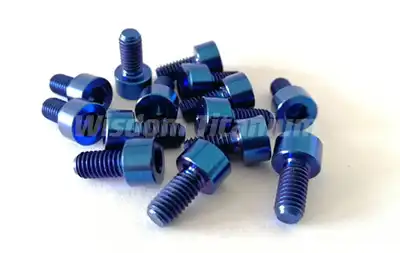
Titanium screws and bolts have changed the way engineers work. What used to be only for aerospace has recently moved to the marine, automotive, and sports equipment industries. The titanium allen head bolt is the best of these fasteners since it is very strong and resists corrosion very well. When you use advanced surface treatments to add color, these bolts go from being just functional parts to design elements that do two things.
Color isn't just about how things look. Anodizing and other surface treatments make oxide layers that preserve the surface and make it last longer. They make things more resistant to wear and tear and make it easy to see what's going on in complicated assemblies. Colored titanium bolts function better than steel bolts for manufacturing racing motorcycles, putting together medical equipment, or working on naval hardware.
Titanium Allen Head Bolts and Their Advantages
Common Titanium Grades and Their Properties
Three titanium grades dominate the fastener industry. Grade 2 (GR2) represents commercially pure titanium with excellent formability and corrosion resistance. It offers moderate strength suitable for general applications where weight reduction matters more than maximum load capacity. Chemical processing equipment often specifies GR2 for its superior resistance to acids and alkaline solutions.
Grade 5 (GR5), also known as Ti-6Al-4V, contains aluminum and vanadium alloys that dramatically increase strength. This aerospace-grade material handles extreme stress while maintaining titanium's low weight. Racing teams prefer GR5 for critical fasteners in suspension systems and engine components. The material withstands vibration and thermal cycling that would fatigue lesser metals.
Grade 7 (GR7) adds palladium to enhance corrosion resistance beyond even GR2 levels. Industries dealing with highly corrosive environments—like chemical plants and desalination facilities—specify GR7 when standard titanium isn't quite enough. The added cost proves worthwhile when equipment must function reliably for decades without maintenance.
Why Allen Head Design Dominates Premium Applications
The hexagonal socket design of titanium allen head bolts provides distinct advantages over external hex heads or Phillips drives. Higher torque transmission occurs because the wrench engages six contact points deep within the bolt head. This design prevents the cam-out and stripping common with other drive types. Mechanics can apply greater force without damaging the fastener.
Low-profile installations favor allen head designs. The countersunk or button head variations sit flush or nearly flush with mounting surfaces. Aerodynamic applications benefit from reduced wind resistance. Aesthetically demanding projects maintain clean lines without protruding bolt heads. The recessed socket also protects the drive interface from damage during handling and installation.
Standardization according to DIN 912 specifications ensures global compatibility. Manufacturers worldwide produce allen head bolts to these precise dimensions. Engineers can source replacements confidently, knowing that thread pitch, head height, and socket size match exactly. This interchangeability reduces inventory complexity and simplifies maintenance procedures.
Color Finishes and Anodizing
The Science Behind Titanium Anodizing
Anodizing titanium is very different from anodizing aluminum. An electrochemical technique makes the natural oxide layer on the titanium surface thicker. Manufacturers can make oxide layers of certain thicknesses by carefully manipulating the voltage. These layers mess with light waves, generating bright colors without using any dyes or pigments.
At low voltages, the color spectrum goes from bronze to blue, purple, and green at higher voltages. Gold shows up at about 15 to 20 volts. Around 40 to 50 volts, deep blue starts to show up. About 70 to 80 volts are needed for purple. Each hue corresponds to a given thickness of oxide that reflects certain wavelengths while letting others pass through and reflect off of deeper layers.
Anodized colors don't chip or peel like painted or powder-coated finishes do. The oxide structure itself has the color, not a coating on the surface. Anodized titanium allen head bolts are great for jobs where the look needs to stay the same even after wear and tear and exposure to the elements. The finish stays the same from cryogenic temperatures to hundreds of degrees.
Functional Benefits Beyond Aesthetics
The anodizing procedure makes the surface harder. The thicker oxide layer protects against scratches and wear better than untreated titanium. Anodized titanium surfaces can tolerate being put on and taken off many times without getting scratched, even though they aren't as durable as tool steel. Thread integrity lasts longer, especially when fastening into soft materials like aluminum or carbon fiber.
Improvements in lubricity make installation easier by lowering friction. The oxide layer makes the surface smoother than bare metal. Assembly technicians see that anodized titanium allen head bolts are easier to thread and need less torque to get the right preload. This feature protects expensive parts from damage during assembly and makes sure that the clamping force is always the same.
Color coding makes it easy to see and identify things quickly. By color, maintenance staff can quickly tell the difference between different bolt standards. It is easy to see which fasteners are critical and need certain torque levels or need to be replaced at certain times. This safety feature has been useful in aerospace and automotive racing, where technicians are under a lot of pressure and can't afford to make mistakes when it comes to identifying things.
Selecting the Right Style and Specifications for Your Application
Thread Sizes and Length Considerations
Metric threads from M3 through M24 cover the vast majority of applications. Smaller M3 and M4 sizes suit electronics housings and precision instruments. Medium sizes like M6 and M8 dominate bicycle components and light machinery. Large M12 through M24 bolts handle heavy structural loads in automotive and industrial equipment.
Length selection depends on grip length—the thickness of materials being clamped together. Engineers typically specify bolt lengths that allow at least two threads to protrude beyond the nut after full engagement. Lengths from 5mm to 100mm provide flexibility for various assembly configurations. Shorter bolts minimize weight and cost. Longer bolts accommodate thick sections or multiple components in a single joint.
Thread engagement depth affects joint strength significantly. A minimum of one bolt diameter of thread engagement ensures the fastener reaches its full strength potential. Softer materials like aluminum require more engagement to distribute loads adequately. Hardened steel or titanium tapped holes can sometimes accept less engagement, but conservative design practices favor deeper engagement for reliability.
Industry-Specific Applications and Requirements
Aerospace demands exacting specifications and complete traceability. Every titanium allen head bolt must include material certifications documenting chemical composition and mechanical properties. Anodized finishes must meet military specifications for adhesion and durability. Manufacturers like Baoji Wisdom Titanium maintain quality systems that satisfy these rigorous requirements while providing the documentation engineers need for compliance.
Marine applications prioritize corrosion resistance above all else. Saltwater creates one of the harshest environments any fastener will encounter. Titanium's natural passivity handles this challenge effortlessly, but proper grade selection matters. Grade 7 offers maximum protection for underwater hardware and components in constant contact with seawater. Anodized finishes add another layer of protection while enabling color coding for maintenance schedules.
Medical and dental applications require not only biocompatibility but also sterilization resistance. Titanium fasteners must withstand repeated autoclaving without degradation. Anodized colors cannot fade or contaminate during steam sterilization cycles. Surgical instrument manufacturers increasingly specify colored titanium allen bolts because they combine all necessary properties—biocompatibility, corrosion resistance, light weight, and visual identification—in a single fastener.
Automotive and motorsport teams push titanium fasteners to performance extremes. Engine components experience thermal cycling from ambient to several hundred degrees. Suspension systems transmit impact loads and vibration constantly. Colored anodizing helps mechanics track inspection intervals and identify upgraded components during pit stops. The weight savings accumulate across hundreds of fasteners to improve power-to-weight ratios measurably.
Why Baoji Wisdom Titanium Delivers Excellence?
Manufacturing Heritage from China's Titanium Valley
Baoji Titanium Valley in Shaanxi Province represents China's largest and most comprehensive titanium industry cluster. This region has earned global recognition as a major titanium production base with capabilities spanning the entire supply chain. From titanium sponge and ingots through bars, plates, tubes, and forgings, Baoji hosts hundreds of specialized enterprises that collectively form an unmatched manufacturing ecosystem.
The industrial scale concentrated in this region provides distinct advantages. Complete vertical integration means shorter lead times and better quality control. When raw material production, alloy development, and precision machining occur within the same industrial cluster, manufacturers can respond quickly to customer requirements. Innovation accelerates as research institutes, national laboratories, and production facilities collaborate closely.
International reputation continues growing as Baoji enterprises supply titanium to Europe, North America, Southeast Asia, and the Middle East. Large-scale conferences and trade exhibitions attract global buyers seeking reliable sources for high-quality titanium products. This visibility has transformed Baoji into a recognized force shaping the titanium industry's future worldwide.
Quality Systems and Production Capabilities
Baoji Wisdom Titanium Industry and Trading Co., Ltd. maintains ISO 9001 certification that demonstrates commitment to consistent quality. Founded in 2016, the company has rapidly established itself as a trusted manufacturer and supplier of standard and customized CNC parts. Serving aerospace, energy, oil and gas, medical, electronics, chemical, marine, automotive, motorcycle, and bicycle industries requires adaptability and precision that few suppliers can match.
All titanium allen head bolts start from high-quality titanium rods subjected to careful inspection before machining. Production technology has matured through years of refinement and customer feedback. Whole-process quality detection ensures that every dimension meets specifications. Stable staffing means experienced machinists and quality inspectors who understand the critical nature of precision fasteners.
Complete inventory of raw materials and standard parts enables quick turnaround even for urgent orders. Price stability comes from strategic material sourcing and efficient production planning. Customers appreciate knowing that quoted prices remain valid and that delivery schedules can be trusted. In industries where downtime costs thousands per hour, reliable suppliers become invaluable partners.
Customization and Technical Support
An experienced research and development team provides customized services that go beyond catalog offerings. Engineers work directly with customers to develop fasteners optimized for specific applications. Whether modifying head styles, adjusting thread forms, or creating unique anodizing patterns, the technical capability exists to transform concepts into production reality.
Sample development from customer-provided drawings or physical parts demonstrates flexibility. Sometimes an existing fastener needs minor modifications. Other times, entirely new designs require prototyping and testing. Baoji Wisdom Titanium engages seriously with these challenges, viewing each custom project as an opportunity to expand capabilities and serve customers better.
Beyond titanium, the company produces fasteners in nickel, tantalum, and zirconium for applications where these exotic materials offer advantages. Titanium rods, flanges, and forgings complement the fastener product line. This diversity means customers can consolidate suppliers and simplify procurement while maintaining quality standards across their entire bill of materials.
Complete specifications are available for our titanium allen head bolt DIN912 product line spanning thread sizes M3-M24, lengths 5mm-100mm, and finishes including polished, anodized, and customized options. Material certifications document GR2, GR5, and GR7 titanium properties. Packaging can be configured to your preferences, from standard cartons to custom arrangements that simplify your receiving and inventory processes.
Questions about specifications, pricing, or technical requirements? Our team responds seriously to all inquiries because we recognize that communication drives product improvement. Through understanding your exact needs, we refine our offerings to meet evolving market demands.
Ready to discuss your titanium fastener requirements? Send your inquiry to sales@wisdomtitanium.com today. Our technical team will respond promptly with detailed information, pricing, and delivery schedules tailored to your project.
FAQs
Q1: Will anodized colors fade or wear off over time?
A: No, anodized colors on titanium are permanent because they result from oxide layer thickness rather than surface coatings or dyes. The color exists within the titanium oxide structure itself, not on top of it. Normal wear may polish high spots slightly but won't remove color. The finish remains stable across extreme temperature ranges and resists chemical exposure that would destroy painted or plated finishes.
Q2: Can I specify custom colors for my titanium allen head bolts?
A: Yes, the anodizing voltage can be adjusted to produce specific colors within the titanium spectrum. Common colors include gold, blue, purple, green, and bronze. Each color corresponds to a precise voltage that creates a specific oxide thickness. Baoji Wisdom Titanium can match color requirements for branding, safety coding, or aesthetic preferences. Contact our technical team to discuss your exact color needs.
Q3: What thread standards do you follow for titanium allen head bolts?
A: Our titanium allen head bolts conform to DIN 912 specifications, which define precise dimensions for socket head cap screws. Thread forms follow metric standards from M3 through M24. This international standardization ensures compatibility with standard hex keys and tapped holes worldwide. We can also produce fasteners to other standards like ISO 4762 or custom specifications upon request.
References
- ASM International. (2015). "Titanium: A Technical Guide, 2nd Edition." ASM International Handbook Committee. Materials Park, OH.
- Donachie, M. J. (2000). "Titanium: A Technical Guide." ASM International. This comprehensive reference covers titanium alloy properties, surface treatments, and fastener applications across industries.
- Lutjering, G., & Williams, J. C. (2007). "Titanium, 2nd Edition." Springer-Verlag Berlin Heidelberg. Detailed coverage of titanium metallurgy, anodizing processes, and engineering applications.
- DIN 912. (2014). "Hexagon socket head cap screws." Deutsches Institut für Normung. Official specification for allen head bolt dimensions and tolerances.
- Boyer, R., Welsch, G., & Collings, E. W. (1994). "Materials Properties Handbook: Titanium Alloys." ASM International. Reference data for titanium grades including mechanical properties and corrosion resistance characteristics.




