
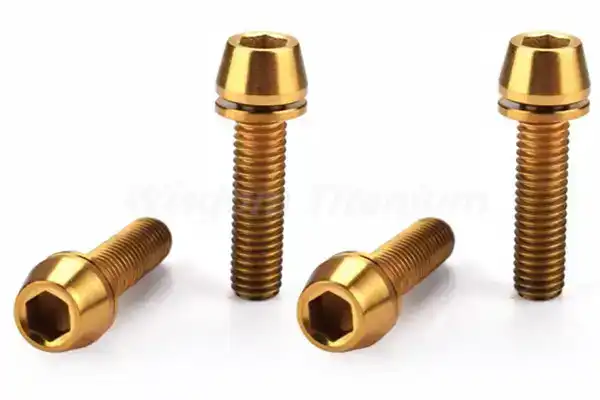
Every serious cyclist knows the frustration. You've invested thousands in a lightweight carbon frame, precision wheels, and high-end components. Yet your bike still carries unnecessary weight in the most overlooked places, the fasteners holding everything together. Standard steel bolts add grams that accumulate across dozens of connection points, quietly sabotaging your performance goals.
The solution sits within a specialized manufacturing hub in Shaanxi Province, China. Baoji Titanium Valley produces some of the world's finest titanium components, including road bike titanium bolt options that rival, and often exceed, European alternatives. These aren't generic hardware store fasteners. They represent aerospace-grade engineering adapted for cycling's demanding requirements.
This review examines the practical realities behind Chinese titanium bolt manufacturing. We'll explore measurable performance advantages, investigate quality standards, and calculate whether premium pricing delivers genuine value. Most importantly, you'll discover why selecting the right supplier matters as much as choosing titanium itself.
Why Road Bike Titanium Bolts Outperform Traditional Fasteners?
Consider the practical implications. A complete titanium bolt conversion, replacing stem, seatpost, bottle cage, and brake hardware, typically saves 80-120 grams. That equals eliminating a full water bottle's weight without sacrificing structural integrity. For competitive riders where seconds matter, this represents a measurable advantage achieved through components that actually enhance durability.
Material Science Behind Superior Performance
The crystalline structure of Grade 5 titanium explains its exceptional fatigue resistance. Unlike softer pure titanium (Grade 2), the aluminum-vanadium alloy maintains strength through millions of stress cycles. Laboratory testing demonstrates that properly manufactured titanium bolts withstand vibration and load fluctuations far better than alternatives.
Temperature stability matters more than most cyclists realize. Road bike titanium bolts' low thermal expansion coefficient prevents loosening during temperature swings, critical for components experiencing brake heat or alpine descents. The material maintains consistent clamping force from freezing morning starts through afternoon climbs, eliminating the micro-movements that work steel fasteners loose over time.
Baoji manufacturers leverage China's complete titanium supply chain, from sponge production through final machining. This vertical integration ensures material traceability and consistent chemistry throughout production batches. Raw material undergoes spectroscopic analysis before machining begins, verifying alloy composition meets aerospace specifications that exceed cycling requirements.
Manufacturing Precision That Delivers Reliability
CNC manufacturing precision determines whether titanium bolts perform as designed or fail prematurely. Modern Chinese facilities employ Swiss-made machining centers accurate to micron tolerances, cutting threads that engage smoothly without cross-threading risk. The difference becomes apparent during installation—quality bolts thread effortlessly while inferior products bind and gall.
Thread rolling versus thread cutting represents another critical distinction. Rolled threads compress material rather than removing it, creating work-hardened surfaces with 30% greater fatigue strength. This manufacturing method also produces smoother finishes that resist galling when paired with titanium frames or components. Baoji Wisdom Titanium employs thread rolling for all road bike titanium bolt production, ensuring maximum durability.
Real-World Weight Savings Across Your Bicycle
Strategic replacement focuses on high-count fastener groups where savings multiply quickly. Bottle cage bolts represent low-hanging fruit—four M5x12mm titanium bolts save roughly 8 grams versus steel equivalents. Stem bolts (typically four to six fasteners) contribute another 12-15 gram reduction. Seatpost clamps, brake calipers, and derailleur mounting bolts add incremental savings that accumulate meaningfully.
Professional mechanics report that complete titanium hardware conversions typically achieve 100-150 gram total savings depending on bicycle specification. This matches the weight difference between standard and lightweight handlebar tape, achieved through components that actually improve reliability rather than sacrificing durability for grams.
Evaluating Strength Standards and Safety Considerations
Strength specifications determine whether titanium bolts serve as genuine upgrades or expensive liabilities. Grade 5 titanium bolts manufactured to aerospace standards exhibit tensile strength around 895-930 MPa and yield strength approximately 828 MPa. These values comfortably exceed the clamping forces encountered in bicycle applications when properly sized and torqued.
Quality Control Systems That Ensure Consistency
ISO 9001 certification provides baseline quality assurance, but leading Chinese road bike titanium bolt manufacturers implement additional verification protocols. Baoji Wisdom Titanium performs dimensional inspection on sample bolts from each production batch, measuring thread pitch, head height, and shaft diameter against engineering drawings. This statistical process control identifies variance before defective components reach customers.
Hardness testing verifies that the heat treatment achieved the target mechanical properties. Rockwell hardness measurements confirm uniform material characteristics throughout each bolt. Non-conforming batches undergo reprocessing or rejection rather than shipment, a quality commitment that protects both company reputation and cyclist safety.
Grade 5 Titanium Specifications
Minimum mechanical properties specified by ASTM B348 include 895 MPa ultimate tensile strength and 828 MPa yield strength in the annealed condition. These values provide substantial safety margins for bicycle applications where typical bolt loads rarely exceed 20-30% of material capability. Conservative engineering ensures long-term reliability even under racing conditions.
Value Analysis: Comparing Chinese Manufacturing to Global Alternatives
Price comparisons reveal significant advantages for Chinese-manufactured road bike titanium bolts. Bulk pricing further amplifies value. Custom orders meeting 200-piece minimum quantities access factory-direct pricing that drops costs an additional 30-40%. For bicycle manufacturers, team purchasing groups, or shops stocking inventory, this economic advantage becomes substantial. The same aerospace-grade material costs less because it originates closer to raw material sources within China's integrated titanium industry.
Baoji Titanium Valley's Manufacturing Advantage
Geography shapes economics in titanium production. Baoji Titanium Valley in Shaanxi Province hosts over 600 titanium-related enterprises, forming China's most concentrated manufacturing cluster. This industrial ecosystem spans from primary sponge production through precision CNC machining, creating efficiency advantages unavailable to isolated manufacturers elsewhere.
The complete supply chain reduces costs and lead times simultaneously. Raw titanium sponge produced locally gets processed into bar stock within the same industrial park. CNC machine shops source material from neighboring mills rather than importing from distant suppliers. Transportation expenses, inventory carrying costs, and supply chain risks all decrease compared to Western manufacturers dependent on Chinese titanium imports.
Research infrastructure accelerates innovation. Baoji hosts national titanium laboratories, university research centers, and corporate R&D facilities that collaborate on advancing processing technologies. New surface treatments, optimized heat treatment cycles, and improved machining techniques developed for aerospace applications rapidly transfer to bicycle component production. This knowledge transfer benefits cyclists through continuously improving product performance.
Evaluating Total Cost of Ownership
The initial purchase price represents only one component of road bike titanium bolt economics. Durability, maintenance requirements, and replacement frequency determine true lifetime costs. Titanium bolts that never corrode, resist galling, and maintain torque over years of service eliminate the hidden costs of premature failure and repeated replacement.
Consider a complete bicycle rebuild cycle. Steel fasteners often require replacement during major service intervals due to corrosion or thread damage. Titanium hardware typically transfers to new frames or components indefinitely, retaining both function and appearance. For cyclists who upgrade bikes every few years, titanium bolts become permanent toolkit assets rather than consumables.
Professional team mechanics calculate labor costs alongside parts expenses. Titanium bolts install more smoothly, require less frequent retorquing, and eliminate the frustration of seized fasteners during routine maintenance. The time savings multiply across fleet management, where twenty bicycles each need periodic servicing. Premium fasteners reduce both parts costs and mechanical hours over competitive seasons.
Selecting a Reliable Chinese Titanium Bolt Manufacturer
Manufacturer selection determines whether you receive aerospace-quality fasteners or disappointing imitations. Established producers demonstrate their capabilities through certifications, customer references, and transparent manufacturing processes. Baoji Wisdom Titanium Industry and Trading Co., Ltd. exemplifies the professional approach that separates premium suppliers from commodity vendors.
Founded in 2016, Baoji Wisdom Titanium operates as an ISO 9001-certified manufacturer serving aerospace, medical, energy, and cycling industries. This multi-sector experience ensures manufacturing standards exceed bicycle-specific requirements. Facilities equipped to produce medical implants and aerospace components necessarily maintain quality systems robust enough for critical applications where failure carries severe consequences.
Road bike titanium bolt range indicates manufacturing sophistication. Companies offering both standard fasteners and custom CNC machining possess the technical capabilities and equipment investments that signal serious operations. Baoji Wisdom Titanium produces titanium bolts alongside custom components, demonstrating versatility across complexity levels. This breadth suggests engineering resources adequate for problem-solving when special requirements arise.
Selecting the right titanium bolt supplier determines whether you receive genuine aerospace-grade components or disappointing substitutes. Baoji Wisdom Titanium Industry and Trading Co., Ltd. combines manufacturing excellence with customer service that exceeds industry standards. The company's location within Baoji Titanium Valley provides direct access to China's most sophisticated titanium infrastructure.
For detailed road bike titanium bolt information, custom quotations, or technical consultation, contact the sales team directly. Email inquiries to sales@wisdomtitanium.com with your specifications and quantity requirements. The responsive team typically provides comprehensive quotations within 24-48 hours, including pricing across volume breaks, lead time estimates, and customization options.
FAQs
Q1: Are Chinese-made titanium bolts as strong as European brands?
A: Yes—Grade 5 titanium bolts from reputable ISO-certified Baoji manufacturers match European strength when produced to ASTM B348 standards.
Q2: What weight savings can I expect from a complete titanium bolt conversion?
A: A full titanium bolt upgrade typically saves about 100–150 grams depending on your bicycle’s configuration.
Q3: How do I prevent galling when installing titanium bolts?
A: Apply anti-seize, clean the threads, hand-start installation, and use controlled torque to prevent galling.
References
- ASTM International. (2021). ASTM B348 - Standard Specification for Titanium and Titanium Alloy Bars and Billets. West Conshohocken, PA: ASTM International.
- Donachie, M. J. (2000). Titanium: A Technical Guide (2nd ed.). Materials Park, OH: ASM International.
- Lutjering, G., & Williams, J. C. (2007). Titanium (2nd ed.). Berlin: Springer-Verlag.
- Boyer, R., Welsch, G., & Collings, E. W. (1994). Materials Properties Handbook: Titanium Alloys. Materials Park, OH: ASM International.
- Faller, K., & Froes, F. H. (2001). The Use of Titanium in Family Automobiles: Current Trends. JOM Journal of the Minerals, Metals and Materials Society, 53(4), 27-28.




