
The dependability of fastening systems decides how safe operations are and how long the equipment lasts in high-performance car assemblies, aircraft structural joints, and precision motorbike parts. When vibrations cause parts to become loose, they can break in terrible ways. Locking mechanisms stop this from happening, especially in places where there is temperature cycling, mechanical shock, and dynamic loading. A complicated question that procurement workers and design engineers often have to deal with is: can standard lock washers and nylon insert lock nuts work well together?
This problem with compatibility becomes very important when using titanium nylon lock nuts in uses that need to be light and resistant to rust. Knowing how the different locking parts work together (or against each other) helps you make the best purchases and follow the right setup steps. We look at the engineering ideas behind nylon insert locking in this piece. We also look at lock washer compatibility through real-life case studies and talk about how to find titanium-based fastening options. The information given gives B2B clients the technical know-how to improve the reliability of fasteners while lowering supply chain risk in tough industrial settings.
Nylon Nuts and Lock Washers
What Are Nylon Lock Nuts?
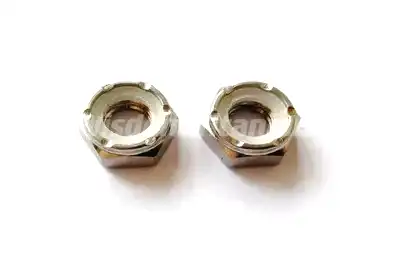
A polymer piece is sealed inside the upper part of a normal hex nut body. These nuts are called nylon lock nuts, nylock nuts, or elastic stop nuts. This nylon collar gets in the way of the threads on the bolts that are mated with it, creating friction that stops the bolts from rotating free when they are shaken. When a bolt meets the nylon part, the threads slightly bend the polymer, creating a strong mechanical grip that doesn't need any extra washers or glue.
Grade 5 titanium nylon lock nuts blend the power of titanium alloy (Ti-6Al-4V) with the proven ability of nylon plugs to lock. These fasteners have a tensile strength of over 895 MPa and weigh about 60% less than steel versions. They also don't rust in sea, chemical processing, or outdoor settings. The natural titanium finish gets rid of worries about coating failure, so the look and performance stay the same over a longer service life.
Nylon Insert Locking Mechanism
Elastic displacement, not thread damage, is how the locking principle works. The undersized nylon plug pinches axially as the bolt goes through the nut. This makes a continuous friction zone along several thread pitches. This spread-out locking action keeps the preload tension even when movements from the outside try to turn the part. Instead of mechanical ways that depend on thread distortion, nylon plugs keep the thread's integrity, so they can be used again in non-critical situations where the nylon stays whole.
Most normal nylon materials can handle temperatures from -40°C to 120°C, but some high-temperature versions can handle temperatures up to 150°C. Beyond these limits, nylon softening makes locking less effective, so in very hot places, all-metal options like cone-type dominant torque nuts are needed.
Types of Lock Washers
Lock nuts try to keep things from coming open in a number of ways, including:
Helical spring washers, also known as split washers, have a cut ring that flattens out when it's loaded. This creates tension and a sharp edge that fits against both the nut face and the joint surface. Their usefulness is still being discussed, as studies have shown that they aren't very good at blocking vibrations in many situations.
Tooth washers have serrations on the inside or outside that bite into surfaces that they are meant to fit, creating resistance by deforming the surface. Different types of external teeth spread the stress on the bearings, while internal teeth focus the stress near the middle of the bolt.
As joints settle, wave washers keep the spring tension by providing axial flexibility. They work better as preload repair tools than as main closing parts.
Each design handles a different type of failure, but their basic mechanical ideas are very different from nylon inserts' friction-based method. When judging fit, this difference becomes very important.
Can You Use a Lock Washer with a Nylon Nut?
Most of the time, putting lock screws and nylon insert nuts together is not required and could even be harmful. Because friction between the nylon plug and the door already makes it very secure, adding more closing parts is not necessary. Putting a lock washer under a nylon lock nut makes things more complicated instead of safer.
Why Lock Washers Conflict with Nylon Inserts
Keeping the right clamp load and thread contact depth is important for the nylon locking device to work. There are several problems that happen when workers put split washers or tooth washers under titanium nylon lock nuts:
Less thread engagement: Because the washer is thick, fewer threads can pass through the nylon insert. For optimal locking, at least four full threads must contact the polymer collar. Washers take up valuable bolt length, which could mean that there isn't enough engagement for friction to build up properly.
Unpredictable preload: When split washers are installed, they flatten out in unpredictable ways, which makes stack heights changeable and makes torque specification harder. This unevenness makes it impossible to accurately control the preload, which is very important in structural and safety-critical assemblies where the stability of the joint rests on accurate clamping force.
Tooth washers bite into both the joint surface and the nut bearing face, which can damage the surface. On titanium parts, this can lead to stress concentration points that cause wear cracks to form when the parts are loaded and unloaded over and over again. The harm to the nut face may also stop it from fitting properly, letting the nut cock at an angle that loads the nylon insert unevenly.
Engineering Analysis of Combined Systems
Fastener study institutes have shown that nylon lock nuts can keep their preload even when they are vibrating without the need for extra fastening devices. As part of a standard evaluation method called the Junker vibration test, screws are moved back and forth while clamp load retention is measured. After 2,000 rounds, nylon insert nuts still hold more than 80% of their original preload, making them better than setups that only use split washers.
Adding lock nuts to this system that works already makes it more complicated without adding any real value. The spring action of the washer can't fix loosening caused by vibrations because the nylon core already stops spinning. Instead, the washer might slightly lift during thermal expansion, leaving a space that lets tiny movements happen that weakens the security of the joint.
Case Study: Motorsport Brake Caliper Assembly
At first, a professional race team asked for split washers to be put under titanium nylon lock nuts on bolts that hold the brake cylinder in place. Engineers found uneven nut seating and less thread contact on several fasteners during the post-race check. An experiment in the lab showed that the washer's spring action stopped the nylon insert from being fully compressed. This left holes where vibration could cause micro-rotation.
After getting rid of the washers and fitting the nuts directly against the caliper mounts, there were no more instances of the nuts coming loose during future races. Measurements of torque retention showed that the preload stayed the same during the race, proving that the nylon plug works well on its own. This experience made engineering advice against mixing locking systems that are already working.
Procurement Guide for Titanium Nylon Lock Nuts
To find titanium fasteners, you need to pay attention to the qualifications of the suppliers, the product specs, and the operations of the supply chain. The tips below will help procurement workers find their way around this niche market area.
Identifying Reliable Suppliers and Certification Requirements
Manufacturers of titanium fasteners must have a quality control system that is certified to ISO 9001. This standard makes sure that there are written procedures for tracking materials, checking their dimensions, and dealing with nonconformances. Other certifications that are useful for certain fields are AS9100 for aircraft, ISO 13485 for medical equipment, and IATF 16949 for suppliers to the car industry.
Ask for material test results (MTRs) that prove the chemical make-up and mechanical qualities. As per ASTM B348 or AMS 4928 standards, grade 5 titanium should have an aluminum content of 5.5 to 6.75%, a vanadium content of 3.5 to 4.5%, and an oxygen content of less than 0.20%. Tensile strength is more than 895 MPa and yield strength is more than 828 MPa, according to mechanical tests.
For large projects, the ability to check suppliers is important. Manufacturers who have been around for a while keep track of everything from the raw titanium sponge to the final inspection and casting. The Baoji Wisdom Titanium Industry and Trading Co., Ltd is in the Baoji Titanium Valley in Shaanxi Province. It is part of China's largest titanium industry area. Sponge making, ingot casting, and finished product making are all centered in this area. This allows for vertical integration, which keeps quality and cost under control throughout the supply chain.
Minimum Order Quantities and Lead Time Planning
Titanium nylon lock nuts usually need a minimum order quantity (MOQ) of 100 to 500 pieces per size and standard. This depends on how hard they are to make. Major suppliers keep standard metric sizes (M3–M24) and their inch counterparts in stock, so pressing needs can be met quickly. Lead times are extended to 4 to 6 weeks for production runs that need to be made because of custom sizes, thread pitches, or changed nylon insert specs.
Pricing Strategies and Bulk Procurement Advantages
When you negotiate yearly blanket orders with planned releases, you can get better prices and make sure you have enough capacity during times of high demand. Suppliers offer savings for buying in bulk starting at 1,000 pieces, with bigger breaks at 5,000 and 10,000 pieces. Through collaborative forecasting, manufacturers can find the best times to buy raw materials and schedule output, which saves them money on each unit and benefits buyers.
Titanium's raw material costs change based on the cycles of world sponge production and aircraft demand. Setting up long-term supply deals with price changes based on public titanium indices saves both parties from changes in the market. Grade 5 titanium nylon lock nuts cost between $2.50 and $4.50 per piece for M8 to M12 sizes when bought in groups of 500. When bought in larger amounts, savings of 15 to 25 percent are applied, lowering the costs even more.
Titanium's worth can be seen by comparing its total cost of ownership instead of its unit price. An $80 stainless steel nut needs to be replaced every 18 months because it rusts, but a $3.50 titanium nut lasts five years. This means that titanium is more cost-effective over the long term by over 60%. To get a full picture of the economic effect of buying, you should include costs for labor, machine downtime, and disposal.
Partner with Wisdom Titanium for Your Precision Fastening Needs
Wisdom Titanium offers hot-forged hex titanium nylon lock nuts that are ISO 9001-certified and made for critical fixing uses where failure is not an option. Our Grade 5 titanium parts have great resistance to rust, high strength-to-weight ratios, and effective nylon insert locking mechanisms. They come in sizes from M3 to M24 and can be threaded in either metric or inch standards. We're in Baoji Titanium Valley, which is China's best place to make titanium products. From getting the raw materials to CNC finishing, we do everything ourselves. This way, we can guarantee stable quality and low factory prices for orders as low as 100 pieces.
Our skilled expert team creates unique solutions for uses in the car, aerospace, motorcycle, and industrial sectors. These solutions are backed by full material certifications and quick after-sales support. You can get custom quotes, talk about the benefits of buying in bulk, and ask for sample kits with full test paperwork by emailing sales@wisdomtitanium.com. Learn why top makers choose Wisdom Titanium as their go-to source for titanium nylon lock nuts in projects that need flawless dependability.
Conclusion
When used with nylon insert nuts, lock washers don't do anything useful and may even make the fastening less reliable by lowering thread engagement and causing uneven preload conditions. Titanium nylon lock nuts can be used to lock things together on their own because they have better friction-based resistance than standard washer systems when the system is vibrating. Their ability to resist corrosion, being lightweight, and being able to be used again and again give them clear benefits over steel, stainless steel, and aluminum in a wide range of challenging situations.
When purchasing titanium fasteners, people in charge of buying things should look at their lifetime costs instead of just the unit price. This is because better material features lower upkeep costs and increase service intervals. Getting your parts from ISO-certified companies that can do vertical integration makes sure that you can track your materials, get accurate measurements, and trust the supply chain, all of which are important for important assemblies.
FAQs
Do Lock Washers Improve Nylon Lock Nut Performance?
Lock washers don't make nylon lock nuts work better; in fact, they might make them less effective. The cotton liner resists vibrations better through friction, so you don't need to add any extra parts. When you add washers, the thread engagement depth goes down and the preload becomes less constant. This makes it harder to do precise assembly with titanium screws. Tests in the business world show that nylon insert nuts keep the clamp load better when the system is vibrating than washer-based systems alone.
What Temperature Range Can Titanium Nylon Lock Nuts Tolerate?
Standard nylon inserts work steadily from -40°C to 120°C, making them good for most industrial, marine, and vehicle uses. This range goes up to 150°C for high-temperature cotton types. The titanium nut body can handle temperatures above 300°C, but the nylon core breaks down when it gets too hot. All-metal prevailing torque nuts made from Grade 5 titanium should be used in situations where they will be exposed to temperatures above 150°C for a long time.
Can Titanium Nylon Lock Nuts Be Reused After Disassembly?
Titanium nylon lock nuts can be installed three to five times before the nylon part wears out enough to make the sealing less effective. A visual check shows that the nylon is in good condition—intact threads and strong pushback during fitting mean that it can be used again. For safety-critical uses, installations must only be used once, no matter how good or bad they look. On the other hand, controlled reuse is good for repair and prototype setups. To make sure that the locking works well, you should always check that the torque needs stay the same across setups.
References
- Bickford, J. H. (2008). Introduction to the Design and Behavior of Bolted Joints: Non-Gasketed Joints (4th ed.). CRC Press.
- Machinery's Handbook (31st ed.). (2020). Industrial Press.
- ASTM International. (2021). ASTM B348: Standard Specification for Titanium and Titanium Alloy Bars and Billets. West Conshohocken, PA.
- SAE International. (2019). Fastener Standards Manual: Aerospace-Automotive-Industrial. Warrendale, PA.
- Croccolo, D., De Agostinis, M., & Vincenzi, N. (2012). "Failure Analysis of Bolted Joints: Effect of Friction Coefficients in Torque-Preload Relationship." Engineering Failure Analysis, 25, 205-216.
- Junker, G. H. (1969). "New Criteria for Self-Loosening of Fasteners Under Vibration." SAE Technical Paper 690055.