
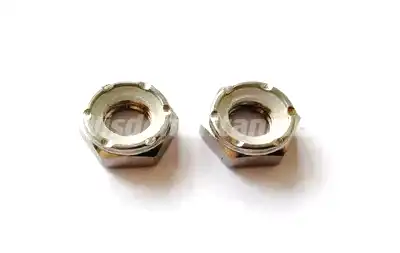
You can twist titanium nylon lock nuts, and doing it right makes sure that the nuts work perfectly in important situations. These special screws use Grade 5 titanium, which has a great strength-to-weight ratio, and a nylon core that makes friction when tightening. When torqued within the manufacturer's recommended ranges, which is usually between 60 and 70% of the torque used for normal titanium hex nuts, the nylon element deforms elastically against the male threads, creating a steady gripping force. To properly torque something, you don't want to under-tighten it, which could cause it to loosen up when it shakes, or over-torque it, which could damage the nylon insert or break the titanium threads. Shops that modify cars, racing teams, and aerospace engineers need to know about torque standards because they count on these fasteners to keep joints together in harsh conditions.
Titanium Nylon Lock Nuts Torque Characteristics
When used in high-stress situations, titanium nylon lock nuts are a clever way to keep fasteners from coming loose. In contrast to regular nuts, which only rely on thread friction, these parts have a nylon polymer ring inside the top part of the nut body. When the male fastener engages this insert during installation, the nylon material slightly contracts, making an interference fit that makes it hard to turn. This device works regardless of the clamping load that is applied. This means that the locking action will still work even if the joint goes through small settlement or thermal expansion cycles.
Material Composition and Structural Features
Premium nylon lock nuts are made from Grade 5 titanium metal (Ti-6Al-4V), which has a tensile strength of over 895 MPa and a density 40% lower than steel versions. The nylon core, which is usually made from polyamide 6 or 6/6, is very resistant to most industrial chemicals, hydraulic fluids, and gasoline products. When things are made, hot forging creates fine grain structures that make them more resistant to wear. This is especially important for parts that are loaded over and over again, like those in brake systems, wheel assemblies, and suspension links.
The force uniformity is directly related to how accurately the threaded bore is measured. Manufacturers like Wisdom Titanium use CNC finishing on forged blanks to keep thread specs within ISO 965-1 guidelines. This makes sure that the nylon insert fits evenly across the thread profile. This accuracy keeps stress from building up in one place, which could weaken the locking device over time when it is installed over and over again.
How the Nylon Insert Enhances Torque Resistance
It's called "prevailing torque" by engineers. It's the resistance you feel before the fastener sits against the matching surface. It happens when the male thread moves the nylon material around in a circle. This common torque is usually between 20 and 30 percent of the final fitting torque. It stays pretty much the same for the nut's useful life as long as it is used within its temperature range. Because nylon is stretchy and can recover its shape, the insert stays in touch with the bolt threads even when the joint loads change during use.
Automotive engineering teams have tested and found that properly torqued nylon lock nuts keep the clamp load more stable than mechanical lock washers when they are subject to motion frequencies between 10 and 2000 Hz. Because of how well they work, they are required for mounting brake calipers and wheel hub systems on race cars, where loosening could cause catastrophic failure.
Operating Temperature Ranges and Thermal Effects
Standard nylon plugs keep closing well between -40°C and 120°C, which is a wide range of temperatures that most cars and motorcycles can handle. When the temperature goes above 120°C, polyamide starts to soften. This lowers the dominant torque and might allow spinning under high vibrational loads. For racing brake systems that keep the caliper hotter than 150°C while stopping hard, you need to use different options, like all-metal locking nuts or controlled cooling methods.
Thermal cycling adds another thing for buying experts to think about. When heated and cooled over and over, the metal body and nylon core expand at different rates. Good makers take this into account by designing the insert pocket with specific gaps that allow for thermal movement without affecting the closing performance at room temperature. When looking for fasteners for places where temperatures change a lot, like off-road motorcycle exhaust systems or high-altitude aircraft parts, it's important to check the supplier's thermal cycle testing procedures.
How to Correctly Torque Titanium Nylon Lock Nuts?
To get a solid joint, you need to follow the torque specs and tightening methods correctly. Because titanium nylon lock nuts and nylon locking elements are different from regular steel screws, they need to be installed in a certain way.
Recommended Torque Values Based on Standards in the Industry
Thread width, metal grade, and application safety factors all affect the torque requirements for titanium nylon lock nuts. A general rule of thumb is that M6 fasteners need 8–10 Nm, M8 sizes need 18–22 Nm, M10 fasteners need 32–38 Nm, and M12 uses need 55–65 Nm. These numbers are starting points that should be changed based on what the maker says and the geometry of the joint.
Because the nylon insert creates more friction, critical uses in car brake systems often call for lower torque values—about 85 to 90 percent of normal titanium fastener specs. Over-torquing is the most common mistake made during installation. This can cause nylon to become squeezed and lose its ability to stretch back to its original shape, as well as titanium threads to become stripped and unable to be cheaply fixed.
Precise Tools and Tightening Techniques
For professional fitting, torque wrenches must be calibrated so that they are accurate to within ±3% of the numbers given. For use in the field, beam-type or click-type torque wrenches work best. Digital torque adapters that can record data are best for specific needs in aircraft and racing assembly documentation. When working with titanium screws, the quality of the socket is very important. Six-point designs spread loads more evenly than twelve-point designs, which lowers the risk of hex nuts' corners rounding.
The order in which the nuts are tightened changes how the joint loads are distributed in multi-fastener systems like brake rotors or wheel hubs. Engineers suggest star-pattern tightening processes with three steps: first snugging to 30% of the final torque, then tightening to 70%, and finally torquing to the specification. This method lets the joint surfaces rest gradually, which keeps them from warping and makes sure that the binding force is the same all over the contact area.
Conclusion
To properly torque titanium nylon lock nuts, you need to know how the mechanical properties of titanium and the binding properties of nylon work together. When weight is important, the climate is corrosive, or the assembly is subject to a lot of shaking, these special screws are much better than regular nuts. Correct fitting methods, such as using lower torque limits that take into account the actual torque and following a set of steps to tighten the joint, ensure the highest level of reliability while keeping the nylon insert or titanium threads from being damaged. Partnering with certified makers that offer material traceability, expert support, and uniform quality across production runs is key to successful procurement. When an application needs the unique mix of strength, corrosion resistance, and closing security that titanium nylon lock nuts offer, the higher price is worth it because of how well they work.
Partner with Wisdom Titanium for Premium Fastening Solutions
Wisdom Titanium sells hot-forged Grade 5 titanium nylon lock nuts at factory-direct prices. These nuts are made with better materials and are strictly inspected for quality. Our Baoji factory is in the middle of China's titanium industry center. It gives us access to the world's largest titanium supply chain, which gives us consistent raw materials and the ability to make more products than single makers can. We keep a lot of sizes M3 through M24 in stock, with threads in both metric and inch units. You can place an order for as few as 100 pieces, which is enough for everything from making a sample to producing a lot of items.
Our methods are ISO 9001-certified, which means they ensure accurate measurements, the ability to track materials, and lot-specific paperwork that meets the needs of regulators in the medical, aerospace, and automobile industries. OEM services include custom thread specs, controlled ranges of dominant torque, and surface processes that are made to fit the needs of your assembly. Our expert team is here to help you through the whole sourcing process, whether you're a race team looking to reduce weight, an automaker vetting suppliers for new vehicle projects, or a modification shop using high-quality parts to gain a competitive edge.
Email our engineering team at sales@wisdomtitanium.com to talk about your unique fastening problems and get thorough quotes for standard or custom configurations. We have been making titanium nylon lock nuts for a long time and sell them all over the world. Our prices are reasonable, and we have the technical know-how and production capacity that your projects need. You can look through our full selection of titanium fasteners and precision CNC parts at wisdomtitanium.com.
FAQ
Can Titanium Nylon Lock Nuts Be Reused After Removal?
Single-use application is recommended by industry guidelines for important fastening places where failure could be dangerous, like brake calipers, wheel hubs, or suspension parts. When the nylon plug is first put in, it permanently deforms, which makes it less effective at locking each time it is used. Technical tests show that the average torque usually drops by 15–25% after the first removal. However, screws that stay at 80% of their specified level may be fine for non-critical uses. As a general rule, racing teams and aircraft makers replace these titanium nylon lock nuts every time they do maintenance to avoid any doubts about how well they will lock. You need to weigh the cost of a clip against the damage that could happen if it fails in your application.
What Are the Risks of Over-Torquing These Fasteners?
If you use too much force, the nylon plug can get crushed, losing its ability to stretch back to its original shape and breaking the locking mechanism. If you over-torque, you could also strip the relatively soft titanium threads. This is especially likely to happen in tapped aluminum or magnesium parts that are popular in racing. Titanium screws with damaged threads can't be fixed cheaply by rethreading because of the cost of the materials, so they have to be replaced completely. By properly calibrating torque tools and following the manufacturer's instructions, these problems can be avoided and joint integrity is maintained at its best.
Are Titanium Nylon Lock Nuts Suitable for High-Temperature Applications?
Standard nylon plugs keep locking up to 120°C, which is hot enough for most motorbike and car uses. For brake systems that keep temperatures above this level, you need special high-temperature nylon formulas or other locking methods, like all-metal prevailing torque designs. Applications that experience short-term temperature spikes, like exhaust system fasteners, may work fine as long as the average working temperature stays within the acceptable range. However, talking to fastener experts can help confirm suitability in cases that are on the edge.
References
1. Bickford, John H. Introduction to the Design and Behavior of Bolted Joints: Non-Gasketed Joints, 5th Edition. CRC Press, 2018.
2. Kulak, Geoffrey L., Fisher, John W., and Struik, John H.A. Guide to Design Criteria for Bolted and Riveted Joints, 2nd Edition. American Institute of Steel Construction, 2001.
3. Titanium Information Group. Titanium Fasteners: Engineering Design Guidelines and Performance Data. Technical Report TIG-002, 2019.
4. Society of Automotive Engineers. SAE J1701: Prevailing Torque Type Fasteners and Torque Specifications. SAE International Standards, 2020.
5. Fukuoka, Toshimichi and Nomura, Masaki. "Proposition of Helical Thread Modeling with Accurate Geometry and Finite Element Analysis." Journal of Pressure Vessel Technology, Vol. 130, No. 1, 2008, pp. 011204-1 to 011204-8.
6. Barrett, Richard T. Fastener Design Manual. NASA Reference Publication 1228. National Aeronautics and Space Administration, 1990.




