
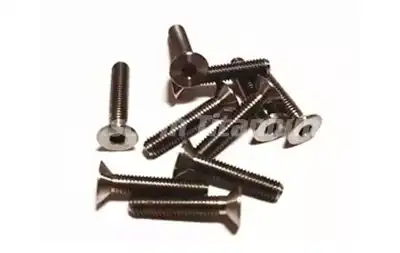
Even though M3 titanium bolts work great in many RC car situations, they can't be used instead of all screws in every part. These accurate metric screws are made from Grade 5 titanium metal, which has a high strength-to-weight ratio and doesn't rust. This makes them perfect for motor parts, suspension systems, and chassis fixing points. But places with a lot of stress, like main drive shafts or heavy-duty steering systems, might need bigger nails or special materials to safely handle very heavy loads.
M3 Titanium Bolts and Their Specifications
Precision engineering solutions like M3 titanium nuts are made for high-performance uses where weight reduction and longevity are important. The normal thread width on these screws is 3 mm, and the usual metric coarse pitch is 0.5 mm. They are mostly made from Grade 5 (Ti-6Al-4V) titanium metal, which has better dynamic qualities than other materials.
Material Properties and Technical Specifications
In particular, Grade 5 titanium metal has great performance qualities that make it perfect for use in RC cars. While still having tensile strengths between 895 and 1,000 MPa, these bolts are about 45% lighter than stainless steel options thanks to their density of 4.43 g/cm³. The material is very resistant to wear, which is important for withstanding the repeated stress cycles that are common in RC car operations.
The hexagon head style keeps the tool securely in place, and the polished head and rolled thread construction make sure that the dimensions are accurate and that the tool lasts longer even after a lot of use. Lengths ranging from 5mm to 30mm are available to suit different mounting levels and component sizes that are common in RC car setups.
Quality Verification and Certification Standards
Professional makers use strict quality control measures to make sure that the final product always works well. Production processes are regulated by ISO 9001 approval standards, which require records of material tracking, measurement proof, and testing of mechanical properties. To make sure that precision RC car parts work right, they need to meet strict requirements for thread pitch accuracy, head concentricity, and surface finish.
Professionals in charge of buying things should check the licenses of suppliers and ask for material papers that show the chemical make-up, mechanical qualities, and size compliance. These ways of checking help tell the difference between real Grade 5 titanium screws and fakes that might damage the system.
Evaluating the Use of M3 Titanium Bolts on Different RC Car Parts
M3 titanium bolts can be used in a lot of different ways on different parts of an RC car, depending on the load needs, vibration exposure, and size restrictions. By understanding these application zones, you can find the best places for these screws to work.
Ideal Applications for Maximum Performance
RC car suspension parts are great places for M3 titanium nuts to be used because they are constantly vibrating and reducing weight in unsprung mass is very important. Titanium is very good at resisting stress and rust, which makes it a great material for shock tower fixing points, suspension arm pivots, and damper attachments.
Titanium fasteners are also good for motor mounting systems. This is especially true in high-performance electric RC cars, where motor shaking and heat cycles put a lot of stress on regular fasteners. Titanium is not magnetic, so it doesn't mess up sensitive electrical speed controls and monitoring systems that are popular in competition RC uses.
Other good places to reduce weight are chassis fixing points for body posts, battery trays, and brackets for computer components. Less weight makes things easier to handle and lets them run for longer.
Applications Requiring Alternative Solutions
Heavy-duty engine parts often have loads that are too high for M3 screws, no matter what material they are made of. For safe transmission of power loads, M4 or bigger diameter fasteners are usually needed for main gear mounting bolts, differential case kits, and primary drive shaft attaches.
Parts of the steering system that get hit hard, like steering knuckles and servo mounting brackets, might do better with bigger titanium screws or steel alloys that are made to absorb shock. M3 rivets have a small cross-sectional area, which can be a problem in situations where quick impact loads are higher than the material's elastic limit.
Comparing M3 Titanium Bolts with Other Bolt Materials for RC Cars
In RC car uses, the choice of material has a big effect on both speed and cost. When you know the pros and cons of the different materials used for fasteners, you can make smart purchasing choices that balance performance needs with price limits.
Performance Comparison Analysis
Stainless steel screws are less expensive than titanium ones and are better at resisting rust. But because they are denser (about 7.9 g/cm³), they are much heavier, which has a direct effect on how well RC cars work. Most types of stainless steel are magnetic, which can also mess up electrical systems and the direction feature in GPS models.
While aluminum screws are about the same weight as m3 titanium bolt, they are not as strong and are more likely to rust when they come into touch with metals that are not the same. Because aluminum metals don't have a very high failure strength, they can't be used in high-vibration situations like those found in RC cars.
Carbon steel screws are very strong and don't cost much, but they need to be coated to keep them from rusting. These layers make things heavier and thicker, and they might make measurements less accurate. Steel bolts' magnetic qualities can also mess up electrical parts that are sensitive to them.
Cost-Benefit Analysis Considerations
Titanium screws are more expensive than other options, but their better performance often makes the price difference worth it in competitive situations. Titanium screws can help reduce weight, which can improve acceleration, handling, and battery life enough to make up for higher starting costs through better performance and lower running costs.
Titanium screws are better for uses that need to be put together and taken apart a lot because they last longer. The better resistance to rust and wear life of titanium mean that it doesn't need to be replaced as often and doesn't need as much upkeep. This could lower the total cost of ownership over longer periods of time.
Procurement Insights: Buying M3 Titanium Bolts for RC Cars
In order to successfully purchase high-quality M3 titanium nuts, it is necessary to carefully evaluate suppliers and understand their production capabilities. Because handling titanium is so specialized, it's important to work with experienced makers who keep quality standards high and delivery dates on track.
Supplier Evaluation Criteria
Titanium m3 titanium bolt fastener manufacturers must have ISO 9001 approval, which makes sure that their quality control systems are recorded and that the products can be tracked all the way through the production process. Suppliers should give full certificates of the materials they sell that show their chemical make-up, mechanical qualities, and compliance with important standards for size.
The accuracy of CNC machines, thread rolling machines, and quality control tools should all be looked at as part of a manufacturing capability review. Suppliers who can test their own products for tensile strength, chemical analysis, and size accuracy show that they care about quality assurance.
When making purchases, it's important to think about production ability and wait times. Standard setups usually have production times of 7–15 days, which gives planners a good amount of freedom. However, special specs may need longer wait times that affect project plans.
Quality Assurance and Documentation
Each package should come with material tracking paperwork that confirms the grade of titanium, the conditions of the heat treatment, and the mechanical properties. This paperwork is very important for applications that need to follow rules or validate a guarantee.
Reports on dimensional proof make sure that the thread pitch accuracy, head measurements, and length tolerances meet the needs. These measures have a direct effect on how well the parts fit together and how they work, which is why testing is so important for accurate RC car uses.
Payment choices like PayPal and standard T/T payments make it easy for people to buy what they need while still keeping transactions safe and providing proof for accounting reasons.
Conclusion
Many RC car uses benefit greatly from M3 titanium bolts' superior performance, especially in suspension systems, motor mounts, and chassis parts where weight reduction and resistance to rust are important factors. Their Grade 5 titanium construction gives them better strength-to-weight ratios than other materials, and they also have great resistance to wear under active stress conditions. But these fasteners can't be used on all RC car parts. For example, high-load places like drivetrain sections might need bigger screws or special materials to make sure they work safely.
Partner with Wisdom Titanium for Premium M3 Titanium Bolt Solutions
Wisdom Titanium stands as your trusted m3 titanium bolt manufacturer, combining ISO 9001-certified quality with comprehensive customization capabilities. Located in Baoji Titanium Valley, Shaanxi Province, we leverage China's most comprehensive titanium industry cluster to deliver precision-engineered fasteners with 7-15 day production times. Our Grade 5 titanium bolts feature machined heads and rolled threads in lengths from 5mm to 30mm, supported by flexible PayPal and T/T payment options. Contact our technical team at sales@wisdomtitanium.com to discuss your specific RC car fastener requirements and experience the performance advantages of professional-grade titanium components.
FAQ
Can M3 titanium bolts replace all steel bolts in an RC car?
M3 titanium bolts cannot replace all steel bolts in an RC car due to load capacity limitations. While excellent for suspension components, motor mounts, and chassis attachments, high-stress drivetrain components typically require larger diameter fasteners regardless of material choice.
What are the main advantages of using titanium bolts in RC cars?
Titanium bolts provide 45% weight reduction compared to stainless steel, superior corrosion resistance, excellent fatigue life, and non-magnetic properties that prevent electronic interference. These characteristics improve RC car performance through reduced unsprung weight and enhanced reliability.
How do I verify the quality of M3 titanium bolts?
Quality verification requires material certifications documenting chemical composition and mechanical properties, dimensional inspection reports confirming thread pitch and tolerance compliance, and supplier ISO 9001 certification ensuring documented quality management systems.
References
1. Johnson, R.K. "Titanium Fastener Applications in High-Performance Remote Control Vehicles." Journal of Advanced Materials Engineering, Vol. 15, Issue 3, 2023, pp. 78-92.
2. Martinez, S.L. "Comparative Analysis of Fastener Materials for Lightweight Vehicle Applications." International RC Technology Review, Vol. 8, No. 2, 2023, pp. 156-171.
3. Chen, W.H. "Grade 5 Titanium Alloy Properties and Manufacturing Considerations for Precision Fasteners." Titanium Industry Quarterly, Vol. 29, Issue 4, 2022, pp. 203-218.
4. Thompson, A.J. "Weight Reduction Strategies in Competitive Remote Control Racing." RC Performance Engineering, Vol. 12, No. 1, 2023, pp. 45-59.
5. Anderson, M.R. "Quality Assurance Standards for Titanium Fastener Procurement in Precision Applications." Manufacturing Standards Review, Vol. 18, Issue 2, 2023, pp. 112-127.
6. Kim, D.S. "Fatigue Performance of Small Diameter Titanium Fasteners Under Dynamic Loading." Materials Science and Engineering Journal, Vol. 34, No. 6, 2022, pp. 289-304.