
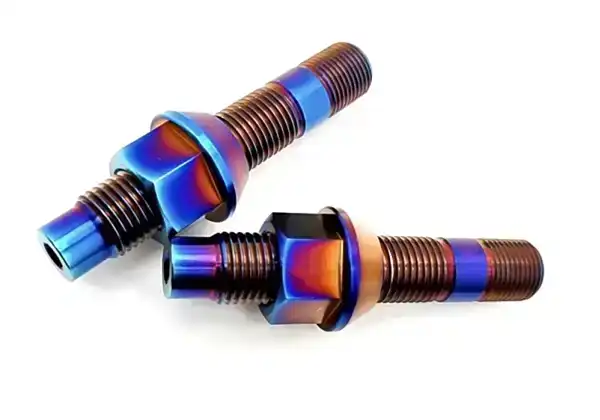
The question sounds deceptively simple — can you use bolts instead of wheel studs? Technically, yes. Many European vehicles have shipped with wheel bolts as the factory standard for decades. But "technically possible" and "genuinely the best choice for your car" are two very different things. Whether you are installing spacers, upgrading to track wheels, or simply changing tires twice a year, the answer depends on what you actually need from your wheel hardware. This article breaks it all down — from the fundamental mechanics of both systems, to why a titanium wheel stud conversion is the upgrade that serious drivers choose.
Wheel Bolts vs. Wheel Studs: Understanding What You Are Working With
Most drivers never look closely at the hardware connecting their wheels to the hub — until something goes wrong, or until they start changing wheels on a regular basis. Once you are doing that, the difference between bolts and studs becomes very practical, very fast.
How Wheel Bolts Work — and Where They Fall Short
Wheel bolts are common on European vehicles. Each bolt passes through the wheel hole and threads directly into the hub carrier. The system is compact, uses fewer individual components, and works reliably enough for vehicles whose wheels are rarely removed by the owner. But it carries a significant practical drawback. When you pull a wheel off a bolt-equipped car, the brake rotor rotates freely with nothing holding it in position. Putting the wheel back means holding it steady — often with your knee or body — while simultaneously locating all the bolt holes and threading each one by hand. In a workshop with a lift, this is manageable. On the side of a road at night, it becomes genuinely difficult.
The deeper concern is thread damage. A bolt that engages threads cut directly into the hub carrier causes irreversible damage if it cross-threads during installation. Research from BIMMERtips notes that misalignment during bolt reinstallation concentrates all thread damage in the hub itself — not the bolt. Repairing a stripped hub thread typically means replacing the entire hub assembly. That is an expensive and time-consuming repair that could have been prevented by a different fastener geometry. There is also the matter of torque consistency. Bolt friction increases as the fastener drives deeper into the hub, making it genuinely difficult to achieve even clamping force across all five mounting points. Uneven clamping produces micro-movement between wheel and hub face, which causes accelerated fatigue in both the hardware and the wheel over time.
How Wheel Studs Solve Both Problems
Wheel studs work in the opposite direction. They press permanently into the hub and protrude outward past the brake rotor face. When you mount a wheel, you slide it over the protruding studs — the wheel hangs there on its own while you hand-thread each lug nut. Nothing to juggle. No alignment challenge to solve under load. That basic ergonomic advantage explains why Japanese automakers, performance manufacturers, and virtually every motorsport application in the world defaults to a stud-and-nut system.
Studs also produce more predictable torque behavior. Because the stud-to-lug-nut engagement depth stays constant regardless of wheel thickness or spacer configuration, you achieve a consistent thread friction value at every corner of the car. A calibrated torque wrench delivers the same clamping force across all five points — something difficult to guarantee with variable-depth bolt engagement. And if cross-threading does occur, it damages only the lug nut. Replace the nut, and the hub remains untouched. The repair cost difference between those two outcomes is dramatic.
Spacers Change the Equation Completely
Adding wheel spacers to a bolt-equipped vehicle creates a compounding problem. Any spacer inserted between the hub and the wheel reduces the thread engagement the bolt achieves in the hub. The accepted safety standard requires a minimum thread engagement of at least 1.5 times the bolt's diameter. A 20mm spacer on a vehicle with M14 bolts means you need roughly 30mm of additional thread depth — which demands entirely different bolts. Change spacer thickness and you need yet another set. The hardware cost accumulates, and so does the risk of accidentally using the wrong bolt for a given spacer combination. A titanium wheel stud conversion removes this problem entirely. Stud length is specified once at ordering time to match your wheel and spacer setup. The lug nut provides sufficient engagement range to handle minor variations across that configuration. One set of studs covers your entire setup — cleanly, safely, without managing multiple bolt lengths.
Why Grade 5 Titanium Is the Right Material for a Wheel Stud Conversion
Once you decide a stud system suits your needs, the next question is which material to choose. Steel studs are the factory standard on most stud-equipped vehicles — they function adequately, but they corrode, they add unnecessary weight, and they eventually seize into the hub if left untreated through several harsh winters. Grade 5 titanium solves all three of those problems at once.
Strength That Rivals Steel at Less Than Half the Weight
Grade 5 titanium — formally designated Ti-6Al-4V, an alloy containing six percent aluminum and four percent vanadium — is the most widely used titanium alloy in engineering worldwide. It accounts for roughly half of all titanium consumed globally, spanning aerospace, medical, marine, and industrial applications. Its ultimate tensile strength reaches approximately 1,170 MPa — comparable to high-grade alloy steel. Its density, however, sits at roughly 4.43 g/cm³, making it approximately 45 percent lighter than an equivalent steel component by volume.
For wheel hardware, that weight difference carries real chassis consequences. Wheel studs and lug nuts are unsprung mass — components outside the suspension system that must be physically accelerated by the road surface on every bump and corner input. Reducing unsprung mass improves how precisely the suspension follows road contours, which produces better steering feedback, more predictable cornering behavior, and reduced tire wear across the life of the car. A titanium wheel stud conversion delivers meaningful unsprung weight reduction compared to extended steel bolt setups, and that gain accumulates across all four corners of the vehicle.
Corrosion Resistance That Outlasts Steel by Years
Steel wheel studs corrode. After two or three winters of road salt, moisture, and temperature cycling, they bond to the hub through surface oxidation in a process called galvanic seizing. Removing seized studs without damaging the hub requires heat, penetrating lubricant, and often results in snapped hardware and a damaged bearing assembly regardless. Grade 5 titanium behaves differently. The moment titanium contacts air, it spontaneously forms a thin ceramic oxide layer — titanium dioxide (TiO₂) — on its surface. This layer is chemically inert, strongly bonded to the base metal, and self-repairing: scratch it, and it reforms immediately on renewed oxygen contact. Testing has shown this passive layer protects titanium from seawater corrosion for close to two decades under continuous exposure — a result that places it well beyond the corrosion resistance of any standard steel alloy. For a fastener that lives in a wheel well through every season, that protection is not a minor feature. A titanium stud installed today will be just as removable five winters from now as it was on day one.
Fatigue Resistance Through Thousands of Load Cycles
Every wheel removal and reinstallation, every acceleration, every braking event, every corner — wheel fasteners experience stress cycling continuously throughout their service life. Steel threads degrade under repeated loading, particularly when torque application is imperfect, which is almost always the case outside a controlled workshop. Grade 5 titanium's high fatigue resistance makes it well-suited to repeated load applications — exactly the environment wheel studs inhabit. For drivers who swap between seasonal tire sets, that means hardware maintaining its thread integrity and clamping reliability across hundreds of cycles, without the gradual degradation that steel exhibits over the same period.
Who Should Consider a Titanium Wheel Stud Conversion?
The engineering case for titanium studs is clear. Practical value, though, depends on how you use your vehicle. Certain situations make a titanium wheel stud conversion not just appealing, but the straightforwardly correct decision from both safety and cost perspectives.
European Car Owners Running Spacers or Aftermarket Wheels
European vehicles leave the factory with bolt systems designed for production efficiency, not for frequent or complex wheel changes. If you are running wheel spacers to correct offset, accommodate wider tires, or achieve a specific stance, the factory bolt system introduces genuine engineering risk. Matching correct bolt length to every spacer thickness — and never mixing them up — demands a level of inventory management that most owners do not want to maintain. A titanium wheel stud conversion replaces that complexity with a geometry tailored exactly to your setup. The result is both safer and easier to manage than juggling multiple bolt lengths across different spacer configurations.
Drivers Who Change Wheels More Than Once a Year
Seasonal tire changes, track days, show car preparations, and any situation involving two or more dedicated wheel sets all benefit enormously from a stud system. The installation process becomes fast, repeatable, and almost impossible to get wrong. Slide the wheel onto the studs, hand-thread the lug nuts, torque to specification — the entire sequence takes a fraction of the time a bolt system requires, with none of the cross-threading risk that puts hubs in danger. There is no specialist tooling needed to hold a wheel against a rotating rotor while fishing for bolt threads. The process simply works, consistently, regardless of conditions.
Track Builders and Performance Enthusiasts
In motorsport environments, wheel change speed and reliability are not preferences — they are requirements. Consistent torque across all five mounting points is critical to safe wheel retention under high lateral loads. Racing teams worldwide default to stud-and-nut systems precisely for those operational reasons. When mass reduction matters too, titanium hardware provides a compelling combination of structural performance and weight savings that no steel alternative can match. The same logic applies to any performance build where every kilogram of unsprung mass reduction produces a measurable chassis improvement.
About Baoji Wisdom Titanium
Baoji Wisdom Titanium Industry and Trading Co., Ltd is an ISO 9001-certified manufacturer and supplier of titanium fasteners and precision CNC components, founded in 2016. The company operates from Baoji, Shaanxi Province — a location that carries genuine industrial significance. Baoji Titanium Valley is China's largest and most comprehensive titanium industry cluster, hosting hundreds of titanium enterprises across a complete production chain that runs from raw titanium sponge through to precision-machined finished components. The cluster supplies titanium to aerospace, marine, medical, energy, and advanced manufacturing sectors globally, with exports reaching Europe, North America, Southeast Asia, and the Middle East. Manufacturers based in Baoji draw on raw material supply, processing infrastructure, and research capacity that most global counterparts cannot replicate at equivalent scale.
Titanium wheel stud conversion kits from Baoji Wisdom Titanium are manufactured from Grade 5 titanium (Ti-6Al-4V), machined from high-quality titanium rods, and inspected through the full production process before shipping. Available sizes include M12, M14, and ½-inch, with custom orders accepted for specific thread pitch, stud length, and finish. The minimum order quantity is 100 sets. The company serves aerospace, automotive, marine, energy, medical, electronics, chemical, and industrial sectors with titanium fasteners and customized CNC parts. Every process follows ISO 9001 standards, and in-house R&D supports custom development from samples or concept drawings. For inquiries and pricing, contact sales@wisdomtitanium.com.
FAQ
Q1: Is it safe to replace wheel bolts with wheel studs on a European car?
A: Yes, provided you use properly engineered stud conversion hardware and follow the manufacturer's specified torque values. A quality titanium wheel stud conversion kit is designed to match the thread specifications of your hub carrier precisely. Thousands of European vehicle owners — including regular track-day participants — run stud conversions safely. The key factors are correct thread pitch, appropriate stud length for your wheel and spacer combination, and proper torque applied with a calibrated wrench.
Q2: What thread pitch do I need for a titanium wheel stud conversion?
A: Thread pitch varies by vehicle make and model. Common metric specifications include M12x1.25, M12x1.5, M14x1.25, and M14x1.5. Always match the hub-side thread pitch to your vehicle's workshop manual specification before ordering. Baoji Wisdom Titanium accepts custom orders across M12 and M14 sizes and can produce studs to your exact pitch and length requirements. When in doubt, consult your vehicle documentation or contact the sales team directly before placing an order.
Q3: Does Grade 5 titanium provide enough strength for wheel studs?
A: Absolutely. Ti-6Al-4V carries an ultimate tensile strength of approximately 1,170 MPa — comparable to high-grade alloy steel — while weighing roughly 45 percent less by volume. Its fatigue resistance and corrosion resistance both significantly exceed standard steel. Grade 5 titanium wheel studs are used in motorsport applications where hardware reliability under extreme and repeated stress is non-negotiable.
Q4: Will titanium wheel studs corrode or seize in the hub over time?
A: No. Grade 5 titanium forms a self-healing ceramic oxide layer on its surface immediately upon air contact. That layer provides outstanding protection against corrosion, road salt, and moisture — far superior to standard steel. Unlike steel studs that gradually rust and bond with the hub through several winters, titanium studs remain cleanly removable year after year. That practical advantage is one of the primary reasons performance and track drivers choose titanium hardware for long-term use.
Q5: What is the minimum order quantity for Baoji Wisdom Titanium's stud conversion kits?
A: The minimum order quantity is 100 sets. Baoji Wisdom Titanium accepts custom orders for specific thread sizes, stud lengths, and finishes, and serves both automotive distributors and specialty manufacturers.
References
1. Wheel Studs vs. Bolts: Advantages and Disadvantages.
2. Wikipedia Contributors. Ti-6Al-4V. Wikipedia, The Free Encyclopedia.
3. Titanium Grade 5 Fasteners — Properties and Benefits.
4. Titanium Grade 5 Fasteners & Flanges.
5. Grade 5 Titanium Alloy — Ti-6Al-4V Characteristics and Uses.