
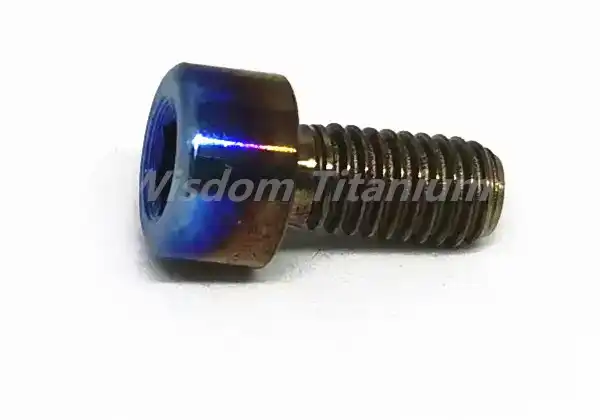
Something shifted in motorsports culture over the past five years. Engine bays once dominated by utilitarian hardware now showcase meticulously detailed components where every visible fastener contributes to overall aesthetic. Custom motorcycles displayed at shows compete not just on performance modifications but on craftsmanship visible in the smallest details. Burnt titanium bolts have emerged as the signature element distinguishing serious builds from casual upgrades.
Why Burnt Titanium Excels in High-Performance Applications?
Grade 5 titanium (Ti-6Al-4V) forms the material foundation for premium burnt bolts. This aerospace alloy delivers tensile strength approaching 950 MPa while weighing 43% less than steel equivalents. The strength-to-weight ratio fundamentally changes performance calculations for racing applications where every gram affects acceleration, handling, and fuel efficiency.
Material Properties Optimized for Motorsports
Yield strength around 870 MPa ensures burnt titanium bolt fasteners maintain dimensional stability under high clamping loads. Unlike softer materials that permanently deform when overtorqued, Grade 5 titanium recovers elastically within design limits. This characteristic proves particularly valuable for engine applications experiencing thermal expansion and contraction cycles that work conventional fasteners loose over time.
Elongation characteristics near 16% provide sufficient ductility, preventing brittle fracture under shock loading. Motorsports applications subject components to vibration, impact forces, and dynamic loads that brittle materials cannot tolerate. Titanium's ability to deform slightly under extreme stress provides a warning before catastrophic failure—a safety margin is absent in high-strength but low-ductility alternatives.
Low thermal expansion coefficient prevents loosening during temperature fluctuations. Motorcycle engines cycling from ambient to 150°C create dimensional changes in conventional steel fasteners. Titanium's expansion rate more closely matches aluminum engine cases, maintaining consistent clamping force across temperature ranges. This thermal compatibility eliminates the micro-movements that gradually work steel bolts loose despite proper initial torquing.
Aesthetic Impact on Custom Builds
The burnt blue finish has become synonymous with premium custom work. Social media platforms showcase builds where heat-treated titanium fasteners complement polished aluminum, carbon fiber, and painted surfaces. The coloring adds visual interest without overwhelming the overall design—subtle sophistication rather than garish decoration.
Bicycle Applications: From Road Racing to Mountain Bikes
Competitive cycling obsesses over weight savings measured in grams. A complete burnt titanium bolt conversion—replacing stem, seatpost, brake, and accessory hardware—typically saves 80-120 grams versus steel equivalents. For professional road racers where seconds separate podium positions, this weight reduction comes without compromising structural integrity or introducing maintenance complications.
Optimal Replacement Locations for Maximum Benefit
Stem bolts represent the most visible and weight-sensitive application. Four to six M5 or M6 fasteners save 12-15 grams while occupying central positions in the rider's sight line. The burnt blue finish coordinates with carbon steerer tubes and handlebar clamping areas. Consistent torque maintenance proves simpler than with aluminum bolts requiring careful monitoring to prevent stripping.
Brake caliper mounting and rotor bolts experience significant stress and thermal exposure. Disc brake applications generate substantial heat during prolonged descents—temperatures where conventional fasteners might experience property changes. Titanium's thermal stability maintains strength characteristics across operating ranges. The burnt finish adds distinctive appearance to components already drawing visual attention.
Bottle cage bolts deliver weight savings multiplied across multiple mounting points. Four bolts per cage, two cages per bicycle creates opportunities for 15-20 gram reductions through titanium substitution. While individually minor, these savings accumulate meaningfully when combined with other upgrade locations. The burnt finish adds subtle detail to frame areas otherwise overlooked.
Installation Considerations for Cycling Components
Carbon fiber components demand special attention during burnt titanium bolt installation. While titanium's chemical inertness prevents galvanic corrosion with carbon, proper torque specifications remain critical. Undertorquing risks component slippage; overtorquing crushes carbon fiber matrix. Use calibrated torque wrenches and follow manufacturer specifications precisely—typically 4-6 Nm for stem bolts, 6-8 Nm for seatposts.
Motorcycle and Motorsports Applications
Custom motorcycle builds showcase burnt titanium bolt applications throughout engines, chassis, and bodywork. Engine case covers, valve covers, and transmission housings present opportunities for weight reduction while adding visual distinction. The heat-treated appearance suggests performance modifications even when fasteners serve purely functional roles. Builders appreciate components performing as impressively as they look.
Racing applications leverage titanium's strength-to-weight advantages where regulations permit aftermarket fasteners. Superbike teams replace steel hardware throughout chassis, suspension, and brake systems achieving measurable weight reductions. The burnt finish becomes incidental to performance objectives, though paddock presentations benefit from aesthetic details distinguishing team bikes from stock machinery.
Street performance motorcycles occupy the intersection of function and aesthetics. Enthusiasts upgrading brakes, suspension, or engine components often replace visible fasteners with burnt titanium alternatives. The modifications signal attention to detail and willingness to invest in premium components. Social media documentation of builds generates engagement through distinctive visual elements including coordinated fastener finishes.
Sourcing Quality Burnt Titanium Fasteners
Market flooding with cheap "titanium" bolts has created confusion among buyers. Many low-cost options employ painted finishes mimicking authentic thermal oxidation or utilize inferior titanium grades lacking proper mechanical properties. Simple verification methods distinguish genuine burnt titanium bolt products from decorative imitations before costly mistakes occur.
Scratch testing reveals coating versus integrated oxide finishes. Authentic burnt titanium shows bare silver-gray metal beneath surface disturbances that rapidly re-oxidizes when exposed to air. Coated products expose contrasting substrate materials—often aluminum or even steel—under surface paint or anodizing. This simple field test provides immediate quality verification.
Material certifications document the titanium grade and mechanical properties. Reputable manufacturers provide chemistry analysis confirming Ti-6Al-4V composition with appropriate aluminum (5.5-6.75%) and vanadium (3.5-4.5%) content. Tensile test reports verify strength characteristics meet or exceed ASTM B348 specifications. Suppliers refusing documentation raise immediate quality concerns, warranting alternative sourcing.
Baoji Wisdom Titanium: Premium Burnt Fastener Specialist
Founded in 2016, Baoji Wisdom Titanium Industry and Trading Co., Ltd. exemplifies professional manufacturing, distinguishing premium suppliers from commodity vendors. This ISO 9001-certified manufacturer operates within Baoji Titanium Valley's integrated industrial ecosystem, leveraging complete supply chain access from titanium sponge through precision finishing operations.
Multi-sector experience spans aerospace, medical, energy, marine, automotive, motorcycle, and bicycle industries. This breadth indicates technical capabilities and quality systems robust enough for applications ranging from decorative to life-safety critical. Manufacturing standards developed for aerospace fasteners naturally exceed requirements for cycling or motorsports components—conservative engineering margins benefiting all customer segments.
Burnt titanium bolt specifications reflect aerospace-derived quality standards. Grade 5 titanium construction delivers 950 MPa tensile strength and 870 MPa yield strength with 16% elongation—values exceeding ASTM B348 minimum requirements. Hardness measurements around 36 HRC confirm appropriate heat treatment. Controlled atmosphere oxidation produces consistent burnt blue finishes across production batches, verified through spectrophotometric measurement.
For detailed specifications, quotation requests, or technical consultation regarding burnt titanium bolt requirements for your cycling or motorsports project, contact the sales team directly. Email inquiries to sales@wisdomtitanium.com with your application details, quantity needs, and specification preferences. Expect comprehensive responses within 24-48 hour,s including pricing, lead times, and technical recommendations optimizing your specific requirements.
References
- Donachie, M. J. (2000). Titanium: A Technical Guide (2nd ed.). Materials Park, OH: ASM International.
- ASTM International. (2021). ASTM B348 - Standard Specification for Titanium and Titanium Alloy Bars and Billets. West Conshohocken, PA: ASTM International.
- Lutjering, G., & Williams, J. C. (2007). Titanium (2nd ed.). Berlin: Springer-Verlag.
- Boyer, R., Welsch, G., & Collings, E. W. (1994). Materials Properties Handbook: Titanium Alloys. Materials Park, OH: ASM International.
- Guleryuz, H., & Cimenoglu, H. (2009). Oxidation of Ti-6Al-4V alloy. Journal of Alloys and Compounds, 472(1-2), 241-246.




