
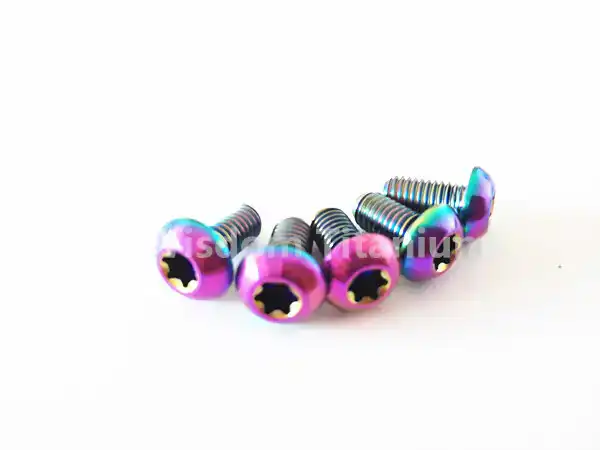
You're staring at two fastener options. One costs five times more than the other. Both look similar enough. Why would anyone pay premium prices for titanium when steel has secured bicycles for over a century? This question haunts cyclists debating upgrades, and the answer isn't as simple as "lighter is better."
This detailed comparison examines bicycle titanium bolts versus steel alternatives across performance metrics, cost considerations, and practical selection criteria. Drawing on manufacturing expertise from Baoji Wisdom Titanium and materials science principles, we'll explore where each material excels, identify scenarios where advantages diminish, and provide decision frameworks helping you invest wisely.
What Titanium Bolts Do Better?
Weight reduction stands as titanium's most celebrated advantage in cycling applications. The material's density measures approximately 4.5 grams per cubic centimeter, roughly 43% lighter than steel's 7.85 g/cm³. This difference accumulates rapidly across complete bicycle builds containing dozens of fasteners. Replacing every steel bolt with titanium equivalents typically saves 50-100 grams depending on the bicycle type and component count—meaningful weight reduction for competitive cyclists who measure upgrades in single grams.
The weight advantage becomes more nuanced when examining strength-to-weight ratios rather than simple mass reduction. Grade 5 titanium alloy (Ti-6Al-4V) delivers tensile strength exceeding 900 MPa while maintaining that 4.5 g/cm³ density. High-strength steel bolts might reach 1200 MPa tensile strength, but at nearly double the density. Calculate specific strength by dividing tensile strength by density, and titanium emerges superior. This relationship allows bicycle titanium bolts to match steel's load capacity while contributing substantially less mass to the overall build.
Corrosion resistance represents perhaps titanium's most compelling long-term advantage. The material forms a stable passive oxide layer just nanometers thick that provides exceptional protection against atmospheric moisture, road salt, and even seawater exposure. This oxide film reforms instantaneously if damaged, creating self-healing corrosion protection that functions continuously without coatings or maintenance. Coastal riders, winter cyclists using salted roads, or anyone storing bikes in humid environments witness dramatic durability improvements compared to steel fasteners that rust despite stainless grades or protective finishes.
Scientific testing demonstrates titanium's corrosion immunity quantitatively. ASTM B117 salt spray testing—the standard accelerated corrosion evaluation—shows titanium experiencing essentially zero material loss after 1000 hours of continuous exposure to 5% salt solution. Stainless steel grades develop surface discoloration and pitting during identical testing. Real-world translation means bicycle titanium bolts maintain appearance and function through decades of varied conditions that would corrode steel alternatives requiring periodic replacement. The initial cost premium amortizes across this extended service life.
Fatigue Resistance and Long-Term Durability
Cyclic loading from road vibration, pedaling forces, and rider weight shifts subjects fasteners to millions of stress cycles annually. Fatigue failure occurs when repeated stresses below yield strength cause progressive crack growth eventually fracturing components. Titanium alloys demonstrate excellent high-cycle fatigue characteristics, maintaining structural integrity through stress reversals that would crack many materials. Grade 5 titanium exhibits fatigue strength around 500-550 MPa at 10 million cycles, approximately 60% of ultimate tensile strength.
Where Steel Bolts Often Remain Better / Competitive?
Cost represents steel's most obvious competitive advantage. Standard M6×20mm socket head cap screws in Grade 8.8 steel cost approximately $0.20-0.40 each in volume quantities. Equivalent bicycle titanium bolts command $2.00-4.00 per piece, representing 5-10 times the steel price. Complete fastener replacement on a typical bicycle might cost $30-50 for quality stainless steel versus $200-400 for titanium. This price differential creates genuine decision pressure for budget-conscious cyclists or those building multiple bikes where costs multiply.
The economic calculation becomes more complex when considering total ownership costs across product lifecycles. Steel fasteners in harsh environments might require replacement every 2-3 years due to corrosion damage. Titanium hardware lasts indefinitely without degradation, potentially 10-20 years or the bicycle's entire service life. Discounting future replacement costs and factoring in labor for fastener removal and installation, the lifetime cost differential narrows considerably. However, many cyclists sell or replace bicycles before realizing this long-term value, making the upfront cost premium harder to justify financially.
Material availability and sourcing flexibility favor steel substantially. Every hardware store, bicycle shop, and online supplier stocks steel fasteners in common sizes and configurations. Need an emergency replacement during a weekend ride? Any hardware store provides options even if not bicycle-specific. Titanium requires specialty suppliers or advance planning since general retailers rarely stock these premium fasteners. This availability gap matters most when traveling, racing in remote locations, or performing urgent repairs where waiting for shipped titanium isn't practical.
What Choosing Depends On: When to Pick Titanium vs Steel?
Environmental exposure determines whether corrosion resistance justifies titanium's cost premium. Coastal cyclists face salt-laden air accelerating corrosion on any ferrous material regardless of stainless grades or coatings. Winter riders using roads treated with deicing chemicals encounter similarly aggressive conditions. Indoor trainer users expose bikes to concentrated sweat containing chlorides and organic acids. These scenarios heavily favor bicycle titanium bolts where corrosion immunity provides tangible benefits preventing replacement cycles and maintaining appearance.
Conversely, bicycles stored indoors in dry climates and ridden only fair weather rarely challenge stainless steel's corrosion resistance. The environmental exposure remains mild enough that quality stainless fasteners last indefinitely without significant degradation. Titanium still offers weight advantages in these conditions, but the corrosion protection premium adds limited value. Budget-conscious riders in benign climates might reasonably conclude steel serves adequately, directing upgrade budgets toward components delivering more noticeable performance improvements.
Weight sensitivity varies dramatically across cycling disciplines and rider priorities. Competitive road racers, climbers attacking mountain passes, or criterium racers accelerating repeatedly from corners notice measurable benefits from 50-100 gram weight reductions. Track cyclists in sprint events particularly value rotational weight savings from lighter hardware on wheels and cranks. These performance-focused applications justify titanium costs through competitive advantages or personal satisfaction from optimized builds.
Touring cyclists carrying camping gear, commuters with panniers, or casual recreational riders find weight savings less compelling. The 75 grams saved through titanium fasteners disappears into statistical noise against 15-kilogram touring loads or the 5-kilogram variation in rider hydration state. These applications might prioritize steel's cost savings and universal availability, spending budget differences on more impactful upgrades like better tires, comfortable saddles, or reliable lighting systems that enhance the actual riding experience more than fastener weight optimization.
Making Your Decision: A Strategic Framework
Start by honestly assessing your riding environment and bicycle use patterns. Do you encounter corrosive conditions regularly? Will you maintain this bike for many years? Does weight reduction align with your riding discipline and competitive level? Affirmative answers support titanium selection. Mild environments, short ownership timelines, or casual riding where weight matters minimally suggest steel remains adequate and cost-effective.
Evaluate your mechanical skill and maintenance approach. Confident home mechanics who carefully follow torque specifications and maintain proper lubrication will extract full value from bicycle titanium bolts. Those depending on shops for all service should verify their mechanics' titanium experience before specifying premium materials. The material demands respect that not all service providers automatically understand despite general mechanical competence.
Consider strategic partial replacement targeting high-value applications. Replace exposed, frequently serviced, or safety-critical fasteners with titanium while accepting steel for protected or low-stress locations. This approach balances cost against benefits more efficiently than all-or-nothing material choices. Prioritize titanium where corrosion resistance, weight reduction, or appearance justification appears strongest for your specific build and usage patterns.
Source Premium Titanium Fasteners With Confidence
Informed material selection separates optimized builds from misallocated budgets. Bicycle titanium bolts deliver genuine advantages in corrosion resistance, weight reduction, and long-term durability that justify cost premiums in appropriate applications. Steel remains entirely adequate and often preferable in scenarios where titanium's benefits don't align with usage patterns or budget priorities. Neither material dominates universally—context determines optimal choices.
Baoji Wisdom Titanium provides premium fasteners for cyclists who've determined titanium suits their requirements. Our ISO 9001-certified manufacturing ensures dimensional consistency and material quality across M5, M6, and M8 standard diameters with customized lengths accommodating precise fitting needs. Anodized and PVD surface finishes enhance durability while providing aesthetic options coordinating with frame schemes and component groups.
Manufacturing excellence from Baoji Titanium Valley in Shaanxi Province provides access to China's most comprehensive titanium supply chain. The vertically integrated ecosystem enables responsive delivery schedules and competitive pricing unmatched by suppliers dependent on distant material sources. Complete raw material inventory supports both standard configurations and custom specifications without procurement delays that might delay build schedules.
For detailed specifications, application recommendations, or quotations on bicycle titanium bolts and related fastener products, contact Baoji Wisdom Titanium today. Our team stands ready to discuss your requirements and provide solutions backed by manufacturing expertise and quality commitment. Send your inquiry to sales@wisdomtitanium.com and experience professional support from titanium specialists who understand that informed material selection requires comprehensive analysis beyond simplistic comparisons. Let us help you determine whether titanium suits your specific applications and provide the premium fasteners your build deserves.
FAQs
Q1: Can I mix titanium and steel bolts on the same bike?
A: Yes, you can mix them, but you must be careful about galvanic corrosion. When two dissimilar metals are in contact in the presence of an electrolyte (like water), corrosion can occur. However, since titanium is highly corrosion-resistant, this is less of an issue than with aluminum. It is generally safe to use titanium for visible parts and steel for internal or less critical components.
Q2: Are titanium bolts stronger than steel bolts?
A: Titanium has a higher tensile strength than many standard steels, meaning it takes more force to pull it apart. However, it is softer than hardened steel. This means you must be careful not to over-torque the bolt, or the threads can strip more easily than steel. Always use a torque wrench and follow the manufacturer's specifications.
Q3: Why are titanium bolts so expensive?
A: The cost is driven by two factors: raw material and manufacturing. Titanium sponge is significantly more expensive than iron ore. Additionally, titanium is difficult to machine because it is gummy and generates high heat. It requires specialized tools, slower speeds, and skilled labor to produce a high-quality fastener, all of which contribute to the final price.
References
- Donachie, M.J. (2000). Titanium: A Technical Guide (2nd Edition). Materials Park, OH: ASM International.
- Ashby, M.F. (2011). Materials Selection in Mechanical Design (4th Edition). Oxford: Butterworth-Heinemann.
- Schraner, P. (2014). The Bicycling Guide to Complete Bicycle Maintenance & Repair. New York: Rodale Books.
- ASM International. (2015). ASM Handbook Volume 2: Properties and Selection—Nonferrous Alloys and Special-Purpose Materials. Materials Park, OH: ASM International.
- Lütjering, G., & Williams, J.C. (2007). Titanium (2nd Edition). Berlin: Springer-Verlag.