
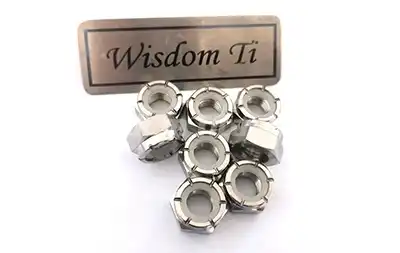
For high-performance uses, finding titanium nylon lock nuts that are the right material grade is essential to the success of your project. Grade 5 titanium (Ti-6Al-4V) is the most common metal for nylon lock nuts because it is very strong for its weight, doesn't rust, and stays stable at high temperatures. This alpha-beta titanium alloy has 6% aluminum and 4% vanadium. It has a tensile strength of over 900 MPa and great fatigue resistance, which are both very important for fasteners that are used in aircraft, racing, and automobile settings where vibration and dynamic loading happen.
Understanding Titanium Nylon Lock Nuts
What Makes Titanium Nylon Lock Nuts Unique?
Titanium nylon lock nuts have a titanium hex body that is precisely cut and a molded nylon collar piece that is placed at the crown of the nut. When threaded onto a bolt, the nylon material creates controlled friction against the threads of the bolt. This creates a dominant torque that stops vibrations from making the bolt open. All-metal locking mechanisms can get stuck or gall up, but the nylon plug can be installed more than once and still work as well as the first time. This design works especially well in motorsports and aircraft, where equipment is constantly vibrating and needs to be accessed for regular repair.
Primary Application Sectors
For titanium nylon lock nuts, speed uses in cars make up a big part of the market. These screws are used by racing teams in suspension systems, brake caliper mounts, and engine parts where lowering unsprung weight directly improves acceleration and handling. High-end electric vehicle makers use titanium fasteners in battery module systems to balance the need for safe links with weight goals for the whole vehicle, which affects how well the range works.
Procurement Considerations for Titanium Nylon Lock Nuts
Verification of Material Certification
Asking for mill test records (MTRs) that show the exact heat or lot from which your fasteners were manufactured is the first step in establishing material tracking. These papers should show that the alloy's composition was checked using spectrography, its mechanical qualities were tested using tensile testing, and it met the requirements of relevant standards like ASTM B348 for titanium bar stock. Reputable makers keep track of batches and can connect finished screws to the raw materials that went into them. This lets problems in the field be investigated. When buying from foreign suppliers, make sure that the material certifications have English translations and use known testing standards instead of internal specs that are kept secret.
Supplier Selection and Relationship Management
Which connection is better—direct maker or distributor? That depends on how many orders you need to place, how much customization you need, and how much supply chain risk you are willing to take. Distributors offer lower minimum orders and faster shipping from stock, which is good for testing prototypes or doing routine maintenance. When you need more than 500 pieces, especially when your requirements call for custom sizes, special nylon compounds, or unique finishes, it becomes more cost-effective to work directly with the maker. While ISO 9001 recognition is a sign of organized quality management, procurement teams should also look at the company's manufacturing skills, such as its hot forging equipment, thread rolling technology, and in-house testing facilities.
Cost Optimization Strategies
Titanium material costs change with the demand for aircraft parts and the amount of titanium sponge that can be made. For Grade 5 bar stock, the price usually ranges from $15 to $35 per kilogram, based on the diameter and the state of the market. Adding value to fasteners is done by forging, milling, and thread rolling. The price of a finished lock nut depends on its size, number, and source. When buying 100 pieces, M8 Grade 5 titanium nylon lock nuts might cost between $2.50 and $4.50 each. When buying more than 1,000 pieces, the price drops to $1.50 to $2.80 each because the setup costs are spread out over a bigger production run.
Installation and Maintenance Best Practices for Titanium Nylon Lock Nuts
Proper Installation Techniques
To get the best joint performance from titanium nylon lock nuts, both the fastener and the part it fits must have clean, unbroken threads. Damage to the threads or pollution with cutting fluids, dirt, or corrosion products can cause friction that isn't constant, which makes torque-tension relationships less reliable. Unlike steel fasteners, which usually need to be oiled, titanium's galling resistance means that it can be installed without any oil. However, anti-seize compounds made specifically for titanium (avoid copper-based products) can be requested for applications that need precise torque control or will be exposed to high or low temperatures.
Reusability and Service Life
One big benefit of titanium nylon lock nuts is that they can be used more than once, unlike throwaway lock nuts or thread-locking compounds. The nylon insert usually keeps its locking torque for 5 to 10 installation cycles, though this depends on the state of the threads, the amount of torque used, and the surroundings. Some of the things that must be done during an inspection before something can be used again are looking for damage to the nylon insert, measuring the torque that was present during fitting, and checking the state of the threads. Setting up written inspection processes makes sure that decisions about whether to repair or reuse fasteners are always made the same way.
Troubleshooting Common Issues
Thread galling can happen when titanium screws are put into holes that are threaded in titanium or aluminum, especially when there is a lot of torque or the fitting is done quickly. When metals touch each other under pressure, they move material and make friction worse. This is called cold welding. Some ways to lower the risk of galling are to install things more slowly, use the right anti-seize chemicals, and make sure you choose the right thread class. Class 2A/2B threads have more room for error than Class 3A/3B threads, which makes them less likely to galle. When galling happens, it's usually necessary to use special extractors or heat to break the bond between the metals.
Conclusion
Using Grade 5 titanium for nylon lock nuts has clear benefits in situations where weight is important, corrosion is a problem, and there is a lot of vibration, such as in the aircraft, automobile, and industry sectors. The material has a special mix of high strength, low density, and great protection to the environment. Its high price is justified by better performance and lower lifecycle costs. To be successful at procurement, you need to check the certifications of materials, build relationships with reliable makers, and follow the right fitting steps to get the most out of your fasteners. Titanium nylon lock nuts are a tried-and-true technology that fills the gap between traditional steel fasteners and new composite solutions as performance needs get tougher and weight reduction goals get more stringent.
Source Premium Grade 5 Titanium Nylon Lock Nuts from Wisdom Titanium
Wisdom Titanium offers factory-direct prices on hot-forged hex titanium nylon lock nuts that are made to strict ISO 9001 standards. Our factory is in Baoji Titanium Valley, Shaanxi Province, which is China's largest and most complete titanium production cluster. We have direct access to premium titanium sponge and mill products, which lets us offer competitive prices without sacrificing quality. Our ready-to-ship inventory includes sizes M3–M24 in both metric and inch threads, and the minimum order size is just 100 pieces. Each fastener has a certified Grade 5 titanium body and a precision-molded nylon insert that is finished in natural titanium for corrosion resistance and good looks.
As a trusted titanium nylon lock nuts manufacturer, we're dedicated to elevating your projects with reliable fastening solutions backed by technical expertise and helpful customer service. Our experienced engineering team offers full OEM services, including custom sizing, specialized nylon compounds for extreme temperatures, and fastener solutions designed for automotive racing, motorcycle performance, and aerospace applications. We maintain strict quality control throughout production, from verifying the raw materials to the final dimensional inspection, to make sure that every batch meets your technical specifications. Contact our team at sales@wisdomtitanium.com to get detailed product catalogs, material certifications, or volume pricing for your next order.
FAQ
Can titanium nylon lock nuts be reused multiple times?
In most cases, grade 5 titanium nylon lock nuts can be used 5–10 times before the nylon insert stops closing. It depends on how well the torque is controlled during installation, the state of the threads, and how long they are exposed to the surroundings. Before allowing reuse, inspection procedures should check the nylon insert for harm and measure the common force. When used for a long time, these fasteners are cheaper than throwaway ones because the titanium body can handle dozens of installation processes without damage to the threads.
How does Grade 5 titanium compare to Grade 2 for corrosion resistance in marine applications?
Both Grade 2 and Grade 5 titanium are very resistant to corrosion in saltwater. They make solid inactive oxide layers that keep the material from breaking down. Because it doesn't have any alloying elements that can make galvanic micro-cells, Grade 2 has slightly better protection in some reducing acid conditions. While Grade 5 is much stronger, it still does a great job of resisting corrosion in almost all naval uses. When choosing a grade, engineering needs should come first. In chloride-rich settings, both materials are much better than stainless steel.
What size range is available for titanium nylon lock nuts?
Standard titanium nylon lock nuts are produced in sizes from M3 to M24 for metric threads and from #10-32 to 1"-8 for inch threads. Smaller sizes below M6 may have limited availability due to manufacturing difficulties in machining compact nylon insert cavities. Custom sizes beyond M24 can be produced through specialized manufacturing processes, though minimum order quantities typically increase substantially. Thread pitch options include both coarse and fine threads, with metric and inch standards accommodated to match regional preferences and existing bolt inventories.
References
1. Boyer, R., Welsch, G., & Collings, E.W. (1994). Materials Properties Handbook: Titanium Alloys. ASM International, Materials Park, Ohio.
2. Donachie, M.J. (2000). Titanium: A Technical Guide, 2nd Edition. ASM International, Materials Park, Ohio.
3. Bickford, J.H. (2007). Introduction to the Design and Behavior of Bolted Joints: Non-Gasketed Joints, 4th Edition. CRC Press, Boca Raton, Florida.
4. Schutz, R.W. & Watkins, H.B. (1998). Recent developments in titanium alloy application in the energy industry. Materials Science and Engineering: A, 243(1-2), 305-315.
5. American Society for Testing and Materials. (2021). ASTM F467: Standard Specification for Nonferrous Nuts for General Use. ASTM International, West Conshohocken, Pennsylvania.
6. Lutjering, G. & Williams, J.C. (2007). Titanium, 2nd Edition. Springer-Verlag, Berlin Heidelberg, Germany.