
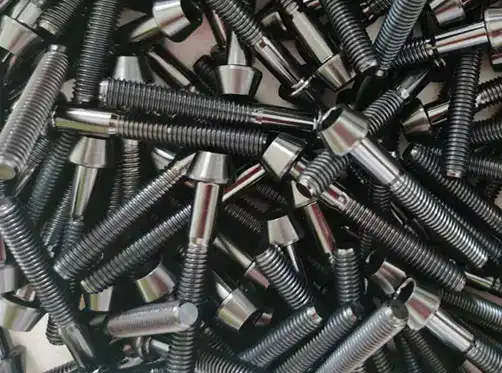
An aerospace engineer specified Grade 2 titanium fasteners for a turbine mounting application. Three months into service, bolts stretched beyond acceptable limits under thermal cycling. The $2 million engine retrofit could have been prevented through proper grade selection. This costly mistake demonstrates why understanding titanium alloy grades matters more than simply choosing "titanium" generically.
Metric titanium fasteners span multiple alloy grades, each engineered for specific performance requirements. Grade 2 offers cost-effective corrosion resistance. Grade 5 (Ti-6Al-4V) delivers exceptional strength-to-weight ratios. Grade 7 resists aggressive chemical environments. Grade 23 provides biocompatible purity for medical implants. Selecting the wrong grade wastes budget on unnecessary performance or worse—creates catastrophic failures from inadequate capabilities.
Characteristics of Mainstream Metric Titanium Alloy Fasteners
The most common unalloyed titanium for industrial use is grade 2. Minimum 99.2% titanium, regulated oxygen (0.25% max), iron (0.30% max), and nitrogen (0.03% max) are interstitial and impurity elements. These components reinforce the pure titanium matrix through solid solution hardening without intermediate phases, ensuring high corrosion resistance and mild mechanical qualities. Yield strength is 275-380 MPa, while tensile strength is 345–480 MPa, depending on processing and oxygen content.
The single-phase alpha microstructure of Grade 2 titanium provides excellent formability and weldability unavailable in alloy grades with complex alpha-beta structures. This metallurgical simplicity translates to straightforward manufacturing processes, reduced tool wear during machining, and lower production costs compared to alloy grades requiring specialized processing. Marine hardware, chemical processing equipment, and architectural applications employ Grade 2 metric titanium fasteners where corrosion resistance outweighs ultimate strength requirements. The material excels in seawater, atmospheric exposure, and many chemical environments while costing approximately 30-40% less than Grade 5 alternatives.
Grade 5 titanium alloy (Ti-6Al-4V) holds the top spot for high-performance metric titanium fasteners due to its superior strength-to-weight ratio. Approximately 6% aluminum and 4% vanadium alloyed with titanium form an alpha-beta microstructure with aluminum stabilizing the hexagonal close-packed alpha phase and vanadium stabilizing the body-centered cubic beta phase. Despite its low density of 4.51 g/cm³, this two-phase structure achieves 950 MPa tensile strength and 880 MPa yield strength in mill-annealed conditions, surpassing Grade 2 capabilities.
Grade 7 titanium adds 0.12-0.25% palladium to commercially pure titanium, making it more corrosion-resistant in reducing acid conditions. Palladium acts as a catalyst to accelerate passive film development in acids without enough oxygen for spontaneous passivation. The metallurgical alteration greatly enhances performance in sulfuric, phosphoric, and hydrochloric acids at concentrations and temperatures that would damage Grade 2 titanium. Palladium's corrosion inhibitor rather than strengthening agent gives it mechanical qualities close to Grade 2.
Grade 23 (Ti-6Al-4V ELI): Medical and Cryogenic Applications
Grade 23 titanium alloy preserves Grade 5's nominal composition (6% aluminum, 4% vanadium) while tightening interstitial element restrictions to extra-low levels. The "ELI" designation (Extra Low Interstitials) reduces oxygen to 0.13% versus 0.20% for Grade 5, and nitrogen and carbon are lowered. This composition refinement improves biocompatibility for medical device applications by reducing impurity content, which may cause immunological reactions or corrosion in physiological settings. It also increases fracture toughness and ductility, especially at cryogenic
Specialty Grades and Emerging Alloys
Grade 9 titanium (Ti-3Al-2.5V) is stronger than Grade 2 and more formable than Grade 5. The lower alloy percentage (3% aluminum, 2.5% vanadium vs. 6% and 4% respectively) makes it easier to cold-work and weld than Grade 5 and has 620 MPa tensile strength. Bicycle frames, aviation hydraulic tubing, and sporting goods use Grade 9, when reasonable strength from commercially pure titanium justifies slight cost increases, but Grade 5 attributes aren't needed.
Core Performance Comparison
Mechanical strength differentials determine load-bearing capacity and component sizing across titanium grades. Grade 2's 345-480 MPa tensile strength suits moderate-load applications where corrosion resistance or weight reduction motivate titanium selection over steel, but ultimate strength requirements remain modest. Grade 5's 950 MPa tensile strength enables fasteners handling substantially higher loads in equivalent cross-sections, or alternatively allows diameter reductions maintaining adequate strength while further minimizing weight. This performance differential proves especially valuable in aerospace, where each gram of weight reduction generates fuel savings compounding across decades of aircraft operation.
Yield strength determines the stress level where permanent deformation begins—critical for fastener applications requiring precise preload maintenance. Grade 2's 275-380 MPa yield limits design stress to approximately 165-285 MPa, applying typical 60-75% safety factors. Grade 5's 880 MPa yield permits design stresses reaching 530-660 MPa, enabling substantially higher clamping forces or reduced fastener quantities achieving equivalent joint performance. The strength advantage allows M6 Grade 5 metric titanium fasteners to potentially replace M8 Grade 2 equivalents, creating space savings valuable in compact assemblies while reducing weight through both diameter reduction and titanium's inherent density advantage versus steel.
Density remains constant across titanium grades at approximately 4.5-4.51 g/cm³, providing consistent weight advantages versus steel's 7.85 g/cm³ or stainless steel's similar density. This 43% weight reduction versus steel applies equivalently whether specifying Grade 2 or Grade 5, though the strength differential means Grade 5 often allows further size reduction, amplifying weight savings. The density advantage proves especially compelling for rotating components like wheel hardware or engine components, where reduced rotational inertia improves performance beyond simple static weight reduction benefits.
Hardness values reflect surface wear resistance and machining difficulty. Grade 2 measures approximately 80-100 HRB (Rockwell B scale), relatively soft and easily machined with conventional tooling. Grade 5 reaches approximately 36 HRC (Rockwell C scale), harder and more wear-resistant but demanding TiAlN-coated carbide tools for efficient machining. Grade 7 approximates Grade 2 hardness since palladium addition affects corrosion behavior without significantly altering mechanical hardness. Grade 23's extra-low interstitials slightly reduce hardness versus standard Grade 5 while improving toughness—a beneficial trade-off for medical and cryogenic applications prioritizing fracture resistance over surface hardness.
Practical Selection Guide: Master Level Selection in 3 Steps
Step one involves prioritizing core application needs, matching fundamental requirements to appropriate grade families. Applications demanding low cost combined with corrosion resistance in marine or general industrial environments point toward Grade 2 commercially pure titanium. The material delivers excellent seawater resistance, atmospheric durability, and resistance to most neutral or oxidizing chemicals at costs substantially below alloy grades. Marine hardware, architectural fasteners, and chemical processing equipment operating in moderate environments specify Grade 2, optimizing performance per dollar invested.
High strength requirements coupled with lightweight design mandate selecting Grade 5 (Ti-6Al-4V) alloy. Aerospace structures, racing components, premium bicycles, and high-performance industrial equipment employ Grade 5 metric titanium fasteners where exceptional strength-to-weight ratios justify cost premiums. The 950 MPa tensile strength and 880 MPa yield strength enable load-bearing applications impossible for commercially pure grades, while maintaining 4.51 g/cm³ density, delivering consistent weight advantages versus steel alternatives. Baoji Wisdom Titanium manufactures Grade 5 fasteners addressing demanding applications where strength and weight optimization prove critical.
Step Two: Environmental and Standards Verification
Operating temperature analysis determines grade thermal capability requirements. Applications maintaining temperatures below 300°C can employ any titanium grade based on other selection criteria. Sustained operation between 300-400°C requires Grade 5 alloy, maintaining adequate strength at elevated temperatures where commercially pure grades show accelerated degradation. Cryogenic exposure below -196°C demands verifying grade low-temperature toughness, with Grade 23 preferred for liquid hydrogen service at -253°C, where standard Grade 5 might show reduced impact resistance. Thermal cycling between extreme temperatures requires fatigue analysis, ensuring the selected grade tolerates repeated expansion-contraction cycles.
Step Three: Cost Control and Processing Risk Management
Avoiding over-specification prevents wasting budget on unnecessary performance capabilities. Marine environments rarely justify Grade 7 since Grade 2 provides excellent seawater resistance at substantially lower cost—reserve Grade 7 for verified aggressive chemical exposures beyond commercially pure titanium's capabilities. Similarly, routine mechanical loads don't require Grade 23's biocompatible purity when standard Grade 5 delivers equivalent strength for non-medical applications. Systematic requirements analysis matching actual operating conditions to a minimum adequate grade optimizes total cost while ensuring reliable performance.
Source Premium Grade 5 Metric Titanium Fasteners
Titanium grade selection requires methodical investigation to match material capabilities to application conditions, balancing mechanical property requirements, corrosion resistance, and cost. Grade 2 commercially pure titanium resists moderate-load corrosion economically. Grade 5 (Ti-6Al-4V) has high strength-to-weight ratios and warrants premium pricing when performance needs surpass commercially pure capabilities. Specialized harsh chemical conditions are covered in grade 7. Grade 23 meets biocompatibility and severe low-temperature toughness requirements for medical implants and cryogenics.
Baoji Wisdom Titanium makes Grade 5 metric titanium fasteners to stringent requirements in M1.6–M24 sizes. Its 950 MPa tensile strength, 880 MPa yield strength, and 4.51 g/cm³ density provide remarkable performance in aerospace, marine, medical, and industrial applications. With 36 HRC hardness and operating temperatures from -250°C to 400°C, it delivers durable operation in harsh conditions while approaching commercially pure titanium corrosion resistance.
For detailed technical specifications, material certificates, mechanical property data, or quotations on Grade 5 metric titanium fasteners optimized for your application, contact Baoji Wisdom Titanium today. Our team stands ready to discuss grade selection criteria, provide engineering analysis supporting specification development, and deliver precision fasteners meeting your performance requirements. Send your inquiry to sales@wisdomtitanium.com.
FAQs
Q1: When should I choose Grade 5 titanium instead of Grade 2?
A: Choose Grade 5 for high-strength, high-temperature (up to ~300°C), or load-bearing applications.
For corrosion-resistant but low-to-moderate load conditions (e.g., marine use), Grade 2 is sufficient and more cost-effective.
Use Grade 5 only when your design stress exceeds Grade 2 capabilities.
Q2: Is Grade 7 required for marine applications?
A: Not usually.
Grade 2 already performs exceptionally well in seawater and coastal environments.
Choose Grade 7 only for reducing acid environments (HCl, H₂SO₄, etc.), not standard marine exposure.
Q3: What should I consider when machining Grade 5 titanium fasteners?
A: Grade 5 requires:
TiAlN-coated carbide tools
Slow cutting speeds with heavy coolant flow
Avoiding dwell/interruptions to prevent work hardening
Anti-seize during installation to prevent galling
Always use the torque values provided for titanium, not steel.
References
- Donachie, M.J. (2000). Titanium: A Technical Guide (2nd Edition). Materials Park, OH: ASM International.
- Boyer, R., Welsch, G., & Collings, E.W. (1994). Materials Properties Handbook: Titanium Alloys. Materials Park, OH: ASM International.
- ASTM International. (2021). ASTM B348 - Standard Specification for Titanium and Titanium Alloy Bars and Billets. West Conshohocken, PA: ASTM International.
- ASTM International. (2020). ASTM F136 - Standard Specification for Wrought Titanium-6Aluminum-4Vanadium ELI (Extra Low Interstitial) Alloy for Surgical Implant Applications. West Conshohocken, PA: ASTM International.
- Lütjering, G., & Williams, J.C. (2007). Titanium (2nd Edition). Berlin: Springer-Verlag.