
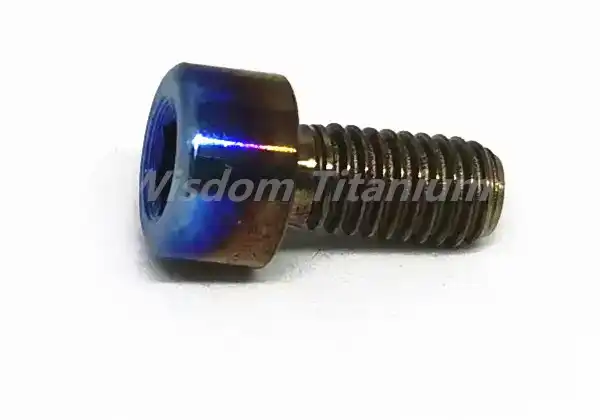
In the past few years, the bicycle business has seen something amazing. What started out as a niche taste has become a popular need. Burnt titanium bolts, which have beautiful blue, purple, and gold heat-treated surfaces, can now be seen on anything from professional race bikes to personalized builds that people flaunt off on social media.
China's titanium manufacturing sector responded decisively to this trend. Facilities in Baoji, Shaanxi Province have perfected the controlled oxidation processes creating these distinctive colorations. But the story extends beyond mere appearance. The best burnt titanium bolt options emerging from Chinese factories in 2025 combine aesthetic appeal with genuine performance advantages, manufactured to standards previously reserved for aerospace applications.
Authentic Burnt Titanium Finishes
True burnt titanium coloring results from controlled thermal oxidation rather than coatings or dyes. When titanium heats in oxygen-rich environments, a transparent oxide layer forms on the surface. The layer's thickness determines color through optical interference—similar physics that create rainbow patterns in oil slicks or soap bubbles. Temperatures between 400°C and 650°C produce the characteristic spectrum from straw gold through violet to deep blue.
The Science Behind Heat Coloring Titanium
Titanium dioxide (TiO2) forms when titanium reacts with atmospheric oxygen at elevated temperatures. The reaction accelerates dramatically above 400°C as thermal energy overcomes activation barriers. Oxide growth follows parabolic kinetics—initial layers form rapidly, then growth slows as oxygen must diffuse through existing oxide to reach fresh titanium beneath.
Interference colors emerge when light waves reflect from both the oxide surface and the oxide-metal interface beneath. These reflected waves interact constructively or destructively depending on oxide thickness and light wavelength. At approximately 25 nanometers in thickness, the oxide appears gold. Increasing to 50 nanometers shifts the color to purple. At 75 nanometers, blue dominates. Further heating beyond 650°C produces gray oxide, losing decorative appeal.
Manufacturing Process for Burnt Titanium Bolts
Production begins with fully machined Grade 5 titanium bolts meeting dimensional specifications. Surface preparation proves critical—machining oils, fingerprint residues, and contaminants must be completely removed before heating. Alkaline cleaning followed by acid pickling creates chemically clean surfaces, ensuring uniform oxidation. Any residual contamination causes color variations or blotching that ruins aesthetic appeal.
Controlled atmosphere furnaces heat-cleaned burnt titanium bolts following precise temperature profiles. Programmable controllers ramp temperature gradually, hold at target levels for specific durations, then cool systematically. Rapid heating risks thermal shock cracking, while excessive hold times darken colors beyond desired hues. Experienced manufacturers have developed proprietary heating curves optimized for specific bolt sizes and target colors.
Post-heating inspection verifies color uniformity across batches. Spectrophotometers measure reflected light wavelength, quantifying color precisely rather than relying on subjective visual assessment. Bolts falling outside acceptable color ranges get reprocessed or rejected. This quality gate ensures customers receive a consistent appearance whether ordering today or repeating purchases months later.
Distinguishing Quality Burnt Finishes from Inferior Products
Market flooding with cheap "burnt titanium" bolts has created confusion among buyers. Many low-cost options employ painted or powder-coated finishes mimicking authentic oxidation. These coatings lack the durability and chemical integration of genuine thermal treatment. Simple scratch tests reveal the deception—authentic burnt finishes show bare titanium beneath surface disturbances while coated bolts expose contrasting substrate materials.
Color consistency indicates manufacturing sophistication. Premium burnt titanium bolt batches display uniform coloring across all fasteners with minimal variation between pieces. Budget products often show mottled appearances or dramatic color shifts from bolt to bolt within single packages. This inconsistency reflects inadequate temperature control or rushed processing, prioritizing speed over quality.
Performance Advantages of Premium Grade 5 Titanium
The burnt titanium bolt aesthetic should never compromise structural performance. Premium manufacturers start with aerospace-grade Ti-6Al-4V (Grade 5) titanium, offering superior mechanical properties compared to commercially pure grades. This alpha-beta alloy delivers tensile strength approaching 950 MPa and yield strength around 870 MPa—values exceeding most cycling applications by comfortable safety margins.
Mechanical Property Verification and Testing
Reputable Chinese manufacturers subject production batches to rigorous mechanical testing, verifying conformance to ASTM B348 specifications. Tensile test machines pull sample bolts to failure, measuring ultimate strength, yield point, and elongation characteristics. These destructive tests provide objective evidence that heat treatment didn't degrade properties below acceptable thresholds.
Torque testing validates thread strength under realistic installation loads. Technicians tighten sample bolts to specified values, then examine threads for deformation, galling, or stripping. Quality burnt titanium bolt products withstand recommended torque specifications without damage. This functional testing ensures aesthetic treatments didn't compromise practical usability—bolts must perform reliably beyond looking attractive.
Corrosion Resistance and Environmental Durability
The titanium dioxide layer created during burnt finishing enhances already-excellent corrosion resistance. While untreated titanium naturally resists environmental degradation, the thicker oxide from heat treatment provides additional protection. Salt spray testing demonstrates that burnt finished bolts withstand 500+ hours of continuous fog exposure without corrosion—far exceeding steel or aluminum alternatives.
Chemical stability across wide pH ranges makes burnt titanium fasteners ideal for diverse environments. Road salt, bicycle cleaning products, and atmospheric pollutants fail to attack the oxide layer. Coastal riders and winter cyclists benefit from hardware that maintains appearance and function despite brutal conditions. The finish requires no maintenance—unlike painted or coated products needing periodic touch-up.
UV stability ensures colors remain vibrant through years of sunlight exposure. Unlike organic dyes or pigments that fade when exposed to ultraviolet radiation, titanium oxides' inorganic structure resists photodegradation. Outdoor bicycles, motorcycle applications, and marine equipment maintain original coloring indefinitely. This permanence eliminates concerns about weather-induced aesthetic deterioration affecting resale value or professional appearance.
Leading Chinese Manufacturers for 2025
Baoji Titanium Valley in Shaanxi Province hosts China's most sophisticated burnt titanium bolt production capabilities. The industrial cluster's integrated supply chain—from titanium sponge through precision machining and controlled atmosphere heat treatment—enables quality control and cost efficiency unavailable elsewhere. Over 600 titanium enterprises within this geographic concentration create competitive pressure, driving continuous improvement.
Baoji Wisdom Titanium Industry and Trading Co., Ltd. exemplifies the professional approach, distinguishing premium suppliers from commodity vendors. Founded in 2016, this ISO 9001-certified manufacturer serves the aerospace, medical, automotive, and cycling industries. Multi-sector experience ensures manufacturing standards exceed bicycle-specific requirements—facilities producing medical implants and aerospace components naturally maintain rigorous protocols.
The company's burnt blue titanium bolts reflect sophisticated production capabilities. Starting with Grade 5 titanium bar stock verified through spectroscopic analysis, CNC machining creates fasteners in sizes from M3 through M24. Thread rolling rather than cutting enhances fatigue strength by 30% compared to cheaper alternatives. Controlled atmosphere heat treatment produces consistent burnt blue coloring across production batches.
Burnt blue surface finishes combine distinctive aesthetics with enhanced corrosion protection. Controlled atmosphere heat treatment produces consistent coloring across production batches. Spectrophotometric verification ensures uniformity, enabling confident ordering for projects requiring matched appearance. The permanent oxide integration eliminates concerns about fading, peeling, or wear affecting long-term appearance.
For detailed specifications, custom quotation requests, or technical consultation regarding burnt titanium bolt requirements, contact the sales team directly. Email inquiries to sales@wisdomtitanium.com with your application details, quantity needs, and any customization preferences. Expect comprehensive responses within 24-48 hours, including pricing across volume breaks, lead time estimates, and technical recommendations optimizing your specific requirements.
FAQs
Q1: Will the burnt blue color fade or change over time?
A: No—the burnt blue titanium oxide layer is permanent, stable, and self-healing under normal use.
Q2: How do burnt titanium bolts compare in strength to standard titanium fasteners?
A: Burnt titanium bolts have identical mechanical strength to standard Grade 5 fasteners because the coloring process does not affect the material’s microstructure.
Q3: Can I request custom colors beyond standard burnt blue?
A: Yes—manufacturers can produce gold, purple, deep blue, or multi-color gradients through controlled oxidation, typically with a 200-piece minimum.
References
- Donachie, M. J. (2000). Titanium: A Technical Guide (2nd ed.). Materials Park, OH: ASM International.
- ASTM International. (2021). ASTM B348 - Standard Specification for Titanium and Titanium Alloy Bars and Billets. West Conshohocken, PA: ASTM International.
- Lutjering, G., & Williams, J. C. (2007). Titanium (2nd ed.). Berlin: Springer-Verlag.
- Guleryuz, H., & Cimenoglu, H. (2009). Oxidation of Ti-6Al-4V alloy. Journal of Alloys and Compounds, 472(1-2), 241-246.
- Boyer, R., Welsch, G., & Collings, E. W. (1994). Materials Properties Handbook: Titanium Alloys. Materials Park, OH: ASM International.




