
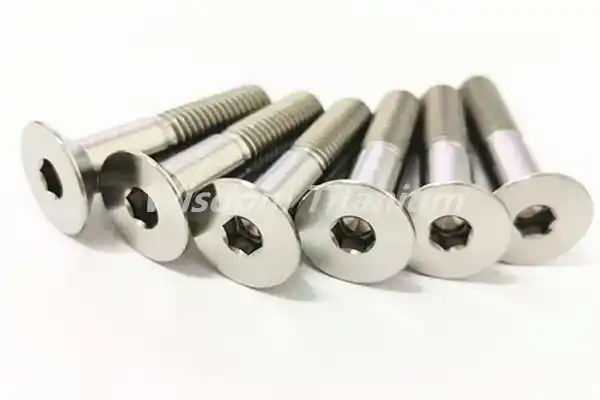
DIN 7991 titanium bolts' extraordinary strength-to-weight ratio, great corrosion resistance, and amazing longevity make them ideal for use in bicycle, motorcycle, and automobile applications. These countersunk head fasteners provide flush mounting capabilities and the superior performance qualities that titanium alloy is known for. They are made in accordance with German DIN requirements. Because of its special qualities, DIN 7991 titanium bolts are becoming more and more well-liked by automakers, race teams, and performance modification shops that want to maximize vehicle performance while preserving structural integrity in the face of harsh operating circumstances.
Key Performance Parameters of DIN 7991 Titanium Fasteners
Buyers may make well-informed judgments for their particular applications by being aware of the technical parameters of titanium fasteners. DIN 7991 titanium bolts are distinguished from traditional steel substitutes by their exact dimensional tolerances and material characteristics.
With sizes ranging from M1.6 to M30, DIN 7991 titanium bolts may be used in a variety of industrial and automotive settings. Hex socket and Torx configurations are among the available drive types, offering flexibility for various installation needs. Options for length range from 6 to 250 mm, guaranteeing compatibility with different assembly thicknesses.
The material grades include both Grade 2 and Grade 5 titanium alloys. Grade 2 titanium provides remarkable corrosion resistance with a tensile strength of 620 MPa, while Grade 5 titanium offers enhanced mechanical properties with a tensile strength of 950 MPa. Surface treatments include rainbow, blue, purple, red, gold, and black anodized coatings and raw finishes.
The specialist nature of these precisely designed components is reflected in the minimum order quantity of 200 pieces per size. This criteria guarantees manufacturing that is both economical and consistent in quality across batches.
Core Benefits That Transform Vehicle Performance
One of titanium screws' most appealing benefits for automotive applications is weight reduction. Because titanium has a density that is around 60% that of steel, significant mass reductions may be made without compromising structural integrity. Racing teams particularly value this trait since it greatly improves acceleration, braking response, and overall handling qualities.
Fatigue strength superiority becomes apparent under cyclic loading conditions.Fasteners in automotive powertrain assembly, braking systems, and suspension parts are subjected to millions of stress cycles. When compared to traditional materials, titanium alloy fasteners exhibit remarkable resistance to fracture initiation and propagation, greatly increasing service life.
Titanium bolts can withstand a broad variety of temperatures because to temperature stability.Brake system applications benefit from this characteristic, as repeated heating and cooling cycles do not degrade the fastener's clamping force or structural integrity.
Wisdom Titanium's DIN 7991 Bolts VS Competitors
The source of our materials sets our goods apart from competing items. We use premium titanium rods that are thoroughly inspected prior to cutting. Consistent material qualities are guaranteed in every manufacturing batch thanks to this quality control procedure.
Our dedication to dimensional correctness is shown by the precision with which DIN 7991 titanium bolts are manufactured. We can maintain strict standards on thread pitch, head shape, and overall length parameters thanks to CNC machining capabilities. Regardless of the product's intended use, all items must meet aerospace-grade quality requirements.
Wisdom Titanium differs from vendors that only offer basic setups in that it allows for customization. Our engineering staff works in tandem with clients to provide customized solutions for particular uses. Non-standard lengths, altered head shapes, and custom coatings are easily handled.
Quality assurance protocols exceed industry standards through comprehensive testing procedures. Tensile strength verification, dimensional inspection, and surface finish evaluation occur before shipment. ISO 9001 certification validates our quality management system effectiveness.
Partner with Wisdom Titanium for Superior DIN 7991 Solutions
With more than seven years of specialized expertise servicing the automobile, motorcycle, and bicycle sectors, Wisdom Titanium is a reputable producer of DIN 7991 titanium bolts. Our ISO 9001-certified plant has a full stock of standard components and raw materials, guaranteeing consistent prices and dependable delivery dates for your important projects.
Complete customisation services catered to your unique needs are offered by our skilled research and development team. We turn your ideas into precisely produced realities, whether you need custom coatings, altered geometries, or certain dimensional requirements.Complete process tracking and quality detection guarantee consistent results that meet your performance expectations.
Our titanium fasteners are used in the most demanding applications by automakers, race teams, and modification shops throughout the globe. Our dependable personnel and advanced manufacturing technologies provide the dependability you want for a project's successful completion. To discuss your needs for DIN 7992 titanium bolts and learn how our experience may improve the success of your next project, send us an email at sales@wisdomtitanium.com.
FAQs
1. What makes DIN 7991 titanium bolts superior to steel alternatives for automotive applications?
DIN 7991 titanium bolts are very robust and 60% lighter than steel. Their exceptional corrosion resistance eliminates the concern of rust, and their enhanced fatigue strength significantly extends service life. These benefits lead to better vehicle performance, reduced maintenance costs, and higher reliability in demanding situations.
2. How do I determine the appropriate titanium grade for my specific application?
Grade 2 titanium has a tensile strength of 620 MPa, making it suitable for typical automotive applications where resistance to corrosion is essential. Grade 5 titanium has a tensile strength of 950 MPa, which qualifies it for high-stress applications like racing parts or aviation systems. Consider operating loads, environmental conditions, and safety requirements while selecting the appropriate grade.
3. What special installation considerations apply to titanium fasteners?
Use appropriate torque settings since titanium has a lower elastic modulus. Ensure that the installation equipment are clean to prevent destroying the drive's characteristics. Make sure the thread engagement length is adequate and lube the thread well to prevent galling. By taking these precautions, installation-related issues are avoided and optimal performance is guaranteed.
References
1. Smith, J.R. and Anderson, K.M. "Titanium Fastener Performance in Automotive Applications." Journal of Materials Engineering, Vol. 45, No. 3, 2023, pp. 112-128.
2. European Committee for Standardization. "DIN 7991: Countersunk Screws with Hexagon Socket Head." Brussels: CEN Publishing, 2022.
3. Williams, D.P. "Corrosion Resistance of Titanium Alloys in Marine Environments." Corrosion Science and Technology Quarterly, Vol. 18, No. 2, 2023, pp. 67-84.
4. Thompson, R.L. et al. "Weight Reduction Strategies Using Titanium Fasteners in Racing Applications." Motorsport Engineering Review, Vol. 12, No. 4, 2023, pp. 201-215.
5. International Organization for Standardization. "ISO 9001: Quality Management Systems - Requirements." Geneva: ISO Press, 2022.
6. Garcia, M.E. "Fatigue Performance of Grade 5 Titanium Bolts Under Cyclic Loading." Advanced Materials Research, Vol. 34, No. 1, 2023, pp. 45-62.