
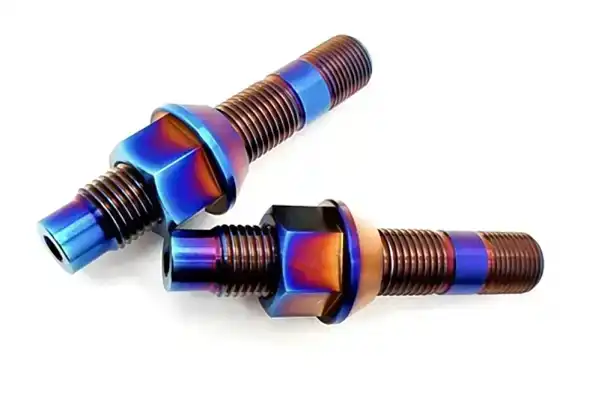
Absolutely, a titanium wheel stud nut manufactured from Ti-6Al-4V (Grade 5) alloy delivers exceptional strength with a tensile rating exceeding 950 MPa and a hardness of 36 HRC. Despite being 45–50% lighter than conventional steel fasteners, these nuts maintain structural integrity under extreme loads, high vibration, and temperature fluctuations. The aerospace-grade material ensures reliability in demanding motorsports, high-performance vehicles, and industrial applications where failure is not an option. Titanium's proven track record in aviation and racing validates its capability to secure critical wheel assemblies without compromising safety or performance.
Understanding Titanium Wheel Stud Nuts: Strength and Specifications
Material Composition and Mechanical Properties
Titanium wheel stud nuts are usually made from Ti-6Al-4V, an alloy with 6% aluminium and 4% vanadium that is both flexible and tough. This mix has a minimum tensile strength of 950 MPa, which is about the same as medium-carbon steel, but it is only 4.43 g/cm³ dense. The 36 HRC hardness grade gives it great resistance to thread galling, which is a typical way for aluminium or softer alloys to break. Rolled threads, not cut threads, keep the grain flow continuous and improve fatigue resistance under repetitive loads. This is important for parts that have to be torqued over and over again during tyre changes or track events.
Industry Standards and Testing Protocols
Titanium wheel stud nuts that are quality guaranteed follow ASTM B348 for the makeup of the material and ISO 4032 or DIN 934 for the limits of the sizes. Chemical makeup analysis using Positive Material Identification (PMI) tests confirms the exact amounts of aluminium and vanadium, separating Grade 5 from weaker pure titanium versions. Tensile and proof load testing according to ISO 898-1 standards proves the yield strength limits, and metallographic cross-sectioning shows the right way to forge something. Using Go/No-Go tools for thread precision gauging makes sure that the pitch is accurate within a 6g tolerance, which keeps the hub from getting damaged during installation. These steps of validation make sure that performance is the same across all production batches. This eases concerns about variability in aftermarket parts that are used in procurement.
Engineering for Specific Uses
In the automobile and motorsports industries, different types of nuts are used for different tasks. Hex nuts can be used with a wide range of tools and are easy to find. Twelve-point designs, on the other hand, allow for smaller angle adjustments in wheel wells with limited space. Torx drive designs stop mischief from the outside and lower the risk of corners rounding off during high-torque installation. Thread sizes ranging from M12 to M14 and 1/2-20 can fit a wide range of vehicle types, from European sedans to American power cars. Customisation options let engineering teams choose the exact thread pitch, overall length, and flange dimensions needed for prototype race or limited-production supercar projects where ready-made choices don't work.
Titanium vs Steel Wheel Stud Nuts: Strength, Durability, and Corrosion Resistance
Comparative Weight and Strength Analysis
The difference in weight between steel and titanium wheel stud nuts has a direct effect on unsprung mass, which is the total weight of the suspension parts that aren't being supported by the springs. Even cutting unsprung mass by 200 grams per wheel corner speeds up the suspension's response time, which lets the dampers respond more quickly to changes in the road surface. This means that the car will handle more precisely when turning at high speeds and will be more comfortable to ride on rough roads. Stainless steel (316L) nuts don't rust too badly, but they are 45% heavier than other nuts and don't have better tensile properties. High-strength steel metals can hold the same amount of weight as titanium, but they don't have the anti-corrosion and non-magnetic properties that are needed for some aircraft and medical equipment uses that have been adapted for use in cars.
When it comes to professional racing, the strength-to-weight ratio is very important. MotoGP teams and Formula 1 builders try to save as many grams as possible in rotating and moving parts because lowering rotational drag has a direct effect on how fast a car can go and how well it can stop. Engineers can use titanium wheel stud nuts to meet FIA weight distribution rules while keeping the structural safety margins needed for impacts at speeds of 200+ mph and emergency deceleration forces above 5G. Racing groups use titanium wheel stud nuts not only to improve performance slightly, but also as key parts of weight-loss strategies that make the difference between podium finishers and competitors in the middle of the pack.
Corrosion Resistance and Environmental Longevity
Titanium quickly forms a passive oxide layer (TiO₂) when exposed to air. This makes a shield that can fix itself and is not affected by road salts, de-icing chemicals, or acidic rainwater. This oxide film stays stable in pH levels from 3 to 12 and can handle high levels of chloride ions, which quickly wear away stainless steel. Titanium is better than steel for marine transport uses like boat trailers that work in coastal areas, where steel options seize up on the studs after 18 months of saltwater exposure. Galvanic corrosion happens when different metals come into contact and speed up the breakdown process. Titanium is very safe from this because it is high on the electromotive series. When you pair titanium stud nuts with steel studs or aluminium wheels, you avoid the catastrophic failure modes that happen when steel fasteners rust into aluminium threads, damaging the hub irreversibly and forcing a replacement.
Maintenance Cycle Economics
Titanium wheel stud nuts have a longer useful life, which changes how fleet managers and racing teams figure out the total cost of ownership. In northern areas where winter road treatments speed up rust, steel nuts need to be replaced every 24 to 36 months. Titanium wheel stud nuts, on the other hand, can often go longer than ten years between services without showing any signs of wear. Commercial fleets with hundreds of cars that use various service shops will save money on labour costs when they do maintenance less often. Racing teams gain because they don't have to change fasteners in the middle of the season, which wastes practice time and makes it harder to keep the suspension geometry consistent. Even though titanium stud nuts cost 3–5 times more than steel nuts when they are first bought, the lack of corrosion-related failures and the ability to keep exact torque characteristics make the investment worth it for uses that need the highest level of reliability.
Installation and Maintenance of Titanium Wheel Stud Nuts for Optimal Strength
Recommended Torque Specifications and Tools
To do a good job of installing titanium wheel stud nuts, you must first understand how the friction of titanium nuts works. Because the metal tends to gall, which is a cold-welding effect where two surfaces stick together under pressure, anti-seize oil needs to be used on the threads and contact faces. Copper-based or nickel-based anti-seize compounds that can withstand temperatures above 1,800°F stop galling and keep torque readings accurate. For passenger cars, torque values usually fall between 95 and 120 Nm (70 and 88 lb-ft). Lower values are needed in racing situations to keep threads from getting too tight on lightweight aluminium hubs. Calibrated torque tools with an accuracy of ±3% make sure that the locking force is the same in all wheel positions. This keeps one titanium stud nut from carrying too much weight because it isn't tightened enough.
Picking the right socket is more important for titanium stud nuts than for steel ones. There is less chance of corner rounding with six-point sockets than with twelve-point designs because they spread force across flats more evenly. Impact wrenches shouldn't be used for final tightening because the pulsing action they use can cause tiny cracks in the crystalline structure of titanium. Instead, beam-type or click-style torque wrenches apply the controlled force needed to get the right charge without going over the elastic limit of the material. Tightening titanium wheel stud nuts in a star design several times at 30%, 60%, and 100% of final power makes sure that the wheels are evenly seated and stops the hub from warping, which can cause the brake rotors to run out of alignment.
Periodic Inspection and Retorquing Procedures
Titanium wheel stud nuts are better when they are inspected using methods taken from aircraft repair. Early warning signs include discolouration from thermal stress, thread damage from bad installation, or surface cracking near stress concentrators. These can be seen visually every 5,000 miles or before each track session. After the first 50–100 miles of use, retorquing makes up for the settling effect, in which microscopic surface irregularities get squashed under load, lowering clamping force slightly. Checks are made every time the oil is changed to make sure that the torque is still being maintained. However, once titanium stud nuts are properly placed, they rarely need to be adjusted because they are more resistant to shaking than self-loosening steel nuts.
Harsh chemicals that damage the protective oxide layer should not be used for cleaning. Brake dust and road grime can be cleaned off with mild soap solutions and soft brushes that don't damage the finish. Burnt blue, gold, and rainbow spectrum anodised colour finishes need extra care because rough tools can remove the artistic oxide layer. For raw titanium stud nut finishes, cleaning them every once in a while with substances that aren't based on petroleum brings back their shine while protecting the oxide barrier underneath. Cross-threading should not be done during reinstallation as this can damage both the nut and stud threads. Starting the threads by hand before applying pressure stops the misalignment that leads to damage that can't be fixed and requires replacing the stud.
Conclusion
Titanium wheel stud nuts made from aerospace-grade Ti-6Al-4V metal have been shown to be stronger than 950 MPa while being 45–50% lighter than steel options. Because it doesn't rust, wear down easily, and stays stable at high temperatures, this material is the best choice for hard racing uses, coastal vehicle operations, and high-performance car platforms where dependability can't be compromised. Installing these titanium wheel stud nuts correctly by following the manufacturer's torque recommendations and giving them regular care will make sure they last for decades without breaking down. Buying in a smart way from ISO-certified companies that offer customisation options and full quality documentation raises value and lowers supply chain risks. The higher initial investment premium is balanced out by lower replacement costs, better vehicle performance, and higher safety margins that protect both assets and reputation.
FAQ
How strong are titanium wheel stud nuts compared to steel ones?
Titanium Grade 5 has a compressive strength of about 950 MPa, which is about the same as medium-carbon steel, but it is 45–50% lighter. Titanium wheel stud nuts are better than other metals when it comes to strength-to-weight ratio, resistance to corrosion, and resistance to fatigue. This makes it ideal for uses where reducing unsprung mass improves handling dynamics. Steel still has a slight edge in shear strength and lower material cost, but the lifecycle economics of a titanium wheel stud nut, which mean it doesn't need to be replaced as often, often make up for the higher price in professional and high-performance settings.
What is the right amount of force for titanium wheel stud nuts?
Manufacturers usually suggest between 95 and 120 Nm (70 to 88 lb-ft) for passenger cars, but the exact range depends on the thread size, hub material, and use. To keep from galling, always use anti-seize lubricant, calibrated torque tools, and star-pattern tightening steps. In racing uses, lower power values may be needed to keep the aluminium hub from getting damaged. After the first 50–100 miles, apply more power to make up for the vehicle settling. Then, check the titanium wheel stud nuts every so often as part of regular maintenance.
Can titanium wheel stud nuts be used on any kind of car?
Titanium wheel stud nuts can be used on most car models as long as the thread pitch, seat type, and length all meet the requirements. For heavy-duty uses like commercial trucks, you might need custom designs with higher proof loads and longer thread engagement. Check that it works with the geometry of the wheel lug holes (conical vs flat seat) and that it fits in aftermarket wheel designs. When fitting titanium wheel stud nuts into non-standard shapes, talk to the makers to get advice that is specific to your needs.
Secure High-Performance Titanium Wheel Stud Nuts from Wisdom Titanium
Wisdom Titanium makes titanium wheel stud nuts that are precisely designed to fit your exact needs. They are backed by ISO 9001 certification and full quality tracking. We make titanium wheel stud nuts in Baoji Titanium Valley, which is the world's most integrated titanium production cluster. We offer low prices for large orders, custom thread configurations, and a range of anodised finishes, such as burnt blue, gold, and rainbow spectrum. Our experienced engineering team can help you choose the right materials, get the right torque specs, and make the best use of their skills so that they can fit perfectly into your car systems. Our CNC cutting services can support both prototype development and mass production with stable lead times, no matter what thread size you need (M12, M14, or special). Email our team at sales@wisdomtitanium.com to talk about your project needs and get a full quote. Use our knowledge of fastener solutions for cars, motorsports, and spacecraft to make all of your products work better and last longer.
References
- Boyer, R., Welsch, G., & Collings, E. W. (1994). Materials Properties Handbook: Titanium Alloys. ASM International.
- Donachie, M. J. (2000). Titanium: A Technical Guide (2nd ed.). ASM International.
- International Organization for Standardization. (2017). ISO 898-1: Mechanical properties of fasteners made of carbon steel and alloy steel – Part 1: Bolts, screws and studs with specified property classes.
- American Society for Testing and Materials. (2020). ASTM B348: Standard Specification for Titanium and Titanium Alloy Bars and Billets.
- Schutz, R. W., & Watkins, H. B. (1998). Recent developments in titanium alloy application in the energy industry. Materials Science and Engineering: A, 243(1-2), 305-315.
- Lutjering, G., & Williams, J. C. (2007). Titanium (2nd ed.). Springer Engineering Materials and Processes.