
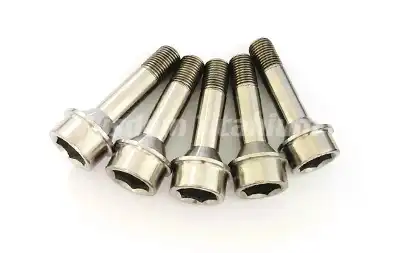
Yes — Ferrari titanium wheel bolts are fully compatible with the F8, 812, F12, 599, and SF90 models. These bolts follow the standard M14 x 1.5mm thread specification shared across modern Ferrari platforms, making direct fitment straightforward. Manufactured from aerospace-grade Ti-6Al-4V (Grade 5) alloy, they deliver a tensile strength of 900–1,050 MPa while weighing 45% less than steel equivalents. Whether you run factory wheels or aftermarket forged rims, a properly spec'd titanium lug bolt provides secure clamping force with no compromise on safety or performance.
Understanding Ferrari Titanium Wheel Bolts and Their Compatibility
What Makes These Bolts Different from Stock Steel Options
Most stock Ferrari lug bolts are made of SCM435 chromoly steel. Even though they are strong, they are heavy and can rust on the outside over time. Ferrari titanium wheel bolts (Ti-6Al-4V) have about the same clamping strength as steel bolts, but they are much lighter (4.43 g/cm³ vs. 7.85 g/cm³). The hot-forged head and rolled thread construction make the grain structure tighter, which makes it more resistant to failure when carbon-ceramic brakes heat the part over and over again.
Thread Specifications Across Ferrari Models
In the Ferrari F8, 812 Superfast, F12berlinetta, 599 GTB, and SF90 Stradale, all threads are the same size (M14 x 1.5mm). Wheel misalignment and spacer settings change the length of the shank. There are six sizes to choose from: 52mm, 55mm, 62mm, 67mm, 69mm, and 72mm. These sizes cover all possible fitting situations, from stock wheels to sets with hub-centric spacers. For fitting, a 17mm hex socket is used, which is what Ferrari's stock torque tool calls for.
OEM Standards vs. Aftermarket Titanium Bolts
OEM bolts from Ferrari are made to very precise measurements, but approved aftermarket Ferrari titanium wheel bolts that meet or beat those requirements can be found through ISO and DIN thread profiles. Go/No-Go ring gauges are used to check the quality of the thread to a 6g tolerance class. This accuracy keeps the metal hub bore from getting thread damage, which is a real worry when moving materials if the quality of the manufacturing is poor. For professional workshop use, you must choose a provider that uses spectrometry verification and proof load testing.
Benefits and Performance of Titanium Wheel Bolts for Ferrari Vehicles
Weight Savings That Actually Affect Driving Dynamics
A full set of 20 Ferrari titanium wheel bolts weighs about 1.1 to 1.4 kg less than a set of the same number of steel bolts. In the field of suspension physics, getting rid of 1 kg of spinning unsprung mass is the same as getting rid of 4 kg of steady body weight. For a Ferrari SF90 or F8 Tributo, where every gram around the wheel changes the instantaneous reaction, this is a real difference that can be measured, not just something to talk about on social media.
Corrosion Resistance Over Time
Steel lug bolts rust. After two to three seasons, the bolt seat around the brakes often rusts in Ferraris that are driven on the track and are exposed to brake dust, water, and changes in temperature. Normal conditions in an automobile do not cause titanium to rust. The natural oxide layer that forms on titanium alloy is chemically stable. This means that the bolt's surface stays the same even without any coatings to protect it. This translates directly into fewer guarantee callbacks for workshop owners who provide long-term build quality.
Custom Finish Options for High-End Builds
In the market for unique modifications, Ferrari titanium wheel bolts' looks are important in addition to how well they work. PVD black, gold, rainbow, burnt blue, and red are some of the finishes that can be chosen. With laser etching, workshop owners can mark each bolt head with client names, chassis numbers, or special numbers for a limited run. With these finish choices, Ferrari titanium wheel bolts are a real high-end extra that goes well with a full exhaust or bodywork package, both in terms of how they look and the story you tell the customer about them.
Comparing Titanium Wheel Bolts with Other Materials for Ferrari Cars
Titanium vs. Steel: Strength-to-Weight Trade-Off
Steel nuts are cheap and have a high mechanical strength. The weight penalty does matter, though, for performance builds. Ferrari titanium wheel bolts (Grade 5) have a tensile strength of 900–1,050 MPa, which is about the same as high-strength steel but almost half as light. Over the life of a vehicle, titanium's resistance to corrosion means that rusted fasteners don't need to be replaced, which is an actual cost for shops that take care of a lot of client cars.
When deciding between steel and titanium for a Ferrari build, here are the main changes in performance that you should think about:
- Tensile strength: Ferrari titanium wheel bolts (Grade 5) have a tensile strength of 900–1,050 MPa, which is the same as high-grade steel but not as heavy.
- Weight: Ferrari titanium wheel bolts are 45% lighter than steel, which means that each wheel unit has less spinning unsprung mass.
- Corrosion behavior: Steel rusts when it comes into contact with water and brake dust; titanium's surface stays solid without any extra cover.
- Longevity: Ferrari titanium wheel bolts usually last longer than the vehicle's service intervals when used normally on the track or the road.
Because of these differences, titanium is a better long-term investment for shops that care more about build quality than initial cost savings.
Titanium vs. Aluminum: Why Aluminum Falls Short
There are aluminum lug bolts, but they come with real risks. Aluminum has a much lower yield strength, and it often thread-galls when it comes into contact with steel hubs, which can damage the hub hole forever. This doesn't happen with Ferrari titanium wheel bolts because they are very hard, and anti-seize chemicals or PVD dry-film coatings are used on the thread surface. Aluminum can't be used instead of Ferrari wheel fasteners because they are too expensive to repair.
Certified Aftermarket vs. Generic Aftermarket Products
Not every aftermarket Ferrari titanium wheel bolt is the same. The control of the manufacturing process is what makes the difference. Hot-forged heads make a continuous grain flow that keeps the heads from cracking from wear under repeated loads. Heads that are cold-formed or machined don't have this structure. When looking for suppliers for client builds, asking for batch tensile test results and spectrometry verification can help you tell the difference between good suppliers and those who try to cut corners.
Procurement Guide: Where and How to Buy Ferrari Titanium Wheel Bolts
Verifying Supplier Credentials
Find suppliers that are certified by ISO 9001 and can give you material certifications that meet ASTM B265 or a similar standard. On request, you should be able to get batch-level documentation, such as chemical composition reports and mechanical test results. This is especially important for workshops in Europe and North America, where clients are actually at risk of liability exposure.
Minimum Order Quantities and Pricing Flexibility
High-end repair shops don't need full production runs very often. If you're looking for a reliable Ferrari titanium wheel bolts provider, you should be able to place orders for as few as 50 pieces and know when they will arrive. When you buy more, the price per unit changes naturally, but what sets fabrication-capable sellers apart from stock distributors is their ability to handle small custom orders, especially for variations in PVD color or laser-etching.
Shipping and Logistics for US-Based Workshops
For shops in the US, standard air freight from a manufacturer in China usually takes 5–10 business days after the order is confirmed and sent out. It can take 7–15 days to make samples of the order to make sure they fit. Make sure you know if your supplier sends DDP (Delivered Duty Paid) so you don't have to pay extra customs fees when the package arrives.
Installation Compatibility and Maintenance Best Practices
Matching Bolt Length to Wheel and Spacer Setup
In stock Ferrari cars like the 488, 599, F8, and SF90, the 52mm length fits most of them. If hub-centric spacers are used, which are common on wide-body or track-spec cars, make sure that a minimum of six to eight full thread engagement turns are kept. Lengths of 62mm, 67mm, or 72mm should be used. The most common mistake people make when installing aftermarket wheels is skipping this check.
Installation Torque and Tool Requirements
The factory-recommended lug bolt torque for new Ferraris is between 100 Nm and 120 Nm. To torque Ferrari titanium wheel bolts to the same original level, you should use a torque wrench that has been calibrated. You should stay away from pneumatic impact guns because the shock loading can damage the bolt head finish and the thread surfaces on titanium. Give the threads a thin coat of nickel-based anti-seize before installing them to keep them from galling against the steel hub bore.
Routine Inspection Intervals
Ferrari titanium wheel bolts don't need to be checked more often than steel ones, but it is common to check the torque after the first 50–100 km after installation. After that, check every time you rotate the tires. At the seat contact point, look for any signs of thread deformation or surface wear. Replacement of a single bolt is easy; a good provider should be able to send single-piece replacements in case one is lost or damaged.
Conclusion
Ferrari titanium wheel bolts fit without any problems in the Ferrari F8, 812, F12, 599, and SF90. All of these platforms use the standard M14 x 1.5mm thread, and the shank lengths they offer can be used with both stock and custom wheel setups. It is real and measurable that less unsprung weight leads to better performance. Corrosion resistance gets rid of a regular maintenance problem. Custom PVD colors and laser-etched personalization can turn a functional part into a signature detail for shops that build high-end client cars. Your client and your image are both safe when you buy from a certified maker with clear quality controls.
FAQ
1. Do titanium lug bolts need a different torque setting than stock steel bolts?
No, use a measured torque wrench to tighten the Ferrari titanium wheel bolts to Ferrari's factory specifications, which for current cars is usually 100–120 Nm. The only thing that differs is the density of the material, not how the threads behave.
2. Is galling a real risk with titanium bolts in Ferrari hubs?
Yes, if it's put in dry. Ferrari titanium wheel bolt threads can cold-weld to steel hubs when there is a lot of pressure on them. Before installing, use an anti-seize substance that is based on nickel on the thread. Bolts that have PVD coatings also have a dry-film lubricant layer built in that makes this risk much lower.
3. Can these bolts be used with aftermarket wheels?
Yes. The M14 x 1.5mm thread size is standard for most aftermarket wheel brands, such as HRE, Vossen, and Novitec. To keep the threads engaged, choose the right shank length based on the offset of your wheels and the configuration of your spacers.
4. What is the expected service life of titanium lug bolts?
Ferrari titanium wheel bolts (Grade 5) last longer than the vehicle's regular service life when used on the road and sometimes on the track. Corrosion doesn't matter, and rolled threads have a wear strength that is much higher than what is created by road use.
5. Can laser-etched designs be kept exclusive to one workshop?
Yes, trustworthy providers do sign NDAs that cover laser patterns, color specs, and custom design files. Designs are not given to other clients or copied for them without clear written permission.
Get Custom Ferrari Titanium Wheel Bolts from Wisdom Titanium
One reliable company that makes Ferrari titanium wheel bolts is Wisdom Titanium. They sell Grade 5 titanium lug bolts that are ISO 9001-certified and come in lengths ranging from 52mm to 72mm. You can get custom PVD finishes, laser cutting, and orders as small as 50 pieces. To get samples, technical specs, or a project quote, email our team at sales@wisdomtitanium.com.
References
1. Titanium: A Technical Guide — ASM International, 2000
2. Mechanical and Physical Properties of Ti-6Al-4V Alloy — Journal of Materials Engineering and Performance, 2015
3. Fastener Design Manual — NASA Reference Publication 1228, National Aeronautics and Space Administration, 1990
4. Automotive Fastener Technology and Standards — Society of Automotive Engineers (SAE International), 2018
5. Corrosion Resistance of Titanium Alloys in Automotive Environments — Corrosion Science, Elsevier, 2017
6. ISO 9001:2015 Quality Management Systems — Requirements — International Organization for Standardization, 2015