
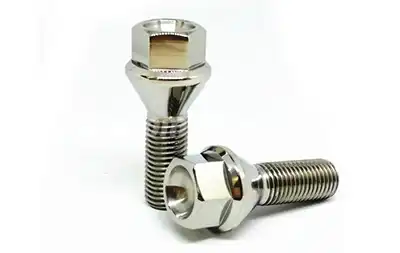
Yes, titanium lug bolts are better than steel alternatives in several measurable ways. Made from Grade 5 titanium alloy (Ti-6Al-4V), they deliver tensile strength above 950 MPa while weighing roughly 40% less than steel. That combination matters whether you're building a race car or stocking a high-margin Amazon listing. They resist corrosion in salt, heat, and road grime without surface flaking. For B2B sellers sourcing automotive fasteners at scale, this means fewer returns, better reviews, and a product that commands a real price premium over standard hardware.
Understanding Titanium Lug Bolts – Features and Benefits
What Makes Grade 5 Titanium the Right Material
Grade 5 titanium (Ti-6Al-4V) is the standard for high-performance screws in the business world. Titanium is made up of about 90% titanium, 6% aluminum, and 4% vanadium. Its density is 4.43 g/cm³, while steel's is 7.8 g/cm³. Every wheel bolt that Wisdom Titanium makes has a tensile strength of at least 950 MPa, which is the same as or higher than the standards for ISO 898-1 Class 10.9 steel. This means that the material can be used not only on racetracks but also in any situation where weight and load-bearing ability are important.
Surface Finish Options That Affect Real-World Performance
The cleaning of the surface is not just for looks; it has a direct effect on the corrosion life and resale value. You can get our titanium wheel bolts with finishes that are polished, anodized, or PVD (Physical Vapor Deposition). More than paint or chrome metal, black, gold, and burned blue PVD finishes don't scratch or fade in UV light. Anodized color choices (red, blue, purple, green, and gold) make products stand out without adding weight or losing thread integrity, which is helpful for sellers who have to manage multiple SKUs on sites like Amazon and eBay.
Thread Design and Fatigue Life
Good titanium screws don't cut their threads; they roll them instead. According to published research, thread rolling keeps the alloy's grain structure and makes threads about 30% more resistant to wear than cut threads under cycle load. This matches ASM International's fastener engineering data. In real life, this is important because a bolt that breaks after being torqued many times leads to liability, returns, and platform penalties. Standard thread sizes are M14×1.25, M14×1.5, M12×1.25, and M12×1.5. Lengths and head types can be changed to fit your needs, such as Hex, Socket, 12pt, T80, and T70.
Titanium Lug Bolts vs. Other Materials: A Detailed Comparison
Titanium vs. Steel: Weight and Corrosion
Steel lug nuts are cheap and strong, but they rust. In places with a lot of salt, chrome-plated steel bolts eventually pit and flake, which causes the bolts to become stuck and requires expensive wheel removal. Titanium naturally forms an oxide layer that can self-heal and stay chemically stable up to temperatures around 400–500°C, which is much higher than what you'd find when stopping normally or even hard. There is a real weight savings: switching from steel to titanium lug bolts for a standard 20-bolt set takes away about 200–300 grams of unsprung mass, which makes the rotational reaction much better.
Titanium vs. Aluminum: Strength That Holds Under Load
Aluminum fasteners aren't as strong as steel ones, but they are lighter. Their tensile strength is usually less than 500 MPa, which is too low for wheels that need to handle a lot of torque. Also, aluminum bolts rust more easily and break down faster when heated and cooled many times. With a yield strength above 870 MPa, Grade 5 titanium is neither too light nor too heavy. It is lighter than steel but much stronger than aluminum. This strength-to-longevity ratio is what makes the difference for procurement buyers who are worried about return rates and product liability.
Life Cycle Cost: The Real Procurement Math
The main complaint about titanium screws is that they cost more per lot. The total cost of ownership changes, though, when you think about how often rust needs to be replaced, how few returns there are, and how much more the average selling price can be on marketplace sites. A steel M14 lug bolt might cost $1 to $2, but a titanium one with a high-end color finish usually costs $6 to $15 per bolt. For someone with a medium-sized Amazon store, that change in revenue is what makes the business case. Quality that lasts also means fewer one-star reviews complaining about rust stains or threads that are coming apart.
How to Choose the Right Titanium Lug Bolts for Your Business Needs
Match Thread Size and Seat Type to Vehicle Application
In the aftermarket, the most common compatibility mistakes are having the wrong thread pitch or seat type. Most European cars, like BMWs, Porsches, Audis, and Mercedes, use M14×1.5 lug nuts that have a conical or ball seat. M12 1.25 or M12 1.5 are often used on Japanese platforms. Before you buy, you should always check the hub thread size and seat angle. If your supplier lets you order mixed batches of different specs, like 50 pieces of M14×1.5 and 50 pieces of M12×1.25, you can try out different listings without putting all of your money into one SKU.
Evaluate Supplier Certifications and Manufacturing Capability
When looking for titanium wheel parts, ISO 9001 approval is a must, not a nice-to-have. It means that the supplier keeps records of quality control at every stage of production. Check with the seller to see if they use rolled or cut threads, if they offer raw material certifications (mill certs), and if they include in-process hardness and dimensional inspection records with every order. As part of the order, suppliers who can provide product photos, dimensional drawings, and different packaging options cut down on the time it takes to list your items.
Budget Planning and MOQ Flexibility
For cross-platform e-commerce sellers, inventory risk and cash flow management are just as important as unit price. If you find the right provider, they should be able to handle low MOQ orders (ideally 50 to 100 pieces per standard) and allow mixed batches of different colors and sizes. In the titanium lug bolts fastener market, prices usually drop by 200, 500, and 1,000 pieces per SKU. When you figure out the landed cost, you need to include air freight for small restocking orders and sea freight for larger consolidated shipments. With a well-stocked provider, a 15–25 day output cycle is possible.
Installation and Maintenance of Titanium Lug Bolts
Anti-Seize Is Not Optional
Titanium can gall when it is threaded into steel hubs when the hubs are dry. This is called cold welding. Use an anti-seize compound made of copper or nickel on the threads before installation. This keeps the bolt from sticking and makes sure that the reading on your torque wrench shows the real holding force and not just friction loss. In aerospace and racing, this step is normal practice, and you should write it down on any product instructions you put in store packaging.
Correct Torque Procedure
A calibrated torque tool, never an impact gun, should be used to place titanium wheel fasteners. Follow the original torque specs set by the vehicle's maker, which are usually 95–130 ft-lbs for M14 applications. Retorque the bolts after the first 50 to 100 miles of driving. Titanium doesn't expand and contract like aluminum wheels and steel hubs do, so it's normal for them to settle at first. This re-torque step is necessary for safety reasons and should be made clear in your product documentation so that customers don't misuse it and have to send it back.
Routine Inspection and Long-Term Care
Compared to steel fasteners, titanium ones don't need as much upkeep. Check the threads visually every time you turn the tire. For PVD-coated surfaces, clean them with water and light soap. Do not use rough brushes. If a bolt's threads are deformed or there are signs of cross-threading from a previous installation, it should be replaced. Do not try to use broken titanium fasteners again. With proper care, aluminum parts will last much longer than steel ones, and this is a strong selling point for products aimed at track and hobbyist users.
Procurement Strategies and Market Insights for Titanium Lug Bolts
Where the Demand Is Growing
Titanium wheel hardware is becoming more popular in racing, the aftermarket for high-end cars, and seaside car markets where salt corrosion is a daily problem. Titanium is always at the top of the list in the Amazon categories for custom wheel parts in both North America and Europe. Southeast Asia and Latin America are starting to see growth as people's disposable incomes rise and the culture of customizing cars grows. When sellers are making long-tail catalog strategies, changing the color and size of items (between M12 and M14, and between anodized colors) is the best way to get search traffic for dozens of vehicle-specific queries.
Building a Reliable Supply Chain
When you buy titanium from a manufacturer in an area that has a history of making it, you get a deeper supply chain than when you buy from a trading company. China's biggest titanium industry center is in Baoji, which is in Shaanxi Province. It includes the whole supply chain, from the sponge to the finished parts. Wisdom Titanium is based in Baoji Titanium Valley and has been a producer with ISO 9001 certification since 2016. This means having access to raw materials, stable prices, and the ability to make things directly, instead of using a third party to do it. This means that your collection will have more regular lead times and quality.
Customization and Packaging for Private Label
A good provider should offer self-seal bag packaging, card headers with your name, label stickers, and basic instruction inserts for sellers who want branded packaging without having to pay a lot for tooling. This type of white-label support turns a common item into a listing with your own name. Talk about the size of the packages ahead of time to make sure they will fit in FBA boxes and don't weigh too much for air freight. The supplier's product photos and videos cut down on the time and money you need to spend getting ready for launch.
Conclusion
Titanium lug bolts are clearly better than steel and aluminum ones when it comes to strength-to-weight ratio, resistance to corrosion, and long-term durability. The business case for B2B buyers and online sellers is based on the ability to charge higher prices, have lower return rates, and have more SKU options. The important thing is to find a manufacturer that can handle low MOQ orders, mixed-batch specifications, and private label packaging without lowering the accuracy of the measurements or the consistency of the surface finish. Titanium screws are a good, scalable product group when those conditions are met.
FAQ
1. Are titanium lug bolts compatible with my vehicle?
Grade 5 titanium wheel bolts are available in M14×1.25, M14×1.5, M12×1.25, and M12×1.5 thread sizes, covering the majority of European and Japanese vehicle applications. Custom lengths and head styles (Hex, Socket, 12pt, T80, T70) are also available. Always verify your vehicle's thread pitch and seat type — conical or ball seat — before ordering. When in doubt, request a sample order before committing to a larger batch.
2. Are titanium bolts stronger than steel?
Grade 5 titanium delivers a tensile strength of 950–1050 MPa, which is comparable to Class 10.9 steel and significantly stronger than standard Grade 8.8 steel bolts — at roughly half the weight. Thread rolling (rather than cutting) further improves fatigue life by preserving grain flow through the material.
3. Do titanium lug bolts require special maintenance?
Apply anti-seize paste to threads before installation. Use a calibrated torque wrench and re-torque after the first 50–100 miles. Inspect threads at each tire rotation. PVD and anodized finishes require only gentle cleaning. No special tools or coatings are needed beyond these basic steps.
4. Can I use an impact gun for installation?
No. Impact guns risk over-torquing and can damage surface finishes. Hand tools and a calibrated torque wrench are the correct approach for titanium fasteners.
Source Titanium Lug Bolts From Wisdom Titanium
Wisdom Titanium is a company that makes titanium lug bolts. It is based in Baoji Titanium Valley, Shaanxi Province, China, and has direct access to the biggest titanium supply line in the world. We can take low MOQ orders as low as 50 pieces per specification, source in mixed batches for both M12 and M14 sizes, offer anodized and PVD color options, and package your products under your own brand name. To get a price or samples, email our team at sales@wisdomtitanium.com.
References
1. ASM International. Titanium: A Technical Guide. ASM International, 2000.
2. Bickford, John H. An Introduction to the Design and Behavior of Bolted Joints. CRC Press, 2007.
3. Boyer, Rodney R. "An Overview of the Use of Titanium in the Aerospace Industry." Materials Science and Engineering: A, 1996.
4. ISO 898-1. Mechanical Properties of Fasteners Made of Carbon Steel and Alloy Steel. International Organization for Standardization, 2013.
5. Lutjering, Gerd, and James C. Williams. Titanium. Springer, 2007.
6. Society of Automotive Engineers (SAE). Fastener Standards Manual. SAE International, 2018.