
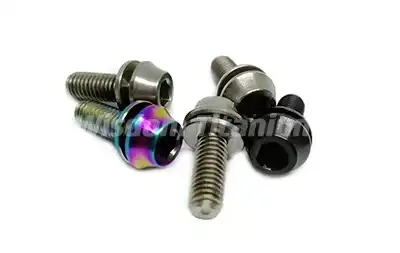
Titanium fasteners for bicycles are really a good match for road bikes. Grade 5 (Ti-6Al-4V) titanium bolts and screws have tensile strength >950 MPa and weigh around 45% less than similar steel hardware. That weight saving is important on a road bike where every gram counts in terms of climbing efficiency and quickness. Weight aside, titanium's inherent oxide layer resists perspiration, road salt, and moisture without surface damage. Titanium fasteners are a smart choice of material for procurement managers and product engineers sourcing hardware for high-end road bike projects, both technically and commercially.
Understanding Titanium Fasteners for Bicycles
What Titanium Fasteners Actually Are
Some of the precisely machined connecting pieces from titanium fasteners include bolts, socket head cap screws, button head screws, flange bolts, and washers. They may be composed of Grade 2 commercially pure titanium or Grade 5 (Ti-6Al-4V) alloy. They are on the stem faceplates, brake calipers, derailleur bolts, bottle cage bosses, seatpost clamps, and chainring contacts of a road bike. These pieces have a straightforward job: hold things together under repeated loading without adding more weight.
Why Grade 5 Ti-6Al-4V Dominates Structural Applications
The minimum tensile strength of grade 5 titanium is 895-950 MPa, and the yield strength is about 828 MPa, which is roughly the same as grade 10.9 steel fasteners. Grade 5 titanium fasteners will not change form over thousands of installation and removal cycles, like aluminum alloy fasteners would when torqued over and over again. It beats steel and aluminum in terms of strength-to-density ratio (approximately 260 kN·m/kg). That’s why road bike makers utilize it in areas where loading forces are strong.
Common Sizes and Styles Available
Wisdom Titanium’s hardware for road bikes is available in M3, M4, M5, M6, M8, and M10 thread sizes. General head styles include the DIN 912 socket head cap screws, the DIN 7991 countersunk flat head screws, the DIN 6921 hexagon flange bolts, and the ISO 7380 button head screws. Customer CAD models are utilized to create specific head profiles, drive recesses, and shoulder designs on CNC. The surface may be treated in two ways: anodizing (giving the trademark blue, rainbow, or gold hues) and PVD coating (making the surface tougher). MOQ is 200 pcs for this case.
Titanium Fasteners vs. Other Materials: Which Is Best for Road Bikes?
Weight Comparison with Steel and Stainless Steel
Mass-market titanium fasteners for bicycles still utilize steel and stainless steel screws since they are inexpensive to fabricate. A typical stainless steel M5 × 10 mm socket screw weighs around 1.8 g; a titanium fastener for bicycles weighs about 1 g. Thus each fastener weighs 0.8 g less. Add together the weight savings of 30-40 screws in a complete road bike construction, and you're looking at 24- 32 g. For businesses who offer builds that are lighter than 7kg, it isn’t just cosmetic; it’s a quantifiable spec point.
Titanium vs. Aluminum Fasteners on Carbon Fiber Frames
Aluminum fasteners (typically 7075-T6) are relatively light, but they present two challenges for carbon fiber road bikes. First, aluminum is anodic relative to carbon fiber in the galvanic series. This may speed up surface corrosion at the interface of the joint in the presence of moisture. Second, aluminum threads tend to deteriorate with repeated torquing, particularly in important areas such as stem clamps. Titanium is closer to carbon fiber in the galvanic series, and its thread form is the same after a lot longer service cycles. This makes it the preferable long-term option for high-end carbon projects.
Evaluating the Cost-Performance Trade-off
A titanium bolt is three to five times the price of a stainless steel one. But when you do the arithmetic factoring in service life, everything changes. Titanium doesn’t pit or stop while it’s spinning properly, so it may last a lot longer before it has to be changed. If you’re selling bikes above $3,000, titanium hardware is something that says something about the quality of your brand that justifies the margin and separates you from the pack.
Purchasing Titanium Fasteners: What B2B Clients Need to Know
Selecting the Right Grade and Thread Standard
For road bikes, always use Grade 5 (Ti-6Al-4V) for structural fastener positions. Ask for a full Material Test Report (MTR) that confirms the ASTM B348 chemical makeup and ASTM F468 mechanical properties. Dimensional tolerances for thread geometry must be in line with DIN 912 or ISO 4762; a thread profile that doesn't meet these requirements will lead to galling during installation and early failure in service. Before you place an order for production, make sure you know the thread class (6g external, 6H internal).
Customization and Sampling Flexibility
When developing a new product, many brands run into a frustrating MOQ barrier: standard minimums of 500–1,000 pieces make early-stage proof pricey. Wisdom Titanium takes orders for samples of 50 to 100 pieces to test the first prototype. The standard minimum order quantity (MOQ) for production is 200 pieces per SKU. It usually takes three to four weeks for custom designs to go from CAD files provided by the customer to CNC-machined samples. For large orders, you can get logo laser printing and anodized color matches for team kits.
Certifications and Compliance Requirements
To get into the European market, you need proof that you follow REACH and RoHS rules. You can get full certification packages from Wisdom Titanium, which include MTRs, ISO 9001 certificates, REACH releases, and RoHS statements. These papers are usually asked for when a supplier is being qualified, and your purchasing and quality teams should look over them before you place your first order for production.
Maintaining Titanium Fasteners on Road Bikes
Anti-Seize Application Prevents Galling
Titanium fasteners for bicycles have a fairly high coefficient of friction, and if they are put together dry, they will cold-weld (seize) under pressure. This is called galling. Before installing, put a little molybdenum disulfide (MoS₂) anti-seize paste on all of the threads on the titanium bolts. This single step stops the most common way that titanium fasteners fail and makes the bolt and the thread that it fits into the frame or part last longer.
Torque Specifications and Installation Discipline
Manufacturers of road bikes list torque numbers in Newton-meters for each fastener point. Follow the published limit and always use a torque wrench that has been calibrated. Most M5 titanium stem bolts on carbon bars can only handle 4–5 Nm of torque. Any more than that and the threads could be damaged, or the carbon fiber could break under the pressure. Because of the difference in elastic modulus, torque specs for titanium bolts at the same thread size are usually 10–15% lower than those for steel bolts of the same size.
Inspection and Long-Term Service
Every time you repair your titanium screws, look for signs of thread wear, surface scoring, or head socket deformation. Titanium's self-healing TiO₂ oxide layer protects against rust from the air without any extra treatment. However, thread integrity can be lost if the wrong tools are used, like old hex keys. If you see thread damage on a fastener, don't try to use it again in a load-bearing position. Instead, replace it.
Real-World Applications and Case Studies
Professional Road Bike Builds
Five years ago, a number of mid-range European road bike brands switched their full bolt kits from stainless steel to Grade 5 titanium. One Italian frame builder said that changing 34 stainless fasteners with titanium ones reduced the weight of each bike by 28 grams. This change improved their stated frameset weight standard by a measurable amount and helped them set their selling price above €4,000.
Team Kit Customization
A Taiwanese business that manufactures parts for derailleurs and brakes and supplies to UCI continental teams requested anodized titanium chainring bolts in team colors with laser-etched branding for a spring classics campaign. The manufacturing run (M5 × 8mm, ISO 7380 button head, blue anodize) satisfied the REACH specifications for the European market, and the color was consistent throughout three batches. This is known to be difficult with anodized titanium as it calls for strict process control throughout the anodizing stage.
Procurement Manager Feedback
“We get two useful benefits from Wisdom Titanium,” say engineers and purchasing managers who have bought from them. “One is that they provide full documentation packages that pass the internal quality audit without back-and-forth. Their prices are stable, making it easy to plan the annual budget.” These operational parameters are as significant as material performance in the selection of a supplier for long-term manufacturing projects.
Conclusion
From a scientific and financial point of view, titanium fasteners for bicycles are a suitable option for road bikes. They are up to 45% lighter than steel fasteners, do not corrode without surface treatment, and preserve their thread form after many assembly cycles. For makers of high-end carbon-fiber road bikes, the material choice also helps them differentiate themselves and command a higher price at retail. The most critical factors for a titanium fastener program are the proper grade (Grade 5 for structural locations), proper use of anti-seize, and sourcing from a vendor that provides you with verified MTRs and consistent anodized color matching from manufacturing batches.
FAQ
1. Are titanium fasteners suitable for mountain bikes as well as road bikes?
Yes. The same Grade 5 titanium properties that benefit road bike builds — corrosion resistance, fatigue strength, and weight reduction — apply equally to mountain bike applications. MTB builds often subject fasteners to more aggressive contamination (mud, water, trail debris), where titanium's passive oxide layer performs particularly well compared to bare steel hardware.
2. How do titanium fasteners help achieve overall weight savings?
Each titanium bolt weighs approximately 45% less than a steel equivalent at the same thread size and length. Replacing a full set of 30–40 fasteners on a road bike typically yields 25–35 g in saved weight, which is significant for brands marketing lightweight builds or competing in weight-class-sensitive categories.
3. What certifications should titanium bicycle fasteners comply with?
For structural road bike fasteners, specify material compliance with ASTM B348 and mechanical compliance with ASTM F468 or equivalent. Thread dimensions should conform to DIN 912 or ISO 4762. European market distribution requires REACH and RoHS declarations. An ISO 9001-certified manufacturer provides the process traceability needed to support these documents reliably.
4. What is the minimum order quantity for custom titanium bicycle bolts?
At Wisdom Titanium, the standard MOQ is 200 pieces per specification for production orders. Prototype and sampling quantities from 50 to 100 pieces are accepted during the development phase.
Request a Sample from Wisdom Titanium—Titanium Fasteners for Bicycles Supplier
Beginning in 2016, Wisdom Titanium has sold Grade 5 titanium fasteners for bicycles to companies in the United States, Europe, and Asia. Our ISO 9001-certified factory in Baoji Titanium Valley, Shaanxi Province, does all of its own CNC machining, anodizing, PVD coating, and paperwork. We can handle sample orders of 50 to 100 pieces, take custom designs made in CAD, and offer full MTR and REACH compliance packages. To get a sample kit or product catalog, email our sales team at sales@wisdomtitanium.com.
References
1. ASTM International — ASTM F468: Standard Specification for Nonferrous Bolts, Hex Cap Screws, and Studs for General Use. 2023.
2. ASTM International — ASTM B348: Standard Specification for Titanium and Titanium Alloy Strip, Sheet, and Plate. 2022.
3. Deutsches Institut für Normung (DIN) — DIN 912: Hexagon Socket Head Cap Screws. 2021.
4. CyclingNews — Road Bike Component Weight Analysis: Materials and Manufacturing Trends. 2022.
5. BikeRadar — Titanium vs. Steel vs. Carbon: Which Frame and Component Material Wins? 2023.
6. Journal of Materials Engineering and Performance (Springer) — Fatigue Behavior of Ti-6Al-4V Fasteners Under Cyclic Loading Conditions. 2021.




