
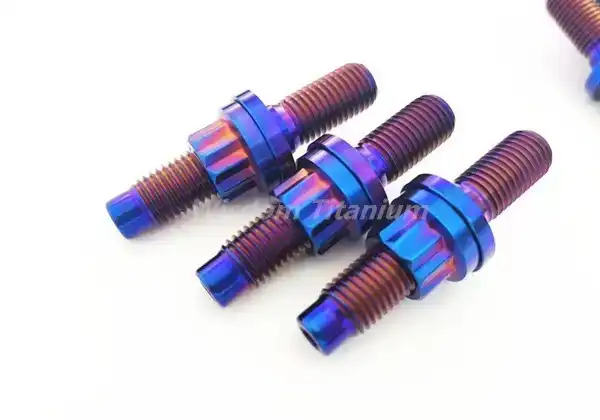
Best titanium exhaust manifold stud kits on the market are manufactured from Ti-6Al-4V Grade 5 titanium alloy. This aerospace-grade material meets ASTM B348 standards, delivering tensile strength between 950 MPa and 1050 MPa. Compared to standard steel studs, Grade 5 titanium fasteners weigh roughly 45% less while resisting corrosion even under sustained exhaust heat. If you're sourcing exhaust manifold hardware for high-performance or motorsport applications, understanding why Ti-6Al-4V dominates this product category is essential before placing any bulk order.
Understanding Ti-6Al-4V Grade 5 Titanium and Its Role in Exhaust Manifold Stud Kits
What Makes Ti-6Al-4V the Right Alloy for This Application?
Ti-6Al-4V has a two-phase alpha-beta lattice because it has 6% aluminum and 4% vanadium in it. This mix gives the metal a yield strength close to 880 MPa and good resistance to fatigue. These are important qualities when studs are constantly going from cold starts to full working temperature. This level of performance can't be matched by widely used pure titanium Grade 2. That's why Grade 5 is the standard for structural engine bolts.
Mechanical Properties Worth Knowing
ASTM B348 says that Grade 5 titanium has a tensile strength of 950–1050 MPa, a yield strength of about 880 MPa, and a density of 4.43 g/cm³. Its thermal expansion value (8.6 µm/m·°C) is lower than stainless steel's (17.2 µm/m·°C). This means that threads are less likely to come loose in aluminum cylinder heads because of differential expansion, which is a real benefit in turbocharged engines that rev quickly.
OEM and Aftermarket Standards
Grade 5 titanium studs made to ISO, DIN, or JIS thread standards can be used with all kinds of vehicle systems around the world. When you use matching nuts, whether they are 12-point, hex flange, or lock nuts, they will fit perfectly with thread tolerance class 6g. This standardization is important for business-to-business buying teams that need to buy parts for more than one car platform at the same time.
Comparison: Ti-6Al-4V vs Other Stud Materials
Grade 5 Titanium vs Steel and Stainless Steel
In exhaust environments, carbon steel studs rust quickly and eventually fuse to aluminum blocks, making them impossible to remove without damaging them. Stainless steel is better at resisting rust, but it's heavier and still has problems with differential expansion. Both problems are solved by grade 5 titanium: it doesn't rust and is 45% lighter than a steel stud of the same size without sacrificing strength.
Grade 5 Titanium vs Grade 2 and Inconel
Some sellers offer titanium exhaust manifold stud kits as a cheaper option, but its tensile strength is only about 340 MPa, which is much lower than the 950 MPa minimum needed for engine fasteners. Inconel works well in very hot or cold conditions, but it is much more expensive and heavier. Grade 5 titanium is the best compromise between price, weight, and mechanical ability for most racing and speed car uses.
Real-World Validation
Racing teams in endurance events have shown that Grade 5 titanium studs can keep the manifolds strong over multiple race weekends without having to be re-torqued. Marine engine makers say that repair intervals are longer in saltwater settings where steel studs used to need to be replaced every season. These results from the real world back up what the data already shows.
Technical Insights: Manufacturing and Installation
How Quality Studs Are Made
Grade 5 titanium pins are made with great care from approved bar stock. When you use rolled threads instead of cut threads, you keep the alloy's grain structure, which makes it much more resistant to wear. A good manufacturer will also use Go/No-Go gages to check the threads to make sure they meet tolerance class 6g standards. They will then use XRF (X-ray fluorescence spectrometry) to check the chemicals in the threads before shipping them.
Surface Finish Options and Their Function
Aside from the quality of the raw materials, surface treatment has a direct effect on both how well the product works and how it looks. These are the normal finishes that can be put on Grade 5 titanium exhaust studs:
- Natural (bare titanium): Retains the alloy's native corrosion resistance, preferred for applications where heat tolerance is the top priority.
- Burnt blue: A heat-induced oxidation finish that produces a gradient blue-to-purple tone, widely recognized in motorsport as a premium aesthetic marker.
- Black PVD coating: Physical vapor deposition creates a hard, wear-resistant surface layer with a clean factory appearance.
- Gold PVD coating: Adds a distinctive visual finish popular in show cars and high-end engine bay builds.
Every finish choice meets a different need for the customer. People who want to buy for track and speed like the color burned blue, while people who want to buy for custom builds and displays like the colors PVD black and gold. At the retail level, sell-through rates go up when you match the right finish to the right customer.
Installation Best Practices
Before fitting, use a high-temperature anti-seize substance made of nickel or copper. Titanium exhaust manifold stud kits can gall, which is a cold-welding effect, when it comes into contact with titanium or aluminum threads that are not oiled. As per the engine manufacturer's instructions, torque M8 studs to 18–25 Nm and M10 studs to 35–45 Nm. Titanium is very flexible, so if you over-torque it, it will permanently stretch instead of deforming as you might see.
Procurement Considerations for B2B Buyers
Specifications That Matter at the Order Stage
Exhaust manifold stud kits come in standard sizes of M8×1.25×45mm, M10×1.25×45mm, or M10×1.25×54mm, which fit most European and Japanese engine systems. The type of torque tool that can be used in the application should match the nut style (12-point, hex flange, or lock nut). Checking the engine manufacturer's paperwork for thread pitch and stud length before finishing a purchase order keeps you from having to pay a lot of money to send something back.
MOQ, Lead Time, and Custom Branding
For business-to-business (B2B) sourcing, a minimum order quantity of 100 sets per SKU makes it affordable to test the first product line. With factory-direct pricing, there is no markup for distributors, and manufacturers who have finished goods in stock can ship quickly to meet seasonal demand spikes. This is a real concern for performance aftermarket brands that are building stock before the spring and summer selling seasons. Titanium exhaust manifold stud kits fastener makers you can trust usually offer standard services like custom name engraving, branded packaging, and designs that are covered by an NDA.
Supplier Verification and Quality Assurance
Ask for material approvals for every package. A reliable supplier gives mill test reports that show the chemical make-up and mechanical properties of each production batch. At the plant level, ISO 9001 approval means that quality management processes have been written down and are not just a marketing claim. It makes sense and is generally understood in B2B fastener buying to ask for XRF test results on sample pieces before committing to a full order.
Why Grade 5 Titanium Stud Kits Work for B2B Clients
Grade 5 titanium exhaust studs don't rust at all and are much lighter than steel equivalents. They can withstand repeated heat cycles without breaking. These traits directly lead to a better product story and lower guarantee return rates for performance aftermarket brands. Titanium screws can be used again after the manifold is taken off, as long as they haven't been over-torqued, according to buyers. This adds a cost-effective argument that works for both professional fitters and track-day customers.
Conclusion
Titanium exhaust manifold stud kits (Ti-6Al-4V) are the best material for exhaust manifold stud kits made for motorsport, performance, and other tough automotive environments. Material guidelines and evidence from real-world use back up its mechanical qualities, resistance to corrosion, and lighter weight compared to steel. The most reliable way for B2B buying teams to get a steady product that they can sell is to choose a factory-direct provider with the right certifications, flexible MOQs, and written quality control processes.
FAQ
1. Does titanium require anti-seize during installation?
Yes. Despite its corrosion resistance, titanium is prone to galling against aluminum threads or other titanium nuts. Always apply a nickel- or copper-based high-temperature anti-seize lubricant before installation.
2. What torque should I use for M8 and M10 studs?
M8 studs typically require 18–25 Nm and M10 studs 35–45 Nm. Always confirm against the specific engine manual. Titanium's elasticity makes over-torquing particularly damaging.
3. Why not just use Grade 2 titanium?
Grade 2 titanium has a tensile strength of roughly 340 MPa — well below the 950 MPa minimum required for structural engine fasteners. Grade 5 (Ti-6Al-4V) is the correct specification for this application.
4. Will PVD color coatings fade under exhaust heat?
High-quality PVD coatings are durable under normal exhaust temperatures. Prolonged exposure to red-hot manifold conditions may gradually alter color tone, but corrosion resistance remains intact.
5. Can these studs be reused after removal?
Yes, provided they have not been stretched beyond their yield point. Grade 5 titanium retains structural integrity through multiple removal and reinstallation cycles under normal conditions.
Get Grade 5 Titanium Exhaust Manifold Stud Kits Direct from the Manufacturer
Wisdom Titanium makes and sells titanium exhaust manifold stud kits with sizes M8×1.25×45mm and M10×1.25×45/54mm. These kits come in natural, burned blue, black, and gold styles and can be ordered with 12-point, hex flange, or lock nuts. We are an ISO 9001-certified titanium exhaust manifold stud kit seller with a location in Baoji Titanium Valley in Shaanxi Province. We have a lot of stock, offer factory prices, and our minimum order quantity (MOQ) is just 100 sets. You can email us at sales@wisdomtitanium.com to get samples or a price for buying in bulk.
References
1. ASTM International. ASTM B348: Standard Specification for Titanium and Titanium Alloy Bars and Billets. ASTM International, 2019.
2. Boyer, R., Welsch, G., & Collings, E. W. Materials Properties Handbook: Titanium Alloys. ASM International, 1994.
3. Donachie, M. J. Titanium: A Technical Guide. 2nd ed. ASM International, 2000.
4. Leyens, C., & Peters, M. (Eds.). Titanium and Titanium Alloys: Fundamentals and Applications. Wiley-VCH, 2003.
5. Bhadeshia, H. K. D. H., & Honeycombe, R. Steels: Microstructure and Properties. 4th ed. Butterworth-Heinemann, 2017.
6. Society of Automotive Engineers (SAE International). SAE J429: Mechanical and Material Requirements for Externally Threaded Fasteners. SAE International, 2014.




