
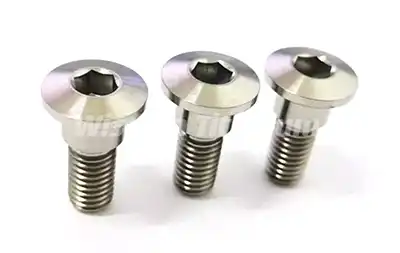
Titanium disc brake bolt is safe, and in many performance contexts, It is safer than standard steel alternatives. Grade 5 titanium (Ti-6Al-4V) delivers a tensile strength of 900–1,050 MPa, which matches or surpasses most OEM steel fasteners. When machined to correct tolerances and installed at specified torque values, these bolts handle the shear forces and thermal cycling that disc brake systems generate during aggressive riding. For brands building premium component lines, the safety case is well supported by material data, not marketing language.
Titanium Disc Brake Bolts: Safety and Strength
What These Bolts Actually Do
A disk brake rotor bolt holds the rotor to the wheel hub. It takes on shear forces when you brake hard and stays tight through heat cycles that can get the surface above 300°C. That's too big for a small bolt to handle. It's important that the bolt doesn't come loose during vibration or bend during peak load.
Mechanical Properties That Matter
Tongs can pull on Grade 5 titanium, which is made of Ti-6Al-4V metal, up to 1,050 MPa (130,000 to 152,000 psi). What this means is that it doesn't permanently change shape when it's loaded. Its yield strength is about 870 MPa. Standard Grade 8.8 steel nuts, on the other hand, can pull apart about 800 MPa. Titanium is stronger than steel in this case, even though it weighs 45% less (4.43 g/cm³).
Fatigue Resistance and Thread Integrity
Instead of cut threads, rolled threads keep the grain flow of the metal, which makes it much less likely to wear down over the life of the bolt. This choice about how to make something is not a style choice. If you load and unload a rolled thread a lot, it will still be strong for a lot longer than a machined thread. Because of this, Wisdom Titanium creates M6 and M8 rotor nuts with fully CNC-machined cores and rolled threads.
Material Benefits and Performance Comparison
Corrosion Resistance in Real Conditions
Steel rotor bolts rust. People who ride in wet places like the Netherlands, the UK, and Scandinavia say that the nuts break after just one season of riding in all sorts of weather. A titanium disc brake bolt makes a stable oxide layer that stays in place on its own. It doesn't need any extra coats to keep salt, brake dust, and water out. This is important for companies that buy parts to sell in places with bad weather, because customer reports of rust have a direct effect on the number of returns.
Weight Savings as a Measurable Selling Point
Together, six M6 titanium rotor bolts weigh about 5–7 grams. Six steel bolts of the same size, on the other hand, weigh about 12–15 grams. There is a real difference between 6 and 9 grams per rotor, and it can be written down on a product page. This information backs up a higher price that tech-savvy customers can understand for brands that are competing on price lists. It's not a small number when you multiply it by all the full-build specs.
Verifying Authenticity and Compliance
Procurement teams should insist on Positive Material Identification (PMI) tests using X-Ray Fluorescence (XRF) to be sure that the material is Ti-6Al-4V. It is not safe for brake systems to be made of pure titanium grade 2 that you can buy in stores because it only has a tensile strength of about 350 MPa. In order to protect the supply chain and meet the brand's legal responsibilities in European markets, it is important to ask for material certifications that are in line with ASTM B348 and compliance paperwork like REACH.
Procurement Considerations for Titanium Disc Brake Bolts
It's not simple to discover titanium disc brake bolt that is both of high quality and easy to buy. Wisdom Titanium needs at least 200 pieces to be ordered. They can make groups of different colors and sizes for less than that. Small to medium-sized brands that keep five anodized colors and two bolt sizes in stock have a problem with having too much inventory. This solves that problem right away. People aren't required to buy 200 of each color, which would mean they would have to buy at least 1,000 of each color. Their order can be put together into one mixed batch instead.
Here are some important things to think about before you place your first order:
- Material certification: Confirm the supplier provides mill certificates traceable to ASTM B348 and can provide XRF test results on request. This is non-negotiable for brands making strength claims on product pages.
- Thread tolerance class: Specify 6g tolerance for consistent fit across wheel hubs from different manufacturers. Loose threads back out under vibration; tight threads cause galling during installation.
- Anodizing consistency: Rainbow and burnt-blue finishes involve gradient processes where batch-to-batch variation is visible to the naked eye. Request a physical color reference card, not just digital images, before approving production.
- Packaging configuration: For brands selling rotor bolt kits by bike model or drivetrain type, per-set packaging with custom barcodes and multilingual installation notes reduces internal sorting labor significantly.
To make sure that wheel hubs from different brands fit the same, set the thread tolerance to 6g. Loose threads pop back out when the machine shakes, but tight threads make it hard to install.
Application-Specific Safety and Performance Insights
Road and Gravel Bike Applications
When stopping often with a moderate load, rotor bolts work on both road bikes and dirt bikes. Most of the time, M6 nuts are used to connect 6-bolt rotors. Most service guides say that between 2 and 4 Nm of force is the right amount for set up. You can mix titanium with a medium-strength thread locker or anti-seize compound and it won't gall. This makes it a good choice for aluminum hub shells where using steel bolts over and over again speeds up thread wear.
Mountain Bike and Aggressive Terrain Use
Accident loads, higher rotor temperatures, and more rotor swaps are added to the mix for mountain bikes. When making bigger rotors, M8 bolts are sometimes used. The 900+ MPa tensile strength of Grade 5 titanium makes it safer than aluminum alternatives, which don't have enough shear strength for this purpose. Shimano and SRAM both list how much torque their rotor interfaces need. In either case, you can use titanium nuts that are the right size and thread tolerance.
Anodized Color Options and Aesthetic Durability
Besides black, gold, rainbow, purple, and burned blue, Wisdom Titanium also makes titanium disc brake bolt with a fifth anodized finish. If you use Grade 5 titanium, the anodization is not paint on the outside; it is an electrical oxide layer that doesn't chip or peel. A brand that makes color-coordinated component kits can tell how happy their customers are and how many times they return an item by how long the finish lasts.
Conclusion
Grade 5 titanium disc brake bolt is safe when it is manufactured correctly, specified appropriately, and installed at the torques its application requires. The material science supports the safety claim: 900–1,050 MPa tensile strength, rolled thread fatigue resistance, and corrosion immunity across real-world riding conditions. For procurement teams building premium component lines, the combination of verifiable performance data, anodized finish options, and flexible mixed-batch ordering makes titanium rotor fasteners a practical, profitable specification choice — not just an aesthetic upgrade.
FAQs
Can titanium rotor bolts be torqued to the same spec as OEM steel bolts?
Not necessarily. Grade 5 titanium (Ti-6Al-4V) is strong but the proper tightening torque is dependent on bolt design, dimensions, thread condition, friction and the requirements of the joint. Do not automatically assume the OEM steel bolt torque specification applies to a titanium replacement. Follow the titanium fastener manufacturer’s application-specific installation instructions including any requirements for thread locker or anti-seize. Over-tightening or under-tightening can lead to inadequate clamping force, fastener damage or component failure.
Does titanium react with aluminum wheel hubs?
Titanium and aluminum are susceptible to galvanic corrosion when two different metals are electrically coupled in the presence of an electrolyte, such as moisture. The actual risk is dependent on the environment, surface treatments and joint design. An approved corrosion inhibitor may assist in reduction of corrosion or seizure, but is not a guaranty against them. Use only products approved for the application, and follow the fastener manufacturer's instructions, as lubricants and thread treatments can affect tightening torque.
Why is Grade 5 required instead of Grade 2 titanium?
Grade 5 titanium (Ti-6Al-4V) is a high strength titanium alloy while Grade 2 is commercially pure titanium of much lower strength in common product forms. Grade 5, according to the relevant material specifications, generally has a minimum tensile strength of about 895 MPa and a minimum yield strength of about 828 MPa. The actual properties are defined by the material standard and product form. Only fasteners designed and approved for brake rotor application should be used. Material grade alone is not an indicator of suitability.
Are these bolts reusable after a rotor swap?
Reusability is dependent on the service requirements of the vehicle manufacturer and fastener manufacturer instructions. Some brake rotor fasteners must be replaced after removal regardless of material or apparent condition. Grade 5. Just because you can't see any damage doesn't mean you can reuse titanium bolts. Follow prescribed replacement policy. Check fasteners as prescribed. Replace fastener damaged, deformed or otherwise out of manufacturer acceptance criteria.
Request a Sample from Wisdom Titanium
We supply Grade 5 Ti M6/M6 bolts with 5 anodized colors (black, gold, rainbow, purple, burnt blue), verified weight & tensile strength (900–1050 MPa), mixed-color small-batch orders, pre-packed bike-kit sets, full ISO 9001 & REACH compliant test reports. Send your specs and color requirements to sales@wisdomtitanium.com to get our color swatch, weight data sheet and free sampling offer today. We guarantee on-time delivery before your 2–7 peak European sales season, and we can sign NDA to protect your exclusive color design.
References
- ASM International. Titanium: A Technical Guide. 2nd ed. ASM International, 2000.
- ASTM International. ASTM B348: Standard Specification for Titanium and Titanium Alloy Bars and Billets. ASTM International, 2019.
- Boyer, R., Welsch, G., & Collings, E. W. Materials Properties Handbook: Titanium Alloys. ASM International, 1994.
- Donachie, M. J. Titanium: A Technical Guide. ASM International, 2000.
- Lampman, S. Wrought Titanium and Titanium Alloys, ASM Handbook Vol. 2: Properties and Selection. ASM International, 1990.
- Peters, M., & Leyens, C. (Eds.). Titanium and Titanium Alloys: Fundamentals and Applications. Wiley-VCH, 2003.