
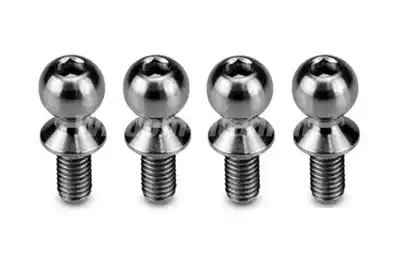
Without a doubt, titanium ball studs are the best way to attach things in tough situations. They are very strong for how light they are, don't rust, and aren't magnetic, which makes them very useful in racing, aircraft, and high-performance car systems. When strength and lightness are combined, the product performs better than any other material when it comes to high vibration, temperature changing, and chemical exposure. More and more, racing teams and people who work on customizing cars depend on these highly designed parts to get an edge in a market where every gram and link counts.
Titanium Ball Studs: Material Properties and Applications
What Defines a Titanium Ball Stud?
A titanium ball stud is a threaded fastener with a spherical head that lets control arms, suspension links, and steering systems turn. Instead of regular steel bolts, these parts are made of titanium alloys, usually Grade 5 (Ti-6Al-4V), which have a high tensile strength while being very light. The spherical shape spreads the pressure evenly across the joint and can handle angle misalignment, which is why they are so important in moving mechanical parts.
Titanium alloy used to make racing ball studs is used for very hard tasks. They can handle repeated stress cycles, rapid impact loads, and changes in temperature that would damage weaker materials. The anodized coating that is usually put on these screws makes the surface harder and easier to identify while protecting the purity of the material underneath. Metric threading makes sure that it works with European and Asian car platforms, and ball sizes that can be changed make it possible to perfectly match to different suspension geometries.
Core Material Properties That Matter
Because of how it is made, titanium works better than other materials in important situations. The tensile strength of the material in Grade 5 alloy form ranges from 895 to 1000+ MPa, which is as strong as or stronger than many heat-treated steels. But with a density of 4.43 g/cm³, it is about 56% as dense as steel, so it is just as strong but much lighter.
The naturally occurring titanium dioxide layer on the surface makes it very resistant to rust. This passive film doesn't change when the pH level changes, and it doesn't get damaged by road salts, brake fluid, hydraulic oils, or moisture in the air, all of which can cause suspension parts to break. Titanium, unlike aluminum, keeps its shape at high temperatures up to 400°C. This makes it a good choice for brake system uses where heat transfer from the calipers and wheels makes the working conditions unpleasant.
Because they are not magnetic, they don't interact with electrical stability control sensors and ABS systems, which are becoming more and more common in modern cars. This trait is especially useful in systems for electric vehicles, where electromagnetic compatibility is very important. Even though biocompatibility doesn't have much to do with cars, it does show that the material is chemically neutral and safe for humans, which is proof of its basic safety.
Application Across Industries
The main group of people who buy racing titanium ball studs are people who work in auto repair shops. For high-performance builds for track-focused cars, losing weight without weakening the structure is important. Under these dynamic conditions, where steel options might loosen or deform, suspension geometry changes during turning produce huge lateral loads. Titanium ball studs keep clamping force and dimensional stability.
Racing teams that have to follow official body weight limits take advantage of titanium's higher density. Changing all of the suspension's steel fasteners to titanium ones can get rid of several kilos of extra weight that isn't being sprung, which directly improves the suspension's reaction and lap times. Professional racing groups have found that using titanium connection components makes a difference in how precisely the car handles and how consistently the tires touch the road.
Installation and Maintenance: Ensuring Optimal Performance
Installation Best Practices
Titanium ball stud performance and longevity are maximized by proper fitting techniques. Before thread preparation can begin, both male and female threads must be checked for dirt, damage, or mistakes in the way they were made. Titanium is not as hard as steel, so it scratches easily. Care must be taken when handling it to avoid galling during assembly.
Even though titanium doesn't rust, lubrication is still necessary. When applied to threads, a light graphite-based additive lowers friction and stops galling. Copper or aluminum-based anti-seize solutions should not be used with titanium because they cause galvanic rusting. Molybdenum disulfide lubricants work well in a wide range of temperatures that are common in vehicle settings.
Pay close attention to torque parameters. Because titanium has a smaller amount of elasticity than steel, it spreads more when the same loads are put on it, which changes how the clamping force develops. This behavior is expected based on the torque values given by the manufacturer. Deviation increases the chance of either not enough preload, which causes the threads to open, or too much stress, which damages the threads. For accuracy, torque wrenches that have been adjusted within the last year are recommended, and torque-angle ways offer better clamping stability in important situations.
Titanium screws should never come into contact with impact tools. High rapid loads and titanium's notch sensitivity work together to make stress concentrations that start cracks. To avoid damage during installation, use hand tools or powered drivers with changeable clutches set below the impact limits.
Maintenance and Inspection Protocols
Titanium ball studs don't need as much care as steel ones, but they should still be inspected every so often to make sure they don't break down unexpectedly. Visual inspection at regular service intervals finds damage that is easy to see, rust on joining surfaces, or movement that can be seen by witness marks moving.
Checking the torque at regular times keeps the tightening force steady and accounts for settling. Parts that are exposed to a lot of shaking may need to be retorqued after the first use because the joint settles down over time. If the initial download was done correctly, subsequent checks usually show stable numbers.
In most places, the natural oxide layer doesn't need any extra defense. Anodized coats make the surface harder and more attractive, but they need to be handled carefully so they don't get scratched and lose their protective properties. Damaged anodization doesn't change how resistant the titanium underneath is to rust, but it might look bad in uses that people can see.
Instead of following a set plan, replacement times are based on past load history and operating severity. For racing uses that involve repeated high-stress cycles, the bearings need to be replaced more often than for street cars that are loaded moderately. Non-destructive testing methods, such as dye penetrant inspection, can find surface cracks in high-value situations where a component failing would have major effects.
Why Are Titanium Ball Studs a Smart Investment for Industrial Use?
Quantifiable Performance Benefits
Losing weight directly leads to better performance in all areas of a vehicle's physics. Getting rid of one kilogram of unsprung mass has the same effect on suspension response as getting rid of four kilograms of sprung mass. Using titanium ball studs instead of steel ones in a full suspension system can get rid of 2 to 3 kilograms of extra weight that isn't being sprung, which makes the control and ride quality much better.
Corrosion protection makes things last longer and costs less to maintain. In harsh conditions, steel bolts used in suspension systems usually need to be replaced every three to five years because corrosion weakens them. Titanium parts usually last longer than 10 years without breaking down, which spreads out the higher original costs over longer times of use.
Racing teams show that using titanium gives them a competitive edge. Weight loss and better damper performance lead to 0.2 to 0.5 second improvements in lap times per lap, which add up to big gains over long race lengths. In professional racing settings, where thousandths of a second split places, the results support the high costs of premium parts.
Cost-Effectiveness Over Lifecycle
Titanium's value offer can be seen in its total cost of ownership study. The initial costs of buying them are 300–400% higher than those of steel versions, but they last longer and don't need to be replaced as often, so the overall costs are lower. More economic benefits come from the fact that rust resistance and cracking resistance save on maintenance work.
Automakers that want to appeal to high-end customers are making titanium screws common equipment more and more. Differentiating a brand with lightweight, high-performance parts is a good way to get customers to pay more, which recovers the costs of materials and improves market standing. This trend makes more people want to buy from OEM sellers and customization shops that cater to enthusiast markets.
Future-Proofing Through Material Selection
As car designs change, they favor materials that can be used for more than one thing. Platforms for electric vehicles that focus on getting the longest range possible need all of their systems to lose a lot of weight. Titanium parts that meet this need and are resistant to corrosion and electromagnetic interference put producers in a good situation as markets change.
Sustainability and lifetime environmental effect are becoming more and more important in regulations. Titanium is durable, so it doesn't need to be changed as often as steel alternatives, which means less material is used and less trash is made. Recyclability at the end of its useful life supports circular economy ideas that are becoming more popular in global regulations.
Engineering standards keep getting stricter as people expect vehicles to perform better. Materials that meet current needs while leaving room for performance improvement are better able to adapt to new needs. Titanium's natural properties give it this safety cushion, which lowers the risk of having to remake as standards change.
Conclusion
Titanium ball studs have been shown to improve performance in demanding racing, motorbike, and car settings. Their higher strength-to-weight ratio, resistance to corrosion, and resistance to fatigue make up for their higher price by improving car handling, lowering servicing needs, and increasing service life. When purchasing these parts, procurement workers should give priority to certified sellers who offer customization options, clear pricing, and complete quality paperwork. Moving toward lighter weight and better performance in vehicles, titanium screws are smart investments that will help companies stay competitive and run their businesses at their best in a wide range of industry settings.
Partner With Wisdom Titanium for Your Racing Ball Stud Needs
Wisdom Titanium specifically makes high-performance race titanium ball studs that are designed for use in cars, motorcycles, and factories. We are an ISO 9001-certified titanium ball stud supplier in Baoji Titanium Valley, which is the world's largest cluster of titanium production facilities. We control the quality of every step of the process, from choosing the raw materials to doing the final review. Our metric-threaded ball studs can be customized to fit your exact needs. They are made of high-quality Grade 5 titanium metal and have long-lasting anodized coatings. The ball sizes can also be changed to fit your exact needs. Our experienced engineering team can help you with technical issues to make sure the best performance, whether you need standard parts or custom CNC solutions. Get in touch with our team at sales@wisdomtitanium.com to talk about your needs and get detailed quotes that come with full material approvals and clear pricing.
FAQ
Are titanium ball studs non-magnetic?
Titanium is paramagnetically behaved, which means it doesn't react magnetically under normal circumstances. Because of this, titanium ball studs don't conflict with electronic sensors, stability control systems, or ABS parts in current cars. This makes them perfect for platforms with a lot of electronic parts.
What are typical lead times for bulk titanium ball stud orders?
Standard setups usually ship between two and four weeks after stock is created. To meet specific needs like different ball sizes, threading, or anodized colors, it takes 6 to 8 weeks to buy the materials, have them CNC-machined, treat the surface, and check the quality.
How do titanium ball studs perform in extreme temperatures?
Grade 5 titanium keeps its shape and mechanical qualities even at very low temperatures up to 400°C. This means it can be used in brake systems, mounting spots next to exhaust pipes, and racing conditions. The material doesn't expand or contract like steel screws do when they are heated and cooled over and over again.
References
1. Boyer, R., Welsch, G., & Collings, E. W. (1994). Materials Properties Handbook: Titanium Alloys. ASM International.
2. Donachie, M. J. (2000). Titanium: A Technical Guide (2nd ed.). ASM International.
3. Lutjering, G., & Williams, J. C. (2007). Titanium: Engineering Materials and Processes (2nd ed.). Springer-Verlag Berlin Heidelberg.
4. Schutz, R. W., & Watkins, H. B. (1998). Recent developments in titanium alloy application in the energy industry. Materials Science and Engineering: A, 243(1-2), 305-315.
5. ASTM International. (2020). ASTM B348-13: Standard Specification for Titanium and Titanium Alloy Bars and Billets. ASTM International.
6. Veiga, C., Davim, J. P., & Loureiro, A. J. R. (2012). Properties and applications of titanium alloys: A brief review. Reviews on Advanced Materials Science, 32(2), 133-148.