
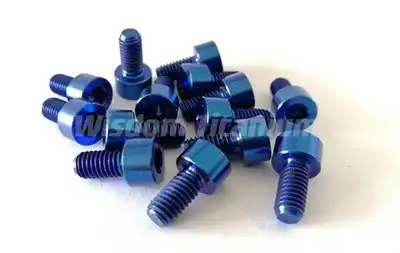
Titanium Allen head bolts are really built for high-performance applications. These socket cap fasteners are made from grade 5 (Ti-6Al-4V) or grade 2 titanium, with tensile strength of >950 MPa and density of just 4.51 g/cm³. That translates to almost steel strength at about half the weight. Their hex-drive design ensures accurate torque transfer, and their natural oxide layer offers outstanding corrosion resistance in chemical, marine, and aerospace applications. If you’re on a procurement team looking for fasteners that save weight without compromising load capacity, titanium Allen head bolts are a technically solid solution.
Understanding Titanium Allen Head Bolts: Material and Performance Overview
What Makes Titanium Different From Steel
Titanium’s atomic structure forms an inert coating of oxide when it comes into contact with air. This layer is not a covering, but it does resist corrosion. Titanium is not susceptible to corrosion like carbon steel; it does not change its size and form when subjected to salt spray, acids, and high temperatures up to 400°C. This passive behavior does not endure; it returns after being damaged on the surface.
Titanium Grade 5 vs. Grade 2
Grade 5 (Ti-6Al-4V) has a tensile strength of over 950 MPa and a yield strength of around 880 MPa. It contains 6% aluminum and 4% vanadium. Grade 2 pure titanium is available from retailers. It’s softer and more flexible. It’s excellent for low-load circumstances when shapeability is more critical than sheer strength. For high-performance applications such as racing, aerospace, and subsea, Grade 5 is generally the material of choice.
How Titanium Compares to Stainless Steel and Aluminum
316 stainless steel has a tensile strength of roughly 515 MPa and a density of 8.0 g/cm³. Grade 5 titanium weighs just 56% of the weight of 316 stainless steel but is nearly double the strength. Aluminum alloys are lighter but also weaker (typically 300-500 MPa) and more likely to fail from fatigue under repeated loading and unloading. For fasteners that need to handle genuine structural stresses in corrosive conditions, titanium is superior to both stainless steel and aluminum.
Evaluating Titanium Allen Head Bolts for High-Performance Applications
In industries where weight, strength, and the environment all play a part, hex socket titanium fasteners have a strong track record. So they are worth noting as they boost achievement in these major ways:
- Weight savings: Titanium Allen bolts are around 43% lighter than comparable stainless steel bolts at 4.51 g/cm³. In Aerospace and Motorsports this has a direct impact on fuel economy, payload, and dynamic handling.
- Corrosion resistance. Grade 5 titanium Allen head bolts are resistant to saltwater, chlorides, and most industrial acids. It does not pit in low-oxygen settings as stainless steel does, which is a recognized failure mode for bolting in subsea and chemical plant applications.
- Lifecycle cost: Titanium fasteners tend to need fewer replacements throughout a service life. In offshore equipment or maritime structures, the cost of replacing bolts, including labor and delay, typically surpasses the original difference in material cost.
Weight reduction: Titanium Allen bolts weigh around 43% less than stainless steel bolts of the same size (4.51 g/cm³). This directly influences fuel economy, cargo capacity, and dynamic handling in both aircraft and motorsport.
Corrosion Resistance: Titanium grade 5 does not corrode in saltwater, chlorides, or most industrial acids. It does not rust as stainless steel does in low-oxygen situations, a well-known cause of failure in subsea and chemical plant bolts.
Cost over a lifetime: Titanium fasteners often need fewer replacements throughout the lifetime. Replacing bolts in maritime structures or offshore equipment involves labor costs and downtime, which can exceed the difference in the cost of the materials.
That means lower maintenance and a longer life for the asset, particularly in locations where it’s hard or costly to get to the screws once they’re put.
Technical Comparison: Titanium Allen Head Bolts vs. Other Materials
| Property | Ti Grade 5 | 316 Stainless | Grade 8.8 Carbon Steel | 6061 Aluminum |
|---|---|---|---|---|
| Tensile Strength (MPa) | 950+ | 515 | 800 | 310 |
| Density (g/cm³) | 4.51 | 8.0 | 7.85 | 2.70 |
| Corrosion Resistance | Excellent | Good | Poor | Moderate |
| Max Service Temp (°C) | 400 | 870 | 425 | 150 |
| Weight vs. Steel | −43% | Baseline | Baseline | −66% |
Fatigue Resistance
By creating compressive leftover stress in the thread root, rolled threads, not cut threads, make wear resistance much higher. Grade 5 titanium Allen bolts with rolled threads work better than Grade 8.8 steel in places where there is a lot of cycle wear, like engine vibration and solid aircraft brackets.
Galvanic Compatibility
It is close to the noble end of the galvanic series for titanium. When used with aluminum or carbon steel structures, the pairing of the materials needs to be considered to make sure that the less noble metal doesn't rust faster. Most of the time, titanium Allen head bolts are used in aluminum aircraft panels; the area ratio is controlled by engineering design.
Real-World Use Cases
Grade 5 titanium socket cap bolts have been used instead of 316 stainless steel in underwater sensor housings in marine rigging. This stops the pitting failures that happen after 18 to 24 months of saltwater exposure. In UAV frame assemblies, the same type of bolt has cut the weight of fasteners by more than 40% while still keeping the torque needed for motor mount applications.
Procurement Guide: Sourcing Quality Titanium Allen Head Bolts
When you need to acquire a lot of titanium hex socket screws, you have to do more than simply compare pricing. Verifiable documentation of batch-level accuracy should be available from suppliers.
Certifications to Require
At the very least, ask for an ISO 9001 certificate, material test reports (MTR) with chemical composition, and REACH/RoHS declarations. AS9100 accreditation offers an additional layer of process control to aviation supply chains. No matter what a supplier charges, any source that cannot offer batch-traceable MTRs is a risk in the supply chain.
Quality Control Checkpoints
Ask suppliers how they test batches that are leaving. Some good ways to check it include XRF chemical analysis to verify the grade of the alloy, GO/NO-GO ring gage testing for thread tolerance (generally 6g class), and dimensional examination of the form of the head. For safety-essential applications, a dye penetrant inspection (DPI) should be requested to detect sub-surface micro-cracks generated by cold heading.
Bulk Order Strategy
If you’re buying more than 1,000 pieces, speak about a tiered pricing scheme and obtain the lead times in writing. Typical lead times for typical DIN 912 socket cap sizes M1.6 to M18 are 15 to 30 days. Before buying full volume, ask for a test order of 500 to 1,000 pcs. Export-standard shipping, with moisture-barrier bags and batch numbers on the labels, helps to monitor the items on arrival.
Installation and Maintenance Best Practices for Titanium Allen Head Bolts
Tools and Torque Settings
For optimal results, use measured torque wrenches and hex keys that fit the socket properly. Titanium is very hard; thus, worn or too-small Allen keys soon vanish into the hole. Remember to put a nickel- or copper-based anti-seize solution on the threads before mounting. For Grade 5 titanium with anti-seize, use 70-80% of the dry force that would be used on a steel bolt of the same size.
Preventing Galling
Galling arises when titanium threads cold weld to one another during installation. This is the biggest error individuals make while putting titanium screws together. Be sure the mating threads are clean and free of burrs and use anti-seize. Install by hand or with a moderate-speed torque wrench. Not an impact driver.
Inspection and Replacement Indicators
Look at the bolt heads at each maintenance check to determine whether the sockets are rounding, threads are deforming, or surfaces are breaking. In corrosive situations, ensure the oxide layer remains intact. Discoloration by itself is not a failure indicator, but surface damage should indicate that it is time for replacement. A structured repair journal connected to batch numbers allows teams to monitor service life and arrange replacements before they fail.
Conclusion
Titanium allen head bolts are a good choice for high-demand applications when stainless steel or carbon steel cannot match the weight, strength, and corrosion specifications. Grade 5 (Ti-6Al-4V) fasteners have a tensile strength of more than 950 MPa and a density of 4.51 g/cm3. They are excellent for chemical, marine, aerospace, and racing applications. To obtain the best performance from these parts, they need to be fitted appropriately, with anti-seize, torque settings, and from batch-traceable suppliers.
FAQ
1. Are titanium Allen head bolts more expensive than stainless steel?
Yes — Grade 5 titanium typically costs 4 to 8 times more per unit than 316 stainless. However, the lifecycle cost gap narrows significantly in corrosive or weight-sensitive applications, where longer service intervals and maintenance savings offset the initial price difference.
2. Can titanium socket cap bolts be used in seawater environments?
Grade 5 titanium resists saltwater corrosion without coatings or sacrificial anodes. Unlike stainless steel, it does not experience crevice or pitting corrosion in low-oxygen seawater, making it a preferred choice for marine hardware and subsea structures.
3. What is the difference between Grade 2 and Grade 5 titanium fasteners?
Grade 2 is commercially pure titanium — softer, more ductile, and better for forming but with lower strength. Grade 5 (Ti-6Al-4V) is an alloy with tensile strength above 950 MPa, suited for structural and high-load applications.
4. Do titanium Allen bolts work with standard hex keys?
Yes — they use standard metric hex key sizes. Using a calibrated, well-fitting key is important to avoid socket rounding, which occurs more readily than with softer steel bolts.
5. What surface treatments are available?
PVD coating and anodizing are the two primary options. PVD increases surface hardness and reduces galling risk. Anodizing adds color coding for part identification and a modest increase in surface wear resistance.
Request a Quote From Wisdom Titanium — Your Trusted Titanium Allen Head Bolts Supplier
In general, Grade 5 titanium Allen head bolts cost 4 to 8 times more per unit than 316 stainless steel. In applications that are corrosive or sensitive to weight, on the other hand, the difference in lifecycle costs is much smaller because longer service intervals and lower maintenance costs more than make up for the initial price difference. To get a quote or confirm a sample, email our team at sales@wisdomtitanium.com.
References
1. Boyer, R. R. An Overview on the Use of Titanium in the Aerospace Industry. Materials Science and Engineering: A, 1996.
2. Donachie, M. J. Titanium: A Technical Guide. ASM International, 2000.
3. Budynas, R. G., & Nisbett, J. K. Shigley's Mechanical Engineering Design. McGraw-Hill, 2020.
4. Peters, M., Kumpfert, J., Ward, C. H., & Leyens, C. Titanium Alloys for Aerospace Applications. Advanced Engineering Materials, 2003.
5. Fastener Standards — ISO 4762 / DIN 912 Socket Head Cap Screws. International Organization for Standardization, 2004.
6. Schutz, R. W., & Thomas, D. E. Corrosion of Titanium and Titanium Alloys. ASM Handbook Vol. 13, ASM International, 1987.




