
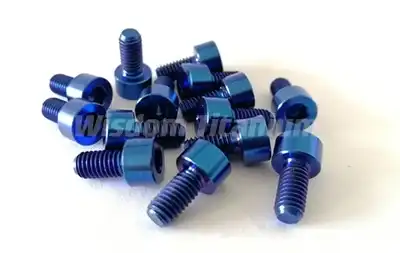
Titanium allen head bolts are one of the most corrosion-resistant fasteners in industrial hardware today. The key is titanium’s inherent ability to produce a thin, stable coating of titanium dioxide (TiO2) oxide on its surface the instant it encounters oxygen. This passive film provides a self-healing barrier against moisture, salt, acids, and many industrial chemicals. Grade 2 and Grade 5 (Ti-6Al-4V) <br/> These hex-socket fasteners come in two grades, with tensile strength over 950 MPa at a density of only 4.51 g/cm3 – strength without the weight penalty of steel.
Understanding Titanium Allen Head Bolts and Corrosion Resistance
What Makes Titanium Inherently Corrosion-Resistant?
Titanium doesn’t rust. It has a passive oxide coating of TiO2 that nearly immediately regrows if scraped or abraded. The oxide layer is stable throughout a pH range of 3 to 11, covering most chemicals that workers are exposed to, notes ASM International. Titanium does not require a coating since it retards further corrosion on the atomic level. This is unlike carbon steel, which rusts slowly when the surface is broken.
Grade 2 vs. Grade 5: Which Offers Better Protection?
Grade 2, commercially pure titanium, has the best corrosion resistance and may be used for moderate-strength chemical processing and maritime gear. Grade 5, often known as Ti-6Al-4V, loses some chemical resistance but gains substantially greater mechanical strength (tensile strength above 950 MPa). This makes it the optimum option for high-load industrial systems, racing components, and aviation parts. Both grades can survive in saltwater and chloride-rich environments where stainless steel would normally fail.
How Titanium Compares to Stainless Steel and Carbon Steel
Carbon steel can rust rapidly if left uncoated, and even 316 stainless steel may corrode in fissures and pits after prolonged chloride exposure. Titanium does a hell of a lot better than either in splash zones, chemical plants offshore, or underwater sensor housings. According to a 2019 study in the journal Corrosion Science, Grade 5 titanium showed no visible pitting after testing with salt spray for 5,000 hours. This performance was beyond the scope of ordinary stainless alloys.
Titanium Allen Head Bolts vs. Other Fastener Materials: Corrosion and Performance Comparison
Mechanical Strength Without the Weight Penalty
With a density of 4.51 g/cm³, titanium hex cap screws are about 45% lighter than steel fasteners of the same size and shape, but they still have a tensile strength of over 950 MPa. This weight decrease is closely linked to technical value for procurement teams that work with aircraft OEMs or performance automakers. Even though aluminum nuts are lighter, their tensile strength rarely goes above 310 MPa, which isn't enough for high-stress parts where titanium allen head bolts work best.
Lifecycle Cost Advantage Over Conventional Fasteners
Titanium socket head nuts cost more per unit at first than stainless steel or carbon steel that has been zinc-plated. In terms of money, though, the longer working life tells a different story. When used in marine environments, where stainless fasteners need to be replaced every two to three years because they rust, titanium bolts that are properly specified usually last the whole structure. Over a typical procurement cycle of three to five years, the purchase premium is balanced out by less downtime and replacements that need to be done less often.
Selecting the Right Grade for Your Application
By knowing these differences, purchasing managers can ask for the right material at the inquiry stage, which cuts down on sampling cycles and shortens the time it takes to qualify suppliers overall.
- Grade 2 titanium bolts — Best for chemical process piping, heat exchangers, and seawater desalination equipment where corrosion resistance takes priority over tensile load requirements.
- Grade 5 (Ti-6Al-4V) bolts — Preferred for aerospace brackets, UAV motor mounts, offshore drilling hardware, and motorsport components where both high strength and corrosion immunity are mandatory.
- Surface treatments (PVD coating or anodizing) — Applied to either grade to increase surface hardness, prevent galling during installation, and allow color-coded identification for inventory management.
Understanding these distinctions allows purchasing managers to specify the correct material at the inquiry stage, reducing sampling cycles and shortening the overall supplier qualification timeline.
Practical Considerations: Installation, Maintenance, and Application
Correct Installation Protects the Oxide Layer
Titanium often galls, which happens when two titanium threads touch each other while they are being torqued. Before installation, you should always use an anti-seize compound that is based on nickel or copper. When anti-seize is used, the torque values for titanium hex socket bolts should be set to about 70–80% of the equivalent steel value. When you over-torque, you damage the passive oxide film at the thread interface and make tiny cracks that make the part less strong and less resistant to corrosion.
Maintenance Routines That Sustain Long-Term Performance
Visual checks for darkening (a sign of chemical attack beyond the oxide layer's capacity) and thread condition reports should be part of regular inspections. Most grades can be cleaned with fresh water or neutral soap that has been dampened. Avoid using rough wire brushes that scratch the passive film. In chemical or subsea plants, clients in the energy and offshore sectors that use downstream manufacturing usually schedule inspections every three months.
Real-World Applications Across Key Industries
Titanium socket screws are used in a lot of different tough areas. In aircraft and UAV manufacturing, they keep motor mounts and structure frames in place when the design calls for less weight. Because the oxide film can last forever in saltwater, marine and subsea operators use them for yacht rigging and underwater sensor housings. They are used instead of stainless steel fasteners in chemical processing plants that deal with chlorine and acid, where pitting rust would cause upkeep problems.
Procurement Insights: Sourcing High-Quality Corrosion-Resistant Titanium Bolts
Certifications That Matter to Serious Buyers
A reliable titanium allen head bolts supplier should have an ISO 9001 quality management certificate, a Material Test Report (MTR) to prove the chemical composition according to ASTM B348 or AMS 4928, and REACH/RoHS compliance declarations to be able to sell their products in Europe. If you are a buyer selling to aerospace or military clients, additionally request First Article Inspection Reports (FAIR) and batch traceability records with heat lot numbers. If you don’t have the necessary papers, a product can’t go to the market, and the vendor risks being sued.
Batch Consistency and Quality Traceability
If you are a wholesaler ordering 1,000 pieces or more, you want items that are consistent from batch to batch. Professional manufacturers will XRF (X-Ray Fluorescence) the Ti-6Al-4V alloy, utilize a GO/NO-GO ring gage to inspect the 6g thread class, and destructively tensile test random samples to confirm that the UTS is a minimum of 895 MPa. A traceable batch numbering system enables distributors to detect and correct any quality issues in the field without having to recall the whole lot of goods.
Lead Times, MOQ, and Pricing Structure
Standard titanium hex bolts in sizes M1.6 to M18 are available, with lead times of 15 to 30 days for orders of 1,000+. New product trials are typically available with lower minimums. This provides purchasing managers with a valuable means of testing out a new grade or size without committing to a major purchase. Bulk pricing is tiered. Our conditions for international business-to-business are 30% T/T deposit and 70% payment before shipping.
Why Choose Titanium Allen Head Bolts? Long-Term Value Through Corrosion Resistance
Cost-Benefit Analysis for Industrial Procurement Teams
Higher pricing does not equal greater overall cost. In tough corporate environments, titanium fastener hex bolts often have a lower total cost of ownership over a five-year period than their stainless steel counterparts. This is because there’s less inspection work, fewer replacement orders, and less likelihood of downtime. When procurement managers provide lifetime cost statistics to internal stakeholders, acceptance of titanium specifications on projects that demand a lot of money is always simpler.
Environmental and Sustainability Advantages
Titanium is safe for living things and doesn’t hurt them. Titanium also remains chemically stable at a number of various pH levels. It does not leach out as zinc-coated steel does and interacts with water in the air. Titanium fasteners need less hazardous surface coatings and less disposal of materials since corroded pieces need to be replaced. If a manufacturing business has active sustainability or environmental compliance procedures, that’s a plus.
Proven Performance in Corrosive Field Environments
For instance, workers on offshore oil platforms and maintenance crews at chemical plants report that titanium screws survive three to five times longer than stainless steel fasteners in chloride-rich conditions. The real-life deployment data, as shown by repair logs and replacement records, support the scientific argument for the use of titanium fasteners instead of alternative materials for high-value, long-term usage.
Conclusion
The titanium allen head bolts don't truly corrode. This is because they feature a self-healing TiO2 passive oxide coating, which prevents them from rusting. This makes them suitable for marine, chemical, aerospace, and power applications. They are available in Grade 2 and Grade 5 bolts. They have a tensile strength of more than 950 MPa and a density of about 4.51 g/cm³. They function well for a long period, both mechanically and chemically. Specifying titanium hex socket bolts allows procurement teams who manage supply chains for demanding downstream sectors to reduce overall cost, improve supply reliability, and enable enterprises to enter regulated markets.
FAQ
1. Are titanium allen head bolts completely rustproof?
Titanium does not rust in the traditional iron-oxide sense. The TiO₂ passive film prevents oxidation from progressing beyond the surface. However, in highly concentrated reducing acid environments (such as hot hydrofluoric acid), the oxide layer can break down. For the vast majority of marine, chemical, and industrial applications, titanium fasteners remain effectively rustproof throughout their service life.
2. Can titanium hex socket bolts be used in saltwater applications?
Yes. The passive oxide film on titanium is particularly stable in chloride-rich environments, including seawater. Grade 2 titanium is widely specified for marine hardware, subsea sensors, and desalination equipment. Grade 5 is preferred where higher mechanical loads accompany saltwater exposure, such as offshore rigging and UAV frame assemblies.
3. How does titanium fastener pricing compare to stainless steel?
Titanium socket head bolts typically cost three to five times more than equivalent 316 stainless steel fasteners on a per-unit basis. However, their longer service life and lower replacement frequency in aggressive environments often produce a lower total cost over a standard project lifecycle of three to five years.
4. Do titanium bolts need special tools for installation?
Standard metric Allen keys and hex socket drivers work with titanium bolts. The key installation requirement is applying anti-seize compound to prevent galling and using a calibrated torque wrench to stay within the manufacturer's specified torque range.
Partner With Wisdom Titanium for Your Next Fastener Order
Wisdom Titanium sells Grade 2 and Grade 5 (Ti-6Al-4V) titanium allen head bolts in sizes M1.6 to M18. These bolts are ISO 9001-certified and come with full MTR paperwork, batch tracking, and export-standard packing. As a reliable titanium Allen head bolts manufacturer based in Baoji Titanium Valley, Shaanxi Province, we can handle large orders with wait times of 15 to 30 days and offer competitive tiered prices. Email sales@wisdomtitanium.com to get samples or a price for a large order.
References
1. ASM International. Corrosion of Titanium and Titanium Alloys. ASM Handbook, Volume 13B, 2005.
2. Schutz, R. W., & Watkins, H. B. "Recent Developments in Titanium Alloy Application in the Energy Industry." Journal of Materials, 1998.
3. Fontana, M. G. Corrosion Engineering. McGraw-Hill, 3rd Edition, 1986.
4. ASTM International. ASTM B348: Standard Specification for Titanium and Titanium Alloy Bars and Billets. ASTM International, 2019.
5. Donachie, M. J. Titanium: A Technical Guide. ASM International, 2nd Edition, 2000.
6. Schumacher, M., ed. Seawater Corrosion Handbook. Noyes Data Corporation, 1979.