
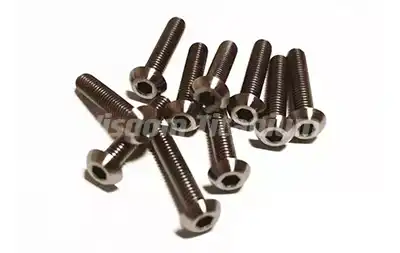
There are two main ways to make M3 titanium bolt threads: rolling or CNC machining. Depending on the job, one approach may be better than the other. For high-stress aerospace and automotive applications, rolled threads are the way to go since they improve the material's tensile strength and grain structure. For specialty components that need strict tolerances, CNC machined threads are the way to go because of their exceptional accuracy and personalizability. You should think about your budget, production volume, and individual performance needs while deciding between different manufacturing processes. Procurement experts can better meet their titanium fastener threading demands when they are aware of these distinctions.
M3 Titanium Bolts and Their Threading Methods
A 3 mm nominal thread diameter and a typical coarse pitch of 0.5 mm define M3 titanium bolts as precision metric fasteners. Grade 5 (Ti-6Al-4V) titanium alloy is the primary material for these specialist fasteners. This alloy is ideal for high-performance uses because to its corrosion resistance and remarkable strength-to-weight ratios.
Key Specifications and Properties of Grade 5 Titanium
Titanium fasteners made in Grade 5 have several benefits over their steel counterparts. These bolts save weight by around 44% while keeping their exceptional mechanical qualities, thanks to their density of 4.43 g/cm³, which is lower than steel's density of 7.9 g/cm³. A self-healing oxide layer offers natural corrosion protection, and the tensile strength is between 895 and 930 MPa. It also has great fatigue resistance.
Threading Manufacturing Methods Overview
There are primarily two ways that M3 titanium bolt threads are made. Titanium is thread-rolled by compressing and shaping it under high pressure using specialized dies; this process does not remove any material from the metal. Grain flow pattern and surface work-hardening are both improved by this procedure. On the other hand, computer numerically controlled thread machining makes use of precise cutting tools to carve out threads that meet precise dimensions and surface quality standards.
Choosing one of these processes has a major effect on the production costs, lead times, and bolt performance characteristics. When it comes to common configurations, thread rolling usually offers quicker production rates, but when it comes to unique specifications and small batch needs, CNC machining gives more flexibility.
Detailed Comparison: Rolled Threads vs. CNC Machined Threads on M3 Titanium Bolts
Performance in demanding applications is impacted by the fundamentally different material properties created by the production methods of rolled and CNC machined threads. Procurement choices might be based on unique technical needs when these distinctions are understood.
Rolled Thread Manufacturing Process and Benefits
By applying controlled plastic deformation, thread rolling alters the structural properties of titanium. To make the titanium blank flow into the thread profile, hardened steel dies are used to compress it at pressures more than 200,000 psi. By removing the heat from the material, the grain flow pattern becomes continuous and follows the threads' shapes, making them stronger than cut threads.
Tensile strengths may be 10-15% higher than the base material as a consequence of grain flow augmentation. Additionally, compared to machined threads, rolled threads have a fatigue strength that is up to 30% higher, indicating improved fatigue resistance. Under cyclic loading circumstances, the work-hardened surface layer retains dimensional stability and adds wear resistance.
CNC Machined Thread Precision and Customization
The use of computer-controlled cutting tools in CNC thread machining allows for the creation of threads with superior surface finish quality and dimensional precision. This method of production achieves essential size tolerances of ±0.025mm by removing material along predefined tool paths. Complex thread profiles, non-standard pitches, and customized features may be achieved with machining, which would be very difficult or impossible to create through rolling.
For applications that need a fine fit-up with mating components, machined threads are the way to go due to their better concentricity and thread form precision. Incorporating unique surface textures, thread relief grooves, and bespoke head geometries into a single configuration is also made possible by the cutting process.
Comparative Performance Analysis
The results of the mechanical tests show that the two threading techniques are functionally different. Ultimate tensile strengths of rolled threads in Grade 5 titanium reach 1050-1100 MPa, whereas those of machined threads range from 950-1000 MPa. Rolled threads regularly exhibit higher tensile strength values. Under high-cycle stress circumstances, fatigue testing reveals that rolled threads achieve a service life that is 2-3 times longer.
Applications requiring exact dimensional control and bespoke setups, however, benefit greatly from CNC machined threads. For sealed assemblies and precise instruments, where thread engagement quality is crucial to performance, machined threads are the way to go due to their higher surface smoothness and dimensional accuracy.
Advantages and Limitations of Each Threading Method for M3 Titanium Bolts
The benefits and limitations of each threading approach determine which ones are best suited for certain tasks. Against their performance needs and operational limitations, procurement experts must assess these aspects.
Rolled Thread Advantages in High-Performance Applications
Rolled threads are very advantageous in demanding automotive and aerospace applications due to their structural benefits. Resistance to fracture initiation and propagation is greatly improved by the elimination of stress concentrations at thread roots, made possible by the increased grain flow pattern. Applications with high vibration levels, such motorcycle braking systems and racing car suspensions, rely on this quality.
When it comes to medium to high-volume manufacturing runs, rolled threads can provide economic benefits. With average cycle durations of 5-10 seconds per item instead of 30-60 seconds for machined threads, the manufacturing technique delivers better production rates compared to CNC machining. Cutting tool wear is not an issue, so you won't have to replace them very often. Plus, the quality stays the same throughout the production runs.
CNC Machining Flexibility and Precision Benefits
When it comes to developing prototypes and specialized applications, CNC machined threads provide unparalleled freedom. Machining allows for specific features, non-standard thread pitches, and bespoke head geometries to be accommodated without the need for costly tooling expenditures. Racing teams and custom modification companies that need unusual fastener setups really appreciate this option.
Tighter assembly tolerances and better component interfaces are both made possible by the accuracy of CNC machining. Throughout the whole threaded length, the thread engagement quality is uniform, allowing for dependable torque requirements and avoiding cross-threading in assembly processes.
Limitations and Considerations for Each Method
There are several limits on thread rolling, such as the minimum thread diameter and the required material thickness. Standard thread profiles and dimensions are the only ones that can be used with the deformation process since it takes a certain amount of material to create the thread correctly. The high cost of die manufacture makes small-batch bespoke work economically unattractive, especially when it comes to specific alterations.
There are likely stress concentration sites at the thread roots, where the cutting tools make abrupt transitions, and there are limits to the economics of production volume for CNC machined threads. Surface imperfections introduced during material removal might potentially impact fatigue performance in high-stakes applications.
How to Choose the Right M3 Titanium Bolt Thread Type for Your Procurement Needs?
Prior to making a threading technique selection, it is important to thoroughly assess the application requirements, performance standards, and cost factors. Mechanical needs, manufacturing numbers, and supply chain considerations should all be part of the decision-making framework.
Application-Specific Performance Requirements
Rolled thread structure is usually the way to go for high-stress applications like motorcycle performance upgrades and vehicle racing. For harsh operational environments, safety margins provided by improved fatigue resistance and higher tensile strength are crucial. When it comes to suspension parts, brake assemblies, and engine mountings—places where failure might have catastrophic consequences—rolled threads are routinely specified by racing teams.
Depending on the application, the dimensional accuracy that CNC machining provides could be crucial for precision instrument applications and specialist equipment assembly. Thread tolerances that beyond the limitations of rolled thread are often required for medical equipment, aeronautical instruments, and special fabrication tasks. Machining threads guarantees dependable performance in these high-stakes applications because to their improved surface polish and dimensional precision.
Economic Evaluation and Supplier Selection
The economic feasibility of any threading technique is greatly affected by volume needs. While CNC machining is still competitive for lower numbers and unique configurations, rolled threads become cost-effective when the quantity exceeds 500-1000 pieces. When comparing lead times, it's worth noting that rolled threads are usually ready in 7–15 days, whereas machined threads might take 10–20 days.
Certification to ISO 9001, traceability of materials, and verification of quality control should be the top priorities when evaluating suppliers. All manufacturing lots are accompanied by dimensional reports, mechanical property verification, and material certifications from reputable vendors. Shipping prices and lead times might be impacted by geographic factors, especially when it comes to urgent needs or specific configurations.
Enhancing Your Supply Chain: Procurement Tips for M3 Titanium Bolts
A thorough familiarity with supplier capabilities, market dynamics, and inventory management factors is necessary for developing effective procurement strategies for M3 titanium bolts fasteners. Reliable supply continuity and substantial cost savings are both possible outcomes of strategic sourcing methods.
Volume Procurement and Inventory Optimization
When buying titanium in bulk, you may save a lot of money. Standard designs sometimes have minimum order numbers ranging from 100 to 500 pieces, with significant price savings offered for orders above 1000 pieces. In addition to securing inventories for continuing manufacturing needs, bulk purchase agreements may save unit prices by 15–25%.
Carrying costs, material availability, and price volatility are all factors that inventory management must take into account. The raw material markets and manufacturing capacity restrictions determine titanium's price volatility. In order to reduce the impact of supply interruptions and increase sourcing flexibility, it is advisable to establish ties with numerous suppliers.
Custom Manufacturing and Technical Support
Procurement groups and their manufacturing partners frequently need to work closely together for custom applications. If a supplier has engineers on staff, they may advise on how to optimize designs and which materials to utilize. As part of their technical support services, businesses should verify dimensions, test materials for properties, and provide suggestions based on unique applications.
Inbound inspection processes and supplier audit procedures are essential components of quality assurance systems. Certifications for materials should attest to their heat treatment conditions, mechanical qualities, and chemical makeup. The standards for surface polish, thread tolerances, and head geometry should be validated by dimensional inspection reports.
Conclusion
Considerations of volume, performance, and application dictate whether M3 titanium bolts with rolled or CNC machined threads are better. While CNC machined threads provide more accuracy and personalization options, rolled threads are the way to go for high-stress applications that need fatigue resistance and ultimate strength. When procurement experts have a firm grasp of these key distinctions, they are better equipped to make judgment calls that maximize efficiency without breaking the bank. To guarantee dependable supply chain performance, successful sourcing strategies take price into account but also assess supplier competencies, quality systems, and technical support.
Partner with Wisdom Titanium for Premium M3 Titanium Bolt Solutions
With extensive manufacturing capabilities and technical knowledge, Wisdom Titanium is prepared to fulfill all of your precision fastener needs. To provide you with the best solutions for your unique applications, our Baoji Titanium Valley plant, which is ISO 9001-certified, combines cutting-edge rolling and CNC machining technology. Our position in Shaanxi Province, home to China's biggest titanium industrial cluster, allows us to take advantage of our fully integrated supply chain and top-notch production capabilities.Contact our technical team at sales@wisdomtitanium.com to discuss your requirements and receive detailed quotations for both rolled and machined thread configurations. We provide flexible payment terms including PayPal and T/T, with production lead times of 7-15 days for standard specifications.
FAQ
Which threading method provides stronger M3 titanium bolts?
Rolled threads typically provide 10-15% higher tensile strength compared to CNC machined threads due to the work-hardening effect and improved grain flow pattern created during the rolling process. The continuous grain structure eliminates stress concentration points common in cut threads.
Are rolled threads suitable for high-temperature automotive applications?
Rolled threads perform excellently in high-temperature environments, maintaining their enhanced mechanical properties up to 400°C. The work-hardened surface layer provides additional thermal stability and oxidation resistance compared to machined threads.
What are the typical cost differences between rolled and machined M3 titanium bolts?
Rolled threads generally cost 15-25% less than CNC machined threads for standard configurations in volumes exceeding 500 pieces. However, custom specifications may favor machined threads due to tooling costs associated with rolled thread dies.
How do lead times compare between the two threading methods?
Standard rolled thread bolts typically require 7-15 days production time, while CNC machined threads may require 10-20 days depending on complexity. Custom configurations may extend lead times for both methods due to engineering and setup requirements.
References
1. Boyer, R. R. "An Overview on the Use of Titanium in the Aerospace Industry." Materials Science and Engineering: A, Vol. 213, 1996.
2. Lutjering, G. and Williams, J. C. "Titanium Engineering Materials and Applications." Springer-Verlag Berlin Heidelberg, 2007.
3. Donachie, Matthew J. "Titanium: A Technical Guide, 2nd Edition." ASM International, 2000.
4. Peters, M., Kumpfert, J., Ward, C. H., and Leyens, C. "Titanium Alloys for Aerospace Applications." Advanced Engineering Materials, Vol. 5, 2003.
5. Rack, H. J. and Qazi, J. I. "Titanium Alloys for Biomedical Applications." Materials Science and Engineering: C, Vol. 26, 2006.
6. Veiga, C., Davim, J. P., and Loureiro, A. J. R. "Properties and Applications of Titanium Alloys: A Brief Review." Reviews on Advanced Materials Science, Vol. 32, 2012.