
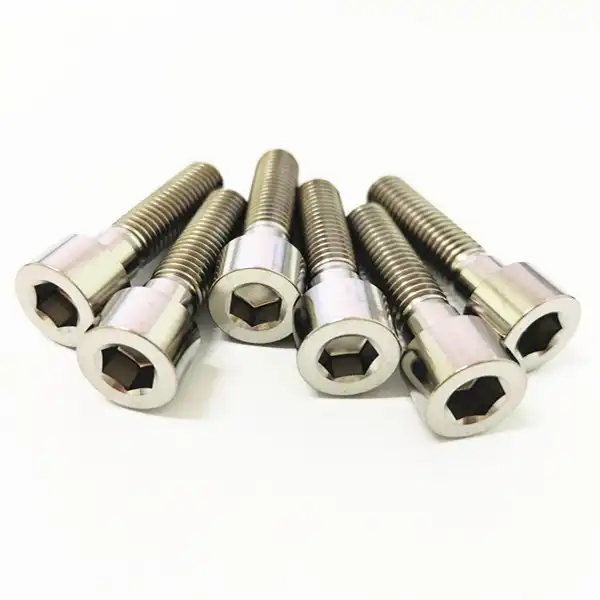
It is important to know about the different head designs when looking for screws for high-performance uses. Allen key bolts, which are also called socket head cap screws, come with a variety of head styles, such as hex socket, flat socket, button socket, oval socket, and cap socket heads. Out of all of these types, titanium allen head bolts stand out because they are very strong for how light they are and don't rust. Titanium alloys, especially Grade 5 (Ti-6Al-4V) and Grade 2, have a tensile strength of over 950 MPa and weigh 45% less than steel bolts of the same size. This makes them essential in aircraft, motorbike racing, high-end bicycle manufacturing, and making changes to cars. The style of the head has a direct effect on how power is applied, how easy it is to get to tools, and how well they look in harsh industrial settings.
Understanding Allen Key Bolt Head Types
Titanium allen head bolts have a hexagonal hole inside that can be used with hex keys or Allen wrenches. This lets you apply a lot of power in tight areas where regular tools are hard to get to. In precision parts, the shape of the head has a big effect on both how well it works and how nice it looks.
Hex Socket Head (Cap Head)
The most common form is the hex socket head, which is defined by DIN 912 and ISO 4762. This cylinder-shaped head has the most contact area for applying pressure, which lowers the chance that the tool will slip during installation. Its high profile gives it a lot of strength, which makes it good for brake caliper bolts, wheel hub systems, and racing-related structural connections. Our titanium models have head heights that range from 6mm to 18mm based on the width of the bolt (M1.6 to M18) and socket sizes that range from 1.5mm to 14mm. Because the cap head is clear, it's perfect for places where inspection and repair access is important. Auto repair shops like this setup for upgrading the brake system because the large head makes it easier to check the torque on a regular basis.
Button Socket Head (Dome Head)
Standard cap heads are about 50% taller than button socket heads because they have a higher shape and a smooth top surface. This design works great for tasks that need smooth surfaces or where screws that stick out could be dangerous. The shorter height also means less weight, which is very important in professional bike and motorbike racing. Following ISO 7380 guidelines, we make button head titanium bolts with head heights that are usually between 3 and 8 mm across our size range. The dome shape spreads the binding force out evenly across soft materials like carbon fiber. This keeps stress from building up in one place, which could damage composite frames. These bolts are used by racing teams on aerodynamic bodies and fairings where reducing drag is important. The curved surface looks nice, and it also draws custom bike shops that make high-end bikes for picky customers.
Flat Socket Head (Countersunk Head)
When put in correctly made countersinks, flat socket heads, also called countersunk designs, sit flush with the mounting surface. This arrangement gets rid of all protrusions, making smooth flying areas that are important for racing. These screws are made according to DIN 7991 and ISO 10642 standards, and the countersink angles are either 90 degrees or 100 degrees. Titanium is easy to machine, which lets you roll threads and shape heads accurately, which ensures a uniform sitting depth. Motorcycle makers use flat-head titanium bolts to place the brake disc because protruding fasteners could get in the way of the caliper's movement or make the rotating parts less balanced. The flat shape also keeps outside objects from getting in the way in open areas, like when off-road bikes are riding through mud or debris. Careful countersink preparation is needed before installation to avoid stress risers, but in performance uses, the clean surface that results is worth the extra work.
Titanium Allen Head Bolts: Properties, Grades, and Benefits
Titanium allen head bolts have performance qualities that can't be matched by other fastening materials. They solve important problems in settings that are sensitive to weight and corrosion.
Mechanical Properties and Grade Comparison
The standard for structural bolts is Grade 5 titanium (Ti-6Al-4V), which has a mass of only 4.51 g/cm³ compared to 7.85 g/cm³ for steel. This means that a lot of weight is saved without any loss of durability. The alloy's tensile strength above 950 MPa is similar to that of heat-treated alloy steel, and in situations with repeated loads, it is stronger than stainless steel. When race teams replace steel wheel lug bolts with Grade 5 titanium (Ti-6Al-4V) ones, they cut the unsprung weight of each wheel by about 60 grams, for a total of 240 grams. This makes the suspension respond better and the cars go faster. The material's elastic stiffness is 114 GPa, which is lower than steel's 200 GPa. This gives it some flexibility, so it can absorb vibrations without permanently changing shape. This makes it last longer in places with high-frequency vibrations, like motorbike engines.
Grade 2 commercially pure titanium has few alloying elements because it is more important to prevent rust than to be strong. It can handle modest loads and has a tensile strength of about 340 MPa. It is also very biocompatible and chemically resistant. Grade 2 is resistant to chloride attack and sea rust, which is good for naval uses and companies that make medical equipment. The material stays strong in pH levels from 1 to 14. Stainless steel, on the other hand, pits when it comes into contact with acidic or chlorine surroundings. Custom bike shops that serve people along the coast use Grade 2 frame bolts and accessory mounts, which means that carbon fiber or metal parts will last for decades without galvanic corrosion.
Non-Magnetic and Temperature Resistance
Titanium alloys are paramagnetic, which means they don't interact with magnetic fields. This is very important for medical imaging and accurate measurement tools. Titanium fasteners keep sensitive parts from being affected by magnetic fields when electronics companies put together sensor housings and robots companies put together actuator systems. The material stays strong at temperatures as low as -196°C (approximately -196°F) and as high as 400°C (752°F) for Grade 5 (Ti-6Al-4V). This is when aluminum softens and steel oxidizes. This type is used in aerospace for fitting exhaust systems and engine cowlings. Titanium bolts are used by motorcycle makers to connect exhaust headers because they won't corrode from combustion byproducts or seize when the temperature changes from cold starts to over 300°C.
Corrosion Resistance in Real-World Applications
The naturally occurring passive oxide layer that forms on titanium surfaces protects them very well from rusting in air, sea, and chemicals. Titanium's oxide film can fix itself after being scratched or abraded, but stainless steel's chromium oxide layer can break down in chloride-rich settings. Offshore wind turbine repair teams say that titanium fasteners last 20 years or more in salt spray situations where Grade 316 stainless steel breaks down in 5 years. In northern regions, automakers choose titanium brake caliper bolts because they don't rust like steel screws do, which makes brake service more difficult. By using only titanium parts on all of their chassis pieces, racing teams that work in a variety of climates, from the hot desert to the humid seaside areas, can avoid breakdowns caused by corrosion.
Procurement Insights: Buying Titanium Allen Head Bolts for B2B Clients
To strategically source titanium allen head bolts, you need to know what the suppliers can do, how to check the materials, and how much it costs per unit.
Supplier Evaluation and Certification
ISO 9001 approval is the basic quality management standard for companies that sell fasteners. It makes sure that there are written procedures for tracking materials, checking dimensions, and testing mechanical strength. Baoji Wisdom Titanium Industry and Trading Co., Ltd. was established in 2016 and is based in Shaanxi Province's Baoji Titanium Valley. It works in China's biggest titanium industry area, which has a lot of working capacity for titanium around the world. Because of its location, this company has access to supply lines that include making titanium sponges, casting ingots, and extruding bars. This makes sure that the quality of the materials is consistent, and the prices are fair. Our ISO 9001 certification makes sure that every batch is checked for chemical makeup and size before it is shipped. Material papers should show the grade of titanium, the ability to track heat lots, and the results of mechanical tests. Reliable providers offer third-party testing confirmation from approved labs that proves Grade 5 material meets the chemical composition standards of ASTM B348 and the mechanical properties of AMS 4928.
Pricing Dynamics and Order Volume Benefits
Titanium raw material prices change based on aerospace demand and the production of sponges around the world. For Grade 5 (Ti-6Al-4V) bar stock, the price usually ranges between $15 and $25 per kilogram. Adding value to fasteners is done by casting or milling, rolling threads, and treating the surface. Orders of less than 100 pieces are priced 30 to 50 percent higher than bulk rates because of setup costs and minimum order prices. When you buy more than 1,000 pieces, you can set up specialized production runs with the best tool changes and testing schedules. This cuts the cost per unit by 25 to 40 percent. Racing teams and shops that make modifications to cars can save money by working with distributors who keep popular models in stock. This way, they can get volume prices without having to make big purchases. Trading companies that serve more than one end user combine orders to get prices from the manufacturer while selling fewer packs. When we make things at Wisdom Titanium, we can use both standard DIN 912 socket head cap screws and custom specs for unique uses that need non-standard lengths, thread sizes, or head changes.
Customization and Lead Time Considerations
If you only need a few pieces, standard catalog items like M6 x 20mm or M8 x 25mm cap head bolts can be shipped from stock in three to five business days. Lead times can go up to 4 to 6 weeks if you need specific length combinations, threading, or surface treatments that aren't available from other companies. This depends on the production queue and the availability of the materials. CNC cutting from bar stock can speed up the production of prototypes (10–50 pieces) for testing and confirmation, so you don't have to wait for forging tool production. When automakers are working on new platforms, they order trial fasteners 8 to 12 months before they go into production. During pre-production builds, they test fitting methods and torque specs. During the off-season, racing teams that are getting ready for the next season work with their sources to make sure they have enough parts on hand before competition dates make it impossible to make changes. Our skilled research and development (R&D) team can work from samples or technical plans to make custom solutions for specific uses, such as making low-profile brake disc bolts or wheel studs with longer shanks for thick adapters.
Conclusion
Picking the right type of allen key bolt head for titanium alloy requires a smart choice that balances mechanical performance, weight optimization, and cost-effectiveness over the product's entire life. Cap head designs give you the most power for structural uses, button heads make things more aerodynamic, and flat heads make surfaces flush in countersunk installs. Grade 5 titanium is as strong as heat-treated steel but 45% lighter. It also resists rust much better than stainless steel in harsh settings. Because the material is compatible with both carbon fiber and aluminum, galvanic rust problems that happen in mixed-material systems are no longer a problem. Installing things the right way, with the right amount of pressure and thread lube, will make sure they last a long time. When you buy in bulk from approved sources like Baoji Wisdom Titanium, you can get better prices on both standard and custom specs because they have access to the whole supply chain and know how to make things.
Partner with Wisdom Titanium for Your Titanium Allen Head Bolt Procurement
Baoji Wisdom Titanium Industry and Trading Co., Ltd. offers a wide range of titanium bolt options. They are backed by ISO 9001 quality systems and have been making products for eight years. We have direct access to raw materials and specialized processing skills that can't be found anywhere else in the world thanks to our location in Baoji Titanium Valley, which is the world's most full titanium production cluster, encompassing everything from sponge production to advanced alloy processing. We keep a large stock of Grade 2 and Grade 5 titanium rods, which lets us quickly make standard DIN 912 socket head cap screws (M1.6–M18) and unique shapes that meet your exact needs. Our experienced technical team supports your project from the idea stage to delivery, whether you're an automaker looking for batch-consistent wheel hub bolts, a racing team looking for lightweight brake system fasteners, or a bike shop looking for high-quality parts. We are a trustworthy company that sells titanium allen head bolts. Our prices stay fixed, we can track our products, and our customer service is quick to respond. You can talk to our team at sales@wisdomtitanium.com about your needs, ask for material coupons, or get a personalized quote for your next purchase.
FAQs
Are titanium allen head bolts a straight replacement for Grade 12.9 steel bolts?
The tensile strength of Grade 5 titanium is about 950 MPa, while the strength of Grade 12.9 steel is 1200 MPa. This means that Grade 5 titanium can be used directly in shear-loaded applications and most stress situations as long as the right safety factors are used. Figure out the real loads and compare them to the material's yield strength. Titanium's 880 MPa yield strength often works well enough when steel's higher final strength gives you too much room for error. For important structural links, look at the engineering specs.
Do titanium screws need to be tightened to a certain torque?
Because titanium has a lower elastic stiffness than steel, it needs lower torque values—usually 60–70% of steel standards when thread lubricants are used. When you over-tighten, threads or hex holes are stripped, but when you under-tighten, the joint can move. Always use torque charts from the maker that are set up for a lubricated operation. Our scientific team gives us exact numbers for all of our M1.6 to M18 sizes.
How can I keep titanium nuts from galling when I'm fitting them?
Before installing, use a copper-based thread lube or a molybdenum disulfide (MoS2) anti-seize substance. Make sure the threads are clean and free of dirt, and install slowly. Hand tools work better than impact drivers. PVD coating or anodised surface processes make galling much less likely to happen. To spread the load evenly, thread contact should be at least 1.5 times the width of the bolt.
Can titanium screws be used with carbon fiber parts?
Titanium is very good at working with carbon fiber because it doesn't form galvanic cells like aluminum or steel do, which can damage composites and cause rust. Because of this, titanium is the best material for fasteners in carbon fiber bike frames, auto body panels, and space structures. The combination of materials gets rid of the corrosion problems that come up with regular screws in composite systems.
References
- Boyer, R., Welsch, G., & Collings, E.W. (1994). Materials Properties Handbook: Titanium Alloys. ASM International.
- Donachie, M.J. (2000). Titanium: A Technical Guide (2nd ed.). ASM International.
- Schutz, R.W., & Watkins, H.B. (1998). Recent developments in titanium alloy application in the energy industry. Materials Science and Engineering: A, 243(1-2), 305-315.
- Bickford, J.H. (2008). Introduction to the Design and Behavior of Bolted Joints (4th ed.). CRC Press.
- Lutjering, G., & Williams, J.C. (2007). Titanium (2nd ed.). Springer Engineering Materials and Processes.
- American Society for Testing and Materials. (2021). ASTM B348: Standard Specification for Titanium and Titanium Alloy Bars and Billets. ASTM International.