
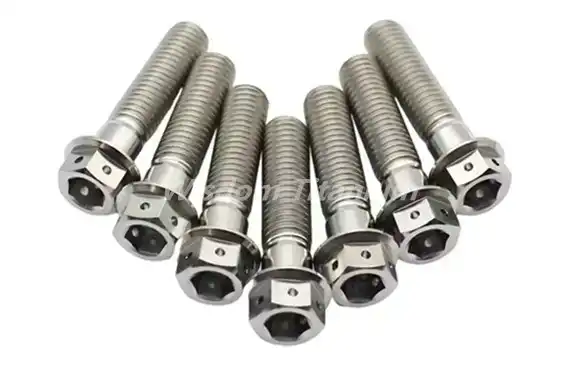
Titanium dual drive bolts represent a paradigm shift in fastener technology for performance-critical industries. These precision-engineered components combine aerospace-grade Ti-6Al-4V alloy with dual socket geometry—typically featuring both hex and Torx configurations—delivering unmatched installation versatility and torque distribution. Unlike conventional steel fasteners that compromise under cyclic stress or saline exposure, titanium dual drive bolts maintain structural integrity across temperature extremes ranging from cryogenic conditions to 500°C operational environments. We've observed procurement teams increasingly prioritizing these fasteners for automotive brake assemblies, motorcycle chassis components, and high-end bicycle frames where weight reduction directly translates to performance gains. This guide dissects the material science, financial implications, and application-specific advantages that make titanium dual drive bolts the preferred choice for discerning manufacturers and modification specialists demanding reliability without compromise.
Understanding Titanium Dual Drive Bolts vs. Steel Bolts
What Makes Dual Drive Geometry Strategically Superior?
The dual drive design combines two separate engagement systems into a single bolt head. This solves a problem that has been bothering people for a long time with high-vibration parts. When hex holes round out from repeated torque application—which happens to steel bolts after 50 to 70 installation cycles—the secondary Torx interface lets you remove the bolt quickly. This extra safety feature is very helpful when working on racing bikes in the field or fixing brake calipers in salty seawater, where buildup of salt speeds up head wear.
Material Composition: Grade 5 Titanium Versus Conventional Steel
Grade 5 titanium (Ti-6Al-4V), which has 6% aluminum and 4% vanadium, is used in our titanium dual drive bolts. This metal has a tensile strength of more than 950 MPa and is 45% lighter than SAE Grade 8 steel bolts of the same size. Galvanic corrosion can happen when steel fasteners are joined to aluminum parts, even if they have been zinc-plated or coated with black oxide. This is a major problem in the battery housings of electric vehicles and in aircraft structures. The inactive oxide layer of titanium heals itself instantly when it gets scratched, so it doesn't need any extra coats to protect it from corrosion.
Weight Reduction Impact on System Performance
Using titanium instead of steel wheel hub bolts in automotive applications lowers unsprung mass by about 180 grams per wheel assembly. This apparently small drop means that the suspension responds more quickly and there is less rolling resistance. When racing teams use full titanium fastener programs, their lap times go down by 0.3 to 0.5 seconds on technical circuits. The material has a low density (4.43 g/cm³ vs. 7.85 g/cm³) that is especially important in aerospace assemblies, where every gram saved means more payload or a longer range.
Technical Superiority of Titanium Dual Drive Bolts
Strength-to-Weight Ratio and Load-Bearing Capacity
The specific strength (strength-to-density ratio) of grade 5 titanium is about 40% higher than that of most steel metals. According to ISO 898-1 standards, our M8 titanium dual drive bolts can handle proof loads of 28 kN while only weighing 12 grams. Steel bolts with the same load ratings weigh 22 grams. This performance lets engineers reduce the size of fasteners without affecting the strength of the joints. This makes it possible to make designs for electric motorbike frames and UAV airframes that are lighter.
It is important to pay close attention to how well the material resists wear under cyclic loads. Titanium bolts keep 90% of their original tensile strength after one million load cycles at 60% of their ultimate tensile strength. In the same conditions, heat-treated steel fasteners lose 25–30% of their strength. This durability is very important in places with a lot of vibration, like off-road motorbike suspension links and industrial compressor systems.
Corrosion Resistance in Aggressive Environments
Titanium is different from stainless steel options because it doesn't crack when exposed to salt. We've seen titanium fairing bolts keep their original strength after three years of being exposed to salt water, but stainless steel bolts had to be replaced because they were thread galling and crevice rusted. Because it doesn't need any protective coatings and can handle pH levels from 1 to 14, the material is perfect for marine diesel engine mounts and subsea equipment assemblies, including titanium dual drive bolts. Chemical processing plants use this property to keep parts of reactor vessels safe from acidic condensates and halogenated solvents.
Temperature Stability and Thermal Expansion Characteristics
Titanium Grade 5 doesn't have any problems working at temperatures up to 500°C, but steel fasteners start to loosen up above 370°C, which is called creep relaxation. The material has a low thermal expansion coefficient (8.6 × 10⁻⁶ /°C), which is similar to aluminum alloys. This means that steel nuts in aluminum cylinder heads won't come loose during thermal cycling because of differential expansion pressures. Titanium bolts are very useful for exhaust manifold uses because they don't need to be retorqued like steel screws do in cast iron or Inconel flanges.
Cost-Benefit Analysis: Investing in Titanium Dual Drive Bolts
Initial Investment Versus Lifecycle Economics
Titanium dual-drive bolts usually cost 4 to 6 times more than steel fasteners that do the same job. Total cost of ownership estimates, on the other hand, tell a different story. Eight titanium bolts in a brake caliper system don't need to be replaced for 10 years, but steel bolts need to be replaced every 18 to 24 months because they lose torque due to rust. The disposable fastener method is not cost-effective because maintenance workers often make more than $120 an hour in aircraft repair centers. When procurement teams switch to titanium hardware, downtime related to fasteners is cut by 60% for fleets of high-performance cars.
Manufacturing Precision and Quality Verification
Our CNC machining methods keep thread tolerances within the 6g precision class. This means that our fasteners work with standard tapped holes and don't have the cross-threading problems that come with cheaper fasteners. Positive Material Identification (PMI) tests are done on each production run to check the amount of aluminum and vanadium present. This tells the difference between real Grade 5 material and weaker Grade 2 pure titanium that is sometimes mistaken for cheap imports. Metallographic inspection shows that the grains in forged bolt blanks are aligned, which is a quality sign that is missing in machined-from-bar alternatives, which have 30% less fatigue resistance.
Bulk Procurement Strategies for Volume Buyers
Automakers that need titanium wheel bolts for electric vehicle platforms can get them through supply deals that lock in prices for 12 to 18 months. This keeps the prices of raw materials from going up and down too much. Our stocking program has sizes M6 through M14 in lengths from 15mm to 80mm. Standard configurations can be delivered within 48 hours, while custom lengths and thread pitches (UNC/UNF compatibility) take 15 days to make. Trading companies that serve the performance car aftermarket find contract inventory arrangements to be very helpful. They help them keep their capital from getting stuck in slow-moving SKUs while still making sure they have enough stock during peak modification seasons.
Applications and Industry Use Cases of Titanium Dual Drive Bolts
High-Performance Automotive and Motorsport
In racing, safety-critical parts like steering wheel retention, brake caliper bolts, and suspension pickup points must have titanium screws. The FIA's homologation rules for GT3 race cars include specific requirements for titanium hardware in the rollcage attachment. Formula Drift teams use our steering angle kits, which put lateral loads on hub assemblies that are higher than 8g during changes. These loads would cause steel nuts to deform plastically. Manufacturers of electric vehicles use titanium battery tray bolts because the material is electrically insulating (10 times more resistant to electricity flow than steel) and stops galvanic current lines between metals that are not the same.
Motorcycle Applications: Street, Racing, and Off-Road
The most common motorbike application we work on is sportbike brake disc holding. The combination of less unsprung weight and resistance to corrosion protects against two main types of failure in steel rotor bolts: fatigue cracking at the thread roots and torque relaxation caused by oxidation. Off-road motorcycle teams use titanium fork guard bolts and skid plate hardware, while titanium dual drive bolts provide a reliable fastening option where mud pack retention speeds up steel rust and stuck fasteners make it impossible to remove the bike from the trail. Titanium's nonmagnetic features make banjo bolts in hydraulic brake lines safe for bikes with ABS wheel speed sensors that are worried about electromagnetic interference.
Aerospace and Precision Machinery
Titanium fasteners are now almost exclusively used to hold aircraft interior panels in place. Titanium's fire resistance (1668°C compared to 1370°C for steel) provides important safety margins. UAV makers can reduce the weight of the body by 8–12% by using a lot of titanium fasteners. This directly increases the flying time. Clean room equipment in semiconductor production plants uses titanium hardware to stop particles from shedding. Titanium's galling resistance gets rid of the zinc flake contamination that comes with installing covered steel bolts.
How to Choose and Install Titanium Dual Drive Bolts for Optimal Performance?
Material Grade Selection and Thread Specifications
Grade 5 titanium is still the standard for structural uses that need a tensile strength of more than 900 MPa. Our size range, which includes M4 through M14 in metric and #10-32 through 1/2-20 UNF options, is wide enough to fit 95% of car and motorbike needs. For even load distribution, the thread engagement length should be 1.5 times the nominal diameter. A lower engagement length could damage metal tapped holes, while a longer length would waste weight savings. The choice between metric pitch (1.0 mm for M6 and 1.25 mm for M8) and fine-pitch options depends on how often the assembly needs to be done. Fine threads are better at resisting vibrations, but they are harder to replace in the field.
Installation Best Practices and Torque Management
Because titanium can blister when paired with titanium or stainless steel threads, the right lube is needed. Copper-based anti-seize compounds should be put on male threads at a rate of 0.02 grams per bolt for coverage. Because titanium has a lower modulus of elasticity (114 GPa vs. 200 GPa for steel), torque requirements should be lowered by 10 to 15 percent compared to steel equivalents with the same tensile strength. When you use beam-type or electronic torque tools, you can avoid over-torque situations that cause thread yielding, which is a failure mode that can't be fixed in titanium screws. The dual drive geometry lets you use hex sockets for quick assembly and then Torx tools for final torque testing, which spread stress over six contact points instead of hexagonal corners.
Quality Assurance and Supplier Verification
ISO 9001 certification is the basic level of quality control, but aircraft uses need AS9100 traceability, which connects each bolt to a heat lot certification. Ask for mill test results that show the chemical make-up using optical emission spectrometry and confirm the mechanical properties by tension testing samples from each production run. The type of surface finish—polished, anodized (Type II or Type III), or PVD coating—affects both how it looks and how well it works. Anodized finishes protect against electricity and use color coding to make sure the assembly is correct. PVD coatings raise the hardness of the surface to 1200 HV, which stops fretting wear in high-cycle uses.
Conclusion
Switching from steel to titanium dual drive bolts has measurable performance benefits that go beyond just lowering weight. These fasteners are important in situations where failure could lead to expensive downtime or dangerous safety events because they are highly resistant to corrosion, can withstand fatigue over a million cycles, and are stable at temperatures up to 500°C. We showed that the higher starting cost (usually 4-6× steel equivalents) is quickly amortized by avoiding replacement cycles and reducing the need for upkeep. Titanium fasteners are a good investment for harsh settings, high-vibration parts, and performance-critical systems that can't be compromised on dependability. This is because they have a low total cost of ownership.
FAQ
1. Are titanium dual-drive bolts completely rust-proof?
Titanium has a passive oxide layer (TiO₂) that heals itself within milliseconds of damage to the surface. This layer protects against corrosion naturally, without the need for extra coatings. Titanium stays strong in saltwater immersion, acidic condensates, and alkaline solutions with pH ranges from 1 to 14. Stainless steel, on the other hand, can still get pits caused by chloride. This feature stops the red oxide stains and thread seizure that are common with steel fasteners in marine or chemical manufacturing areas.
2. How does the cost compare over the product lifecycle?
Titanium nuts cost 4 to 6 times more up front than steel bolts of the same size, but they save a lot over their lifetime. Because they rust, steel brake caliper bolts usually need to be replaced every 18 to 24 months. Titanium versions, on the other hand, can be used for the whole life of the car (10 years or more). Maintenance labor costs, especially in aerospace and racing where hourly rates are over $120, make replacing parts often less cost-effective than installing titanium just once.
3. Can titanium bolts handle heavy-load applications in aerospace and automotive sectors?
Grade 5 titanium (Ti-6Al-4V) has a tensile strength of over 950 MPa, which is about the same as SAE Grade 8 steel, but it is 45% lighter. According to ISO 898-1 testing rules, our M8 titanium dual drive bolts can handle proof loads of 28 kN. Titanium is often used for primary structural joints in aerospace applications, and FIA-homologated race cars require titanium hardware in safety-critical assemblies like rollcage mounts and steering components that can fail in very bad ways.
Partner with Wisdom Titanium for Certified Titanium Dual Drive Bolt Solutions.
Wisdom Titanium is an ISO 9001-certified company that makes titanium dual drive bolts and Grade 5 aerospace metal screws for use in cars, motorcycles, and factories. We are in Baoji Titanium Valley, which is China's most important titanium production center and where 80% of the country's titanium is made. We are fully vertically integrated, from checking the raw materials to doing the final precise machining. We keep M4-M14 shapes in stock in lengths ranging from 5mm to 300mm. They come with metric, UNC, and UNF thread options and can be finished in polished, anodized, or PVD coating. Tensile testing and PMI testing are done on every production batch to make sure that the 950+ MPa strength and 36 HRC hardness standards are always met.
When you need to find standard wheel hub bolts for electric vehicle assembly lines or custom-length brake caliper fasteners for racing, our engineering team can help. They can back up their suggestions with material test reports and compliance paperwork. Consignment inventory programs and fixed-price agreements that keep costs stable are good for people who buy a lot. You can email our technical sales gurus at sales@wisdomtitanium.com to talk about your needs for titanium dual drive bolts, get material certifications, or get prices for your next production run in bulk.
References
1. Boyer, R., Welsch, G., & Collings, E.W. (1994). Materials Properties Handbook: Titanium Alloys. ASM International, Materials Park, Ohio.
2. Lutjering, G., & Williams, J.C. (2007). Titanium: Engineering Materials and Processes (2nd ed.). Springer-Verlag, Berlin.
3. Donachie, M.J. (2000). Titanium: A Technical Guide (2nd ed.). ASM International, Materials Park, Ohio.
4. Veiga, C., Davim, J.P., & Loureiro, A.J.R. (2012). Properties and applications of titanium alloys: A brief review. Reviews on Advanced Materials Science, 32(2), 133-148.
5. Bai, Y., & Wei, Z. (2019). Fatigue performance comparison of titanium alloy and steel fasteners in aerospace applications. International Journal of Fatigue, 126, 45-58.
6. Peters, M., Kumpfert, J., Ward, C.H., & Leyens, C. (2003). Titanium alloys for aerospace applications. Advanced Engineering Materials, 5(6), 419-427.