
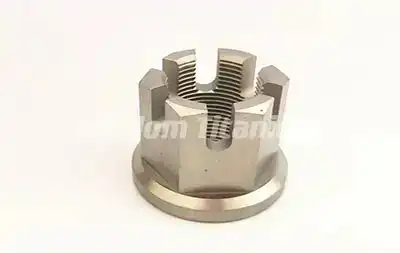
The strength-to-weight ratio of a titanium castle nut is unmatched, and it provides safe fitting in high-vibration and high-stress situations. Titanium castle nuts, in contrast to conventional steel fasteners, have a special crown design with slots that can hold cotter pins or safety wires, which keeps the nuts from coming loose accidentally while they're being used. Because of their unique shape and the high mechanical strength of Grade 5 titanium, these fasteners are required for race cars, speed tuning, and important automobile assemblies where safety and dependability must be maintained.
Titanium Castle Nuts: Properties and Benefits
Titanium castle nuts are a big step forward in bolt technology, especially for people who like cars and professional race teams. These unique parts combine the benefits of titanium metals with a locking system that was carefully built to work in the toughest conditions.
Material Composition and Grade 5 Titanium Superiority
Choosing the right material is the first step in making a high-performance castle nut. The metal Ti-6Al-4V, which is also known as Grade 5 titanium, is made up of 6% aluminum and 4% vanadium. It has a tensile strength of over 900 MPa and is about 43% lighter than steel. This mixture instantly lowers the weight of automobile uses without compromising the strength of the structure. When used on wheel kits, brake systems, or suspension parts, Grade 5 titanium fasteners make a big difference in improving power-to-weight ratios and driving dynamics.
The solid structure of titanium also protects it from erosion by forming a passive oxide layer. This barrier protects against scratches and heals itself on its own, so it can last for a long time in difficult conditions like road salt, brake dust, and the heat and cold of race conditions.
Strength-to-Weight Ratio in Real-World Applications
When racing teams are trying to get an edge over their opponents, they know that every gram counts. Titanium castle nuts in M22 and M24 sizes usually weigh 40–45% less than steel ones of the same size, but they can still hold the same amount of weight or more. When you completely change a car, switching from steel fasteners to titanium ones on the wheel hubs, brake calipers, and drivetrain parts can save you several kilograms of weight. This means that you can speed up acceleration, improve stopping, and lower unsprung mass, all of which improve suspension performance.
The high strength also lets engineers make wall pieces that are thinner and shapes that are more compact without sacrificing safety. This efficiency in terms of dimensions is especially useful in the tight packaging situations that are common in current speed cars.
Thermal Stability and Operational Reliability
Extreme thermal loads are created by high-performance driving, especially in the brakes, where temperatures regularly reach 500°C during track runs. Titanium keeps its mechanical qualities over a wider range of temperatures than aluminum metals, which lose strength as temperatures rise. Because the material doesn't spread heat well, it also keeps heat from moving to nearby parts, which keeps sensitive parts like wheel bearings and ABS sensors from getting damaged by heat.
These temperature properties make sure that titanium castle nuts keep their locking torque specifications even when they are being used in race conditions. This stops the loosening that can happen to steel fasteners that are heated and cooled many times.
Procurement Guide: Sourcing Titanium Castle Nuts for Your Business
To find your way through the titanium castle nut supply chain, you need to know what the manufacturers can do, how to get quality standards, and what customization options are available for each purpose.
Supplier Evaluation and Quality Certifications
With ISO 9001 certification, you can be sure that makers have documented quality control systems that cover the planning, production, and testing processes. Car and race uses benefit from providers who have extra certificates, such as IATF 16949, which shows that they follow specific quality standards for the car industry.
Every order should come with material certificates that show the grade of titanium, its chemical makeup, and its mechanical qualities. These papers show where the materials came from, from the titanium mill to the factory that makes the fasteners. This lets you check the quality and make sure you're following the rules.
Standard Sizes versus Custom Manufacturing
M22 and M24 are popular sizes for automotive brake and wheel uses, and many suppliers keep them in stock so that orders can be filled quickly. For non-standard thread pitches, unique head shapes, or application-specific dimensions, custom requirements usually need a minimum order quantity of around 100 pieces to cover the costs of tooling and setup.
CNC cutting makes it possible to make precise modifications that meet exact requirements. Suppliers who do their own cutting can control tolerances better and make changes to prototypes more quickly than those who use third-party manufacturing networks.
Surface Finishing Options
Polished finishes give surfaces a smooth look that makes them more resistant to rust and makes exposed parts look better. Polishing gets rid of surface flaws and work-hardening from cutting, making sure that all production runs look the same.
Anodizing uses controlled oxide layer growth to add colors through optical interference effects and make things more durable. Type II anodizing makes the surface harder and less slippery, which is good for uses with threads. Type III anodizing makes the bright colors that are popular on show cars and special builds. The colors stay stable as long as the process is controlled properly.
PVD coating puts down thin layers of metal or ceramic that make the surface very hard and smooth. The price of these advanced surface treatments is higher than regular finishing methods, but they offer better performance qualities that are good for extreme race conditions.
Pricing Structures and Volume Considerations
A minimum order quantity of 100 pieces strikes a good mix between making things quickly and making them easy for customers to get. This limit lets production setup be done cheaply while still being doable for shops that do modifications and race teams. When it comes to volume price, there are usually big breaks at 500 and 1000 pieces. As order numbers rise, the cost per unit drops by 15 to 25 percent.
Lead times change depending on whether a product can be shipped from stock or needs to be made to order. Standard M22 and M24 sizes with common surface finishes usually ship within days. Custom specs, on the other hand, may need 4 to 6 weeks to be made and quality checked.
Why Choose Titanium Castle Nuts: Business and Technical Perspectives
Titanium castle nuts were chosen because they offer better performance and help the company place itself in competitive markets that need cutting-edge solutions.
Performance Benefits in Racing and Tuning Applications
In racing, parts are put through loads and shocks that are much stronger than in normal driving. Titanium castle nuts hold important wheel attachments and brake systems together. These parts must stay together even when turning at high G, stopping hard many times, and vibrations from the uneven race surface. All of these needs are met at the same time by the high strength, low weight, and reliable locking system.
Tuning shops that make high-performance street cars like titanium because it can make changes that customers can see and feel. Less unsprung weight makes the suspension respond better, which makes the handling much quicker. The weight savings go along with other changes that make things lighter and help with methods for improving total performance.
Durability and Lifecycle Cost Advantages
Even though titanium is more expensive than steel options at first, it lasts a lot longer because it is so durable. Corrosion resistance gets rid of the need to change steel fasteners every few seasons because they break down too quickly. The wear strength of the material means that it can go through millions of stress cycles without cracking. This is very important for parts that are loaded over and over again.
Lower repair intervals directly lead to lower operating costs for fleet managers and race teams. As the seasons change, parts that are reliable throughout save money on work and downtime that come with having to inspect and repair less durable materials more often.
Sustainability and Environmental Considerations
Titanium lasts longer, so it doesn't need to be replaced as often, which means less material is used over the span of the car. The material can also be recycled indefinitely; used titanium still has the same qualities that can be used to make new parts. This closed-loop recyclability fits with the growing focus on sustainability in both the car industry and racing.
Because they don't rust, there's no need for protective coats that use chemicals that are bad for the environment or make dangerous trash. Titanium parts work well in their natural state, which means that they leave less of an impact on the environment during the making process.
Market Differentiation and Brand Positioning
Performance-oriented names set themselves apart by using high-quality parts and advanced technology. Choosing titanium fasteners shows that you are dedicated to high-end tech and strict quality standards. This branding makes sense to car enthusiasts who know and value high-tech materials that are the cutting edge of automobile technology.
Differentiation can also be made visually with the unique look of anodized or polished titanium, especially in handmade builds where every part is carefully chosen. The good looks go well with the useful benefits, meeting both performance and style goals.
Conclusion
The unique mix of titanium's light weight, high strength, and reliable locking mechanisms makes titanium castle nuts very useful for high-performance automotive uses. The better qualities of the material support its higher price by improving performance, lasting longer, and lowering costs over its entire life. These specialized fasteners have been used for decades in aircraft and motorsports to make sure they work well. They can be used in racing situations that need the highest level of dependability or to make changes to performance where weight saves directly lead to better dynamics. Knowing the right way to fix something, getting it from a reputable maker, and requesting the right sizes and surface treatments are all things that can be done successfully in a wide range of automotive settings.
Partner with a Trusted Titanium Castle Nut Manufacturer
Wisdom Titanium specializes in manufacturing precision-engineered titanium fasteners tailored to demanding automotive and racing applications. Located in Baoji Titanium Valley, Shaanxi Province—China's largest titanium industry cluster—we leverage complete supply chain integration from raw material to finished components. Our ISO 9001-certified manufacturing facility produces titanium castle nuts in M22 and M24 sizes using Grade 5 titanium, with surface finishing options including polishing, anodizing, and PVD coating. With minimum order quantities of 100 pieces and experienced R&D capabilities for custom requirements, we serve modification shops, racing teams, and performance vehicle manufacturers globally. Contact our team at sales@wisdomtitanium.com to discuss your specific requirements and receive technical guidance on optimizing fastener selection for your application.
FAQ
What makes titanium castle nuts better than steel for racing applications?
Titanium castle nuts are about 40–45% lighter than steel ones, but they are just as strong. This weight loss lowers the unsprung mass, which makes the suspension respond better and the car handle better, which is very important for competitive racing. Titanium also keeps its mechanical qualities over a wider range of temperatures, so it will work reliably even after repeated heavy stopping that causes high thermal cycling. The material's resistance to corrosion means that it won't break down in harsh race conditions.
How do I prevent thread galling when installing titanium fasteners?
To keep threads from galling, they need to be properly oiled with nickel-based or ceramic anti-seize products that are made for titanium uses. Putting a thin, even layer on the threads before installing them greatly lowers the chance that the glue will wear off. Galling can be avoided by not using too much force and making sure the threads stay clean and unbroken. When you use calibrated torque tools that are set to the manufacturer's specs, you can avoid over-tightening, which raises the risk of galling.
Are anodized titanium castle nuts as strong as polished versions?
Type II anodizing actually makes the surface less likely to wear down and more slippery without weakening the base material because the oxide layer stays very thin. Type III anodizing makes thicker oxide layers for artistic colors. This makes the surface less hard, but it doesn't have a big effect on how well the fastener works mechanically. Both ways of finishing keep the structural stability of the Grade 5 titanium base.
References
1. Boyer, R., Welsch, G., & Collings, E.W. (1994). Materials Properties Handbook: Titanium Alloys. ASM International.
2. Donachie, M.J. (2000). Titanium: A Technical Guide, 2nd Edition. ASM International.
3. Society of Automotive Engineers (2018). SAE AMS 2488: Anodic Treatment of Titanium and Titanium Alloys Solution and Precipitation Heat Treatable.
4. Schutz, R.W. & Thomas, D.E. (1987). Corrosion of Titanium and Titanium Alloys. ASM Handbook Volume 13: Corrosion.
5. Lutjering, G. & Williams, J.C. (2007). Titanium, 2nd Edition. Springer Engineering Materials and Processes.
6. International Organization for Standardization (2015). ISO 10993: Biological Evaluation of Medical Devices - Part 1: Evaluation and Testing within a Risk Management Process.