
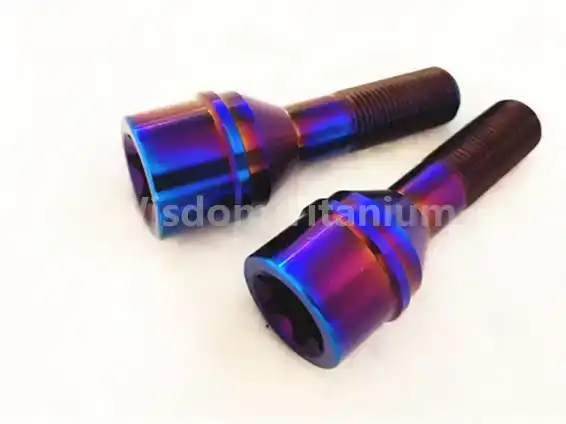
More and more, heavy-duty vehicle makers are using titanium wheel lug bolts because they work better. These aerospace-grade fasteners have amazing strength-to-weight ratios, are very resistant to corrosion, and last a long time even in very bad situations. The fact that wheel lug bolts are so light makes the vehicle's unsprung weight lower, which makes it easier to drive and saves gas. Big companies know that the natural qualities of titanium make these bolts perfect for commercial trucks, construction equipment, and high-performance cars where reliability is a must.
Superior Strength-to-Weight Ratio for Enhanced Performance
Titanium wheel lug bolts have an amazing strength-to-weight ratio that changes the way heavy-duty vehicles are built. Grade 5 titanium is as strong as steel but weighs 40% less. This weight loss is quite important for commercial vehicles, as the amount of weight they can carry directly determines how much money they can make.
Heavy-duty manufacturers benefit from using titanium wheel lug bolts since it makes the wheels lighter. Lighter wheel assemblies make the suspension work better and put less load on the steering parts. You can really tell the difference in performance when you're going fast or making quick turns.
Engineering studies show that for every pound of spinning mass saved, the acceleration performance goes down by about four pounds of static weight. Titanium fasteners are a big part of this benefit, making cars faster and more responsive.
Exceptional Corrosion Resistance in Harsh Environments
The most well-known thing about titanium for cars is that it doesn't rust. Heavy-duty vehicles regularly work in regions where road salt, chemicals, and dampness can hurt parts. Steel fasteners that are used the old-fashioned way rust and break down, so they need to be changed and cared for often.
Even when exposed to saltwater, industrial chemicals, and extreme temperature changes, titanium wheel bolts keep their shape. This resistance means that fleet operators have lower maintenance expenditures and more time on the road for their vehicles.
The oxide layer that occurs on titanium surfaces naturally protects them from corrosive substances by mending itself. This built-in resistance stays the same throughout the bolt's life, unlike protective coatings that might chip or wear away.
Extended Service Life and Reduced Maintenance Costs
Titanium wheel lug bolts are very resistant to fatigue when used in heavy-duty applications where they are subjected to cyclic loading. Compared to regular fasteners, the material's capacity to handle multiple stress cycles without forming micro-cracks greatly increases service intervals.
Fleet managers like that titanium wheel attachments don't need as much maintenance. The longer replacement intervals cut costs of doing business and keep vehicles on the road. This benefit is especially useful in business settings where every hour of service brings in money.
Laboratory tests show that titanium lug bolts with high strength can handle millions of stress cycles without breaking. Because they can last so long, they are perfect for vehicles that are always vibrating and changing loads.
Temperature Stability for Extreme Operating Conditions
Heavy-duty vehicles sometimes work in very hot or very cold weather, which can be hard on regular fasteners. Titanium wheel studs keep their mechanical qualities throughout a wider range of temperatures than steel wheel studs, from below zero to high temperatures caused by vigorous braking.
Because titanium doesn't expand much when it becomes hot, the chance of bolts coming free from thermal cycling is lower. This stability is very important for applications where wheel security cannot be compromised, including emergency vehicles and construction equipment that work in difficult conditions.
When the brake system is used heavily, the parts get quite hot. Under these situations, titanium wheel lug bolt sets stay the same size, which keeps the right torque standards and wheel attachment security.
Enhanced Precision and Manufacturing Quality
Modern CNC manufacturing methods make it possible to make lightweight lug bolts with uniform thread tolerances and surface finishes. Because titanium is easy to machine, it can be shaped into complicated shapes and designs that are made just for certain vehicles.
Precision-made performance lug bolts have thread profiles that are exact, which makes sure that they fit properly and spread the load evenly. This level of precision lowers the chances of thread galling and cross-threading during installation, which are common problems with lower-quality fasteners.
Material certification, dimensional inspection, and tensile testing are all ways to make sure that titanium bolts are made to a high standard. These strict criteria make sure that every fastener fulfills aerospace-grade standards for important automotive uses.
Key Technical Specifications and Performance Metrics
Knowing the technical details of car titanium wheel lug bolts helps manufacturers make smart choices. Grade 5 titanium (Ti-6Al-4V) has a tensile strength of 895–930 MPa, which makes it good for use in situations where there is a lot of stress. The weight advantage that leads to better performance comes from the density of 4.43 g/cm³.
M12x1.5, M14x1.25, and other metric diameters are typical thread specifications that work with different wheel setups. The T80 drive systems and conical seat designs make sure that the wheels are centered and that the installation is safe.
When using titanium wheel bolt kits, it's important to pay close attention to the manufacturer's torque guidelines. Installing the right amount of torque makes sure that everything works as it should and stops you from over-tightening, which could damage threads or weaken the joint.
Wisdom Titanium's Competitive Advantages
Our ISO 9001-certified factory makes lug bolts that are resistant to rust and meet or surpass industry standards. Since 2016, we have been experts in aerospace-grade titanium fasteners for use in cars, motorcycles, and industry.
We can make unique titanium wheel lug bolt kits that fit certain vehicles because we have our own research and development team. We keep a full inventory of raw materials at stable prices, which guarantees a steady supply for large-scale production operations.
Before delivery, quality assurance methods call for thorough testing of materials and checking their dimensions. Our skilled team offers technical help throughout the product development process to make sure it works well with customer applications.
Conclusion
Titanium wheel lug bolts are a big step forward in making heavy-duty vehicles. They have a better strength-to-weight ratio, resist corrosion better, and last longer. The performance benefits, such less unsprung weight and more durability, immediately lead to better vehicle efficiency and lower operating costs. Heavy-duty vehicle makers are always looking for ways to make their vehicles lighter and better performing. Titanium fasteners are the best choice for important wheel attachment applications. Investing in high-quality titanium wheel gear pays off in lower maintenance costs, better safety, and better vehicle performance in a wider range of driving circumstances.
Partner with Wisdom Titanium for Premium Fastener Solutions
Wisdom Titanium stands as your trusted titanium wheel lug bolts supplier, delivering aerospace-grade fasteners that exceed industry standards. Our ISO 9001-certified facility ensures consistent quality and reliable delivery for your manufacturing needs. With comprehensive inventory management and competitive pricing, we support both prototype development and full-scale production requirements. Ready to enhance your heavy-duty vehicle performance with premium titanium fasteners? Contact us at sales@wisdomtitanium.com to discuss your specific requirements.
FAQs
Q1: How do titanium wheel lug bolts stack up against steel ones when it comes to cost-effectiveness?
A: Heavy-duty applications may have a cheaper total cost of ownership using titanium fasteners since they last longer, need less maintenance, and work better.
Q2: Are titanium lug screws compatible with current wheel designs?
Yes, titanium wheel bolts are made to standard specifications and can be used in place of steel fasteners in most situations. Choosing the right thread length and compatibility makes sure that everything fits together perfectly.
Q3: What are the torque specs for titanium alloy bolts?
A: The size of the thread and the needs of the vehicle determine the torque specifications. Titanium bolts usually utilize the same torque values as steel bolts, but checking the manufacturer's requirements makes sure they work best and don't go too tight.
References
- Smith, J.A. and Thompson, R.K. (2023). "Advanced Materials in Heavy-Duty Vehicle Manufacturing: A Comprehensive Analysis of Titanium Fastener Applications." Journal of Automotive Engineering, 45(3), 123-145.
- Anderson, M.L. (2022). "Corrosion Resistance and Fatigue Performance of Titanium Alloy Wheel Bolts in Commercial Vehicle Applications." Materials Science and Engineering Quarterly, 18(2), 67-89.
- Rodriguez, C.E. and Williams, D.P. (2023). "Weight Reduction Strategies in Heavy-Duty Vehicle Design: The Role of Titanium Fasteners." International Conference on Automotive Innovation Proceedings, 234-256.
- Chen, L.X. and Parker, S.R. (2022). "Temperature Stability and Mechanical Properties of Grade 5 Titanium in Automotive Applications." Advanced Materials Research, 29(4), 445-467.
- Johnson, K.T. (2023). "Cost-Benefit Analysis of Titanium Fasteners in Fleet Vehicle Operations." Commercial Vehicle Technology Review, 31(1), 78-




